
Sit down at a Brazilian boteco — a corner bar — and whatever you order arrives in the same glass. Order cachaça, order draft beer, ask for plain water: it all comes in a thick, low, little tumbler with vertical ridges around its base. This is the copo americano, the least glamorous glass in Brazil, and the most used.
Brazil's Most Common Glass
The copo americano is a conical tumbler, wider at the top and tapering slightly toward the base. It holds about 190ml — small — and the glass is thick and heavy. The lower body is cut with closely spaced vertical facets.
There is nothing fancy about it. And that is precisely what made it the most common object of its kind in Brazil. On bar counters, in kitchen cupboards, at street stalls, in restaurants — the same glass is stacked everywhere. Whatever you are drinking, this is the glass most likely to be in a Brazilian's hand.
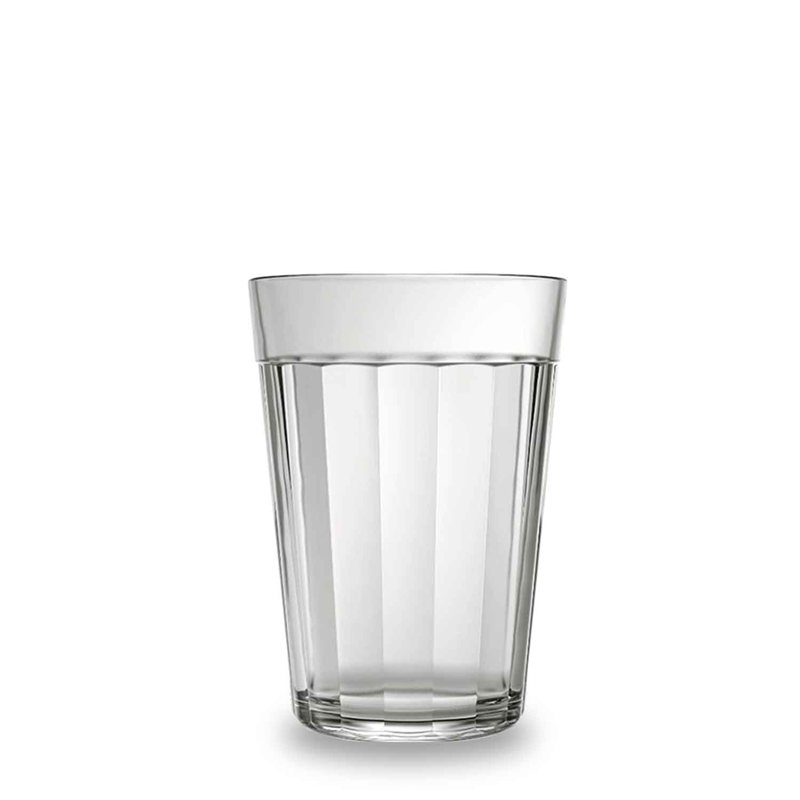
The copo americano — a small, thick conical glass of about 190ml. The vertical facets around its base are its signature (photo: Antonio Augusto R Ramos, CC BY-SA 4.0)
Where Form Is Function
Every feature of this glass has a reason.
The thick glass is for durability. In a busy bar a glass is knocked and dropped hundreds of times a day, so above all it must resist breaking. Heavy walls and a thick base survive rough handling.
The vertical facets near the base are a non-slip grip. Even with a sweaty hand or a wet glass, the ridges catch the fingers and keep it from slipping. They also stiffen the wall structurally far better than thin smooth glass would — it is how a handleless glass holds up without a handle.
The conical shape is built for stacking. Wide at the top and narrow at the base, the glasses nest into each other, saving space on tight shelves and in busy kitchens.
And thanks to its small, consistent volume, the copo americano became more than a glass — it became a measuring tool. Brazilian home recipes routinely call for "one copo americano of flour" or "two of milk." With no proper measuring cup at hand, everyone pictures the same amount: it is a de facto standard unit.
The Boteco Glass — From Cachaça to Chopp
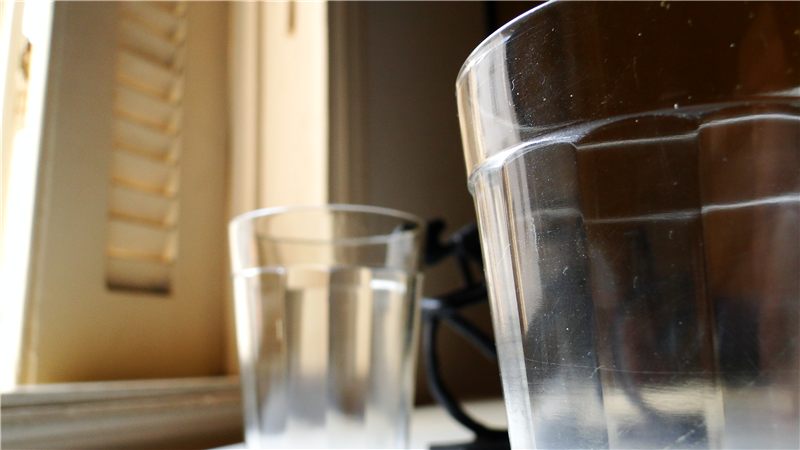
One glass for everything — cachaça, chopp (draft beer), water, juice, even coffee. A glass woven into the daily life of the boteco and the home (photo: Marcelo Braga, CC BY 2.0)
What makes the copo americano special is, paradoxically, that it is dedicated to nothing. If a whisky glass is for whisky and a wine glass for wine, this is a glass for everything.
Brazil's national spirit, cachaça, is served in it neat — and so is the caipirinha, the national cocktail of cachaça, lime, and sugar. So is chopp (draft beer), so is fresh fruit juice, so is a midday glass of water. In the boteco this one glass is the spirit glass, the water glass, and the juice glass at once. The glass does not define the drink; the drink borrows the glass.
Nadir Figueiredo and 1947
The copo americano has a maker. The glass we know today was introduced in 1947 by the Brazilian glassmaker Nadir Figueiredo. The exact origin of the name is uncertain — it is often said to have been inspired by an American-style glass — but what is clear is that it outgrew a single company's product name and became a common noun. In Brazil today, "copo americano" refers not to one brand but to any glass of that shape.
This is where good industrial design ends up. Like the Coca-Cola contour bottle or Russia's faceted granyonyi stakan, the copo americano became so ordinary that it stopped reading as design at all. People call it "a glass," not "a design." Yet the thickness, the facets, the cone, the volume — every one of those decisions was refined to the Brazilian hand over nearly a century.
The Ordinary as Design
| Feature | Reason |
|---|---|
| Thick glass | Durability against rough use and drops |
| Vertical facets | Grip on a wet hand, plus added strength |
| Conical shape | Stacks for storage, saves space |
| ~190ml fixed volume | A de facto standard unit for cooking |
| Plain, neutral form | Holds anything — spirit, water, juice |
Many of the world's glasses strive to be special — concentrating aroma, holding temperature, curving themselves around a single drink. The copo americano went the opposite way. Loyal to no drink, fitting every occasion, familiar in every hand. The choice to be the most ordinary glass is exactly what made it the most used glass in Brazil. A glass need not be rare to be great.
Copo americano — Antonio Augusto R Ramos / Wikimedia Commons (CC BY-SA 4.0) · Copo americano by a window — Marcelo Braga / Wikimedia Commons (CC BY 2.0)
Comments
Be the first to leave a comment.