Almost every cup in the world is better the more it holds. Yet there is one built on the exact opposite idea. Pour past a certain line and every last drop drains out through the bottom. This is Joseon Korea's Gyeyeongbae (戒盈杯). Fill it greedily and you lose everything. Before it was a vessel for drinking, it was a warning.
The name is the philosophy — 戒盈杯
Read the characters literally and you get both the mechanism and the lesson. Gye (戒) means to guard against, yeong (盈) means to be full, bae (杯) means cup — "the cup that guards against fullness." It was also called the jeoljubae (節酒杯), the "cup of drinking in moderation."
Where most cups are judged by how much they can hold, the Gyeyeongbae was designed around not letting you overfill. Its very name carries a caution against excess and greed.
How the drink disappears — the science of the siphon
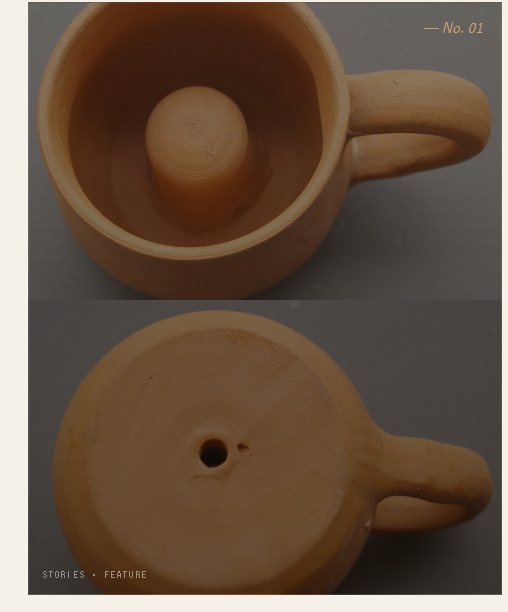
The secret lies in a small column rising from the middle of the cup. It looks decorative, but inside it hides a siphon.
Within the column runs a thin, inverted-U-shaped channel. One end opens at the bottom of the cup, rises almost to the top of the column, then bends back down and passes out through the stem or base.
Pour a sensible amount — below roughly the 70% line — and nothing happens, because the surface of the liquid sits lower than the top of the channel's bend. But the moment you greedily cross that line, the liquid spills over the apex of the U and the siphon kicks in. Once the flow starts, atmospheric pressure keeps pushing the liquid through, and all of it drains out the hole in the base. The one who poured modestly drinks; the one who filled to the brim is left with an empty cup.
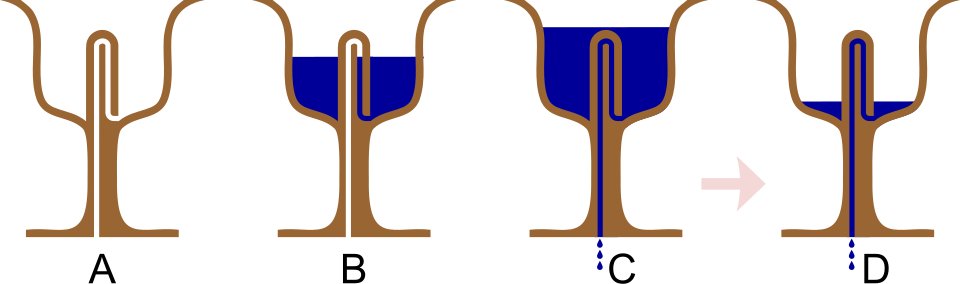
A empty → B filled in moderation (safe) → C the moment you cross the line, the siphon engages → D emptied through the hole in the base. The inverted-U channel inside the central column is the key (diagram: Nevit Dilmen, CC BY-SA)
This principle is not uniquely Korean. The West has a nearly identical vessel, the Pythagorean cup, said to have been devised by the ancient Greek mathematician Pythagoras to share water fairly — or to curb overdrinking. It is still sold as a souvenir on the island of Samos today. East and West, unaware of each other, built cups that inscribed the same lesson using the same law of physics.
The vessel Confucius saw — the tilting jar and the Mean
Trace the idea behind the Gyeyeongbae back far enough and you arrive at an ancient East Asian vessel: the uigi (欹器), also known as the yujwajigi (宥坐之器), the "vessel that sits beside you."
The Xunzi and the Confucian Analects' Family Sayings record that Confucius saw such a vessel in the shrine of Duke Huan of Lu. It behaved like this:
Empty, it tilts; filled to the middle, it stands upright; filled to the brim, it topples over (虛則欹, 中則正, 滿則覆).
Confucius turned to his disciples and asked: what is there that, filled completely, does not topple? From this comes the spirit of the Doctrine of the Mean (中庸) — neither excess nor deficiency, but the right measure. It echoes the line from the Book of Documents: "Fullness invites loss; humility receives gain" (滿招損 謙受益).
The Gyeyeongbae takes this abstract teaching and renders it as a cup you can hold. If the tilting vessel was a moral metaphor — "a mind too full collapses" — the Gyeyeongbae proved the same point as lived experience: pour the drink too full and you lose it.
Joseon's Gyeyeongbae and the legend of the merchant Im Sang-ok
A Joseon white-porcelain cup (15th c., National Museum of Korea) — the Gyeyeongbae was crafted with this same porcelain technique (photo: leigh, CC BY-SA)
No account of the Gyeyeongbae in Korea is complete without the great merchant Im Sang-ok (林尙沃, 1779–1855). Born in Uiju, he built one of the largest fortunes of his era through the ginseng trade.
As the story is widely told, Im kept a Gyeyeongbae by his side and watched it constantly to guard against greed. Just as the cup loses everything when it overflows, he reminded himself, so wealth pursued without limit can vanish in an instant. His motto is handed down alongside it: "Wealth should be level as water; a person upright as a scale" (財上平如水 人中直似衡).
That said, much of this episode was popularized through the novelist Choi In-ho's Sangdo (商道) (2000) and its television drama, so it's wise to weigh how much is record and how much is literary embellishment. Even so, it is clear that the Gyeyeongbae was regarded in late Joseon as a symbol of moderation.
There are several tales about who made it. Records say the late-Joseon Silhak scholar Ha Baek-won (河百源, 1781–1845) devised a cup that leaks when overfilled, while in the Hongcheon area of Gangwon Province a legend tells of a potter, U Myeong-ok (禹明玉), who crafted exquisite white porcelain (seolbaekjagi) and from it made the Gyeyeongbae. How much is fact and how much is oral legend is unclear, but it shows the cup was remembered not as a mere curiosity but as a "vessel that held a lesson."
A cup beyond a cup
What makes the Gyeyeongbae special is precisely that it is not a cup that makes the drink taste better. It neither concentrates aroma nor holds temperature. What it works on is not the taste of the drink but the mind of the drinker.
With a single, simple piece of physics — fill it and you lose it all — the cup makes the abstract virtues of restraint and humility something anyone can see with their eyes and feel with their hands. It shows the cost of greed not in words but in an empty cup.
Today the Gyeyeongbae survives less as a practical drinking vessel than as a symbol given as a gift and a lesson — handed to someone facing a new beginning, or to someone newly risen to a high position. When the urge to fill more is the very thing to be most wary of, this is the fitting cup. Don't fill it to the brim — neither the cup nor your greed. That is the single sentence a vessel once set in Confucius's shrine, passed through the tables of Joseon, still carries to us today.
Working trick cup (Pythagorean cup), inner column and base hole — Materialscientist / Wikimedia Commons (CC BY-SA 3.0) · Operation cross-section diagram — Nevit Dilmen / Wikimedia Commons (CC BY-SA 3.0) · Joseon white-porcelain cup (National Museum of Korea) — leigh / Wikimedia Commons (CC BY-SA 2.0)
Comments
Be the first to leave a comment.