The country that drinks the most whisky in the world is neither Scotland nor the United States. It is India. By volume, India empties almost half of all the whisky on the planet. And yet, for all that drinking, India has no glass it can call its own. For tasting, it borrows Scotland's Glencairn outright; for everyday drinking, it reaches for a thick rocks tumbler.
What India does have is a unit of its own. Indians do not count whisky by the glass. They count it by the peg.
The Peg — India's Unit of Whisky
In India and across South Asia, a serving of whisky is not "a glass" but "a peg." The word appears on bar menus and at the kitchen table alike.
- Chhota peg — the "small peg," roughly 30 ml
- Bada peg — the "large peg," roughly 60 ml
Where the Western glass defines how you drink through its shape, India defines it through the amount poured. Use the same rocks tumbler, and whether you pour a chhota or a bada is what sets the character of the drink. The glass is merely a vessel; the meaning lives in the unit. It is exactly the same principle as the Korean soju glass, which writes drinking culture into the size of the glass (a fixed 50 ml) — only the direction is reversed. Korea fixed the glass to set the amount; India turned the amount into a unit and let the glass go free.
The Patiala Peg — When the Hand Becomes the Measure
At the summit of peg culture sits the Patiala peg. Beyond the chhota and the bada, it is an oversized pour that fills the glass. And the way it is measured is unique: not by a jigger, but by the fingers.
Stand the glass on the table, lay four fingers — index to little finger — flat against its outside, and pour whisky to the height of those four fingers. That is a Patiala peg. The bigger the hand, the bigger the drink. It is perhaps the most human (and most dangerous) pour in the world, where the measure is not a fixed volume but a person's own hand.
The story traces back to Maharaja Bhupinder Singh of Patiala, in Punjab. During the colonial era, his court team faced British guests in a tent-pegging contest (a cavalry sport of spearing a peg from horseback at full gallop). The night before, the Maharaja is said to have plied his guests with pegs far larger than usual; the next day, hungover and unsteady, the visitors were easily beaten. That outsized pour took the city's name and became the Patiala peg.

In India, a serving is defined not by the shape of the glass but by the "peg" — the amount. A Patiala peg is an oversized pour, filled to the height of four fingers laid flat against the glass (photo: DoubleGrazing, CC BY-SA 4.0)
Why Soda, Not Neat
In India, whisky is not a spirit to be nosed and sipped neat. It is a drink to be lengthened with soda, water, or ice and savoured over a meal. Pour the peg, top it with soda for a "whisky-soda," or cut it with water for a "whisky-pani" (pani, water) — these are the standard.
There is a clear reason. In India's heat, slowly rolling a 40-percent spirit around neat is no easy thing. Soda and ice lower the strength and keep the glass cool, suiting the hours-long drinking that accompanies a hot-weather dinner. Many popular Indian whiskies, too, are made less for nosing than for cool dilution. That is why the thick rocks tumbler became the default glass — a vessel that holds ice, survives the knocks, and sits comfortably in the hand throughout a meal.
Two Faces of the World's Largest Whisky Nation
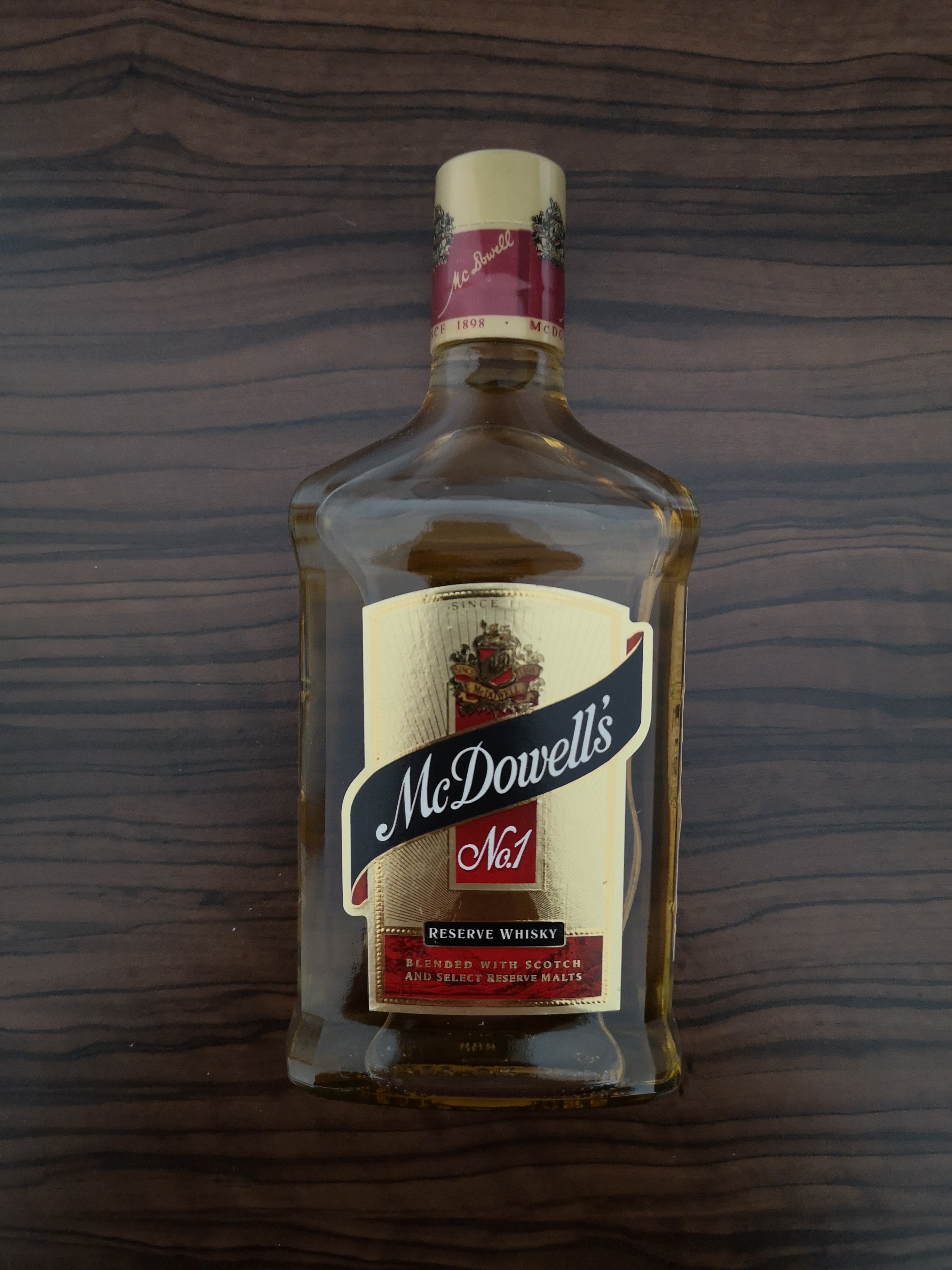
IMFL brands like McDowell's No.1 rank among the best-selling whiskies on earth. Yet many are distilled from molasses rather than grain — which means they cannot legally be called "whisky" under EU rules (photo: Gargarapalvin, CC BY 4.0)
Indian whisky has two faces. One is the mass-market spirit known as IMFL (Indian Made Foreign Liquor). Brands like McDowell's No.1 and Officer's Choice are world-leading by sales volume. But much of this whisky is distilled not from grain like barley but from molasses, a by-product of sugarcane. Strictly speaking, the method is closer to rum, and under European Union rules the name "whisky" cannot be applied. This is the everyday Indian spirit — counted in pegs, cut with soda.
The other face is the Indian single malt that has lately astonished the world.
Where Three Years Becomes Twelve — Tropical Maturation
In 2004, the Bangalore distillery Amrut released India's first single malt. Tellingly, its debut stage was not India but Glasgow, Scotland — at a time when the very idea of "an Indian single malt" still sounded strange. Then came Paul John of Goa, Rampur of northern India, and Indri of Haryana. Indri took the top honour (Best in Show) at a 2023 global whisky competition, proving that Indian single malt was no longer a backwater.
Their secret is climate. In India's heat, whisky matures far faster than in Scotland. As the spirit breathes fiercely with the cask, the "angel's share" lost to evaporation reaches 10–15 percent a year — a different order entirely from Scotland's roughly 2 percent. So a whisky matured three or four years in India can carry a concentration rivalling a spirit aged ten years or more in cool Scotland. It is a whisky fit for a country that drinks fast and ages fast.

Indian single malts, Goa's Paul John among them, climbed onto the world stage on the strength of fast tropical maturation. Three or four years in India can match ten or more in Scotland (photo: John Distilleries, CC BY-SA 4.0)
It is only when tasting these single malts that India sets down the peg and the soda and picks up the Glencairn and the copita. For that one moment of chasing aroma with the nose, it uses the world's common glass. The glass is borrowed, but the spirit, the unit, and the way of drinking are India's own — and somewhere in between lies the identity of Indian whisky.

The Soju Glass and the Patiala Peg
| Korean soju glass | Indian Patiala peg | |
|---|---|---|
| What sets the standard | the size of the glass (fixed 50 ml) | the amount poured (four fingers) |
| Role of the glass | the glass defines the amount | the glass is just a vessel; the unit defines |
| How it is drunk | emptied as is, refilled | lengthened with soda, water, ice |
| Where culture lives | the shape and standard of the glass | the unit "peg" and the measure of the hand |
Many nations have written their drinking culture into the shape of the glass. Turkey put its way of drinking into a pinched waist, Brazil into thick vertical ribs, Japan into the narrow neck of the tokkuri. India took a different road. It borrows the glass wherever it can, but turned the amount of a single pour into a unit of its own. The Patiala peg, measured by four fingers, shows that a glass's identity need not lie only in the curve of the crystal. Sometimes a nation's drinking culture is held not in the vessel, but in the width of the hand that fills it.
Amrut single malt — Vikrambj / Wikimedia Commons (CC BY-SA 3.0) · Whisky and soda — DoubleGrazing / Wikimedia Commons (CC BY-SA 4.0) · McDowell's No.1 — Gargarapalvin / Wikimedia Commons (CC BY 4.0) · Paul John single malt — John Distilleries / Wikimedia Commons (CC BY-SA 4.0) · Amrut Fusion — Matt Wunderle / Wikimedia Commons (CC BY 2.0)
Comments
Be the first to leave a comment.