The vessel that best represents Scotland, the homeland of whisky, is — surprisingly — not a glass at all. It is a shallow bowl, footless and stemless, with two small handles set on either side: the quaich. Where the Glencairn narrows its mouth so one person can gather aroma, the quaich was from the start a vessel for two or more. A cup to be passed, shared, and passed back. The Scots call it the cup of friendship.
From Cuach to Quaich
The name comes from the Scottish Gaelic cuach, meaning simply "cup." The pronunciation carries a guttural Gaelic catch at the back of the throat — roughly kway-uchh. The shape is plain: a shallow round bowl with flat, ear-like handles on each side. In Scotland these handles are called lugs (ears). There are usually two, though three or even four appear on occasion. Born in the Highlands, the quaich had spread to Lowland cities such as Edinburgh and Glasgow by the late 17th century.
A Pledge in Two Hands
The heart of the quaich is that its handles sit on both sides. The story commonly told runs like this: when you hand the cup over with both hands and receive it with both, both palms are open and visible — no weapon can be hidden in a sleeve. And by drinking first, before the guest, the host proves the cup holds no poison. The two handles, in other words, were an unspoken pledge: I mean you no harm.
Whether that account is literal history is uncertain. What is certain is that the quaich has long stood as a symbol of hospitality, peace, and friendship — a drinking vessel that gives trust a physical shape, kin to the old custom of clinking glasses so the liquid mingled and proved there was no poison.

The quaich is described as a "traditional Scottish cup for whisky." A shallow, footless bowl with a handle (lug) on each side — handed over and received with both hands (photo: Apie, CC BY-SA 3.0)
From Wood to Silver

A pewter quaich from around 1700. Beginning in wood, the quaich moved through pewter and silver — shifting from an everyday vessel to an object of ceremony and commemoration (photo: Auckland Museum, CC BY 4.0)
The oldest quaichs were made of wood. Some were stave-built like a barrel, narrow strips joined upright; others were turned on a lathe from a single block. A few had a small disc of silver or glass set into the base. Later the form moved to harder, more ornate pewter and silver — and tellingly, silver quaichs were often engraved with fine lines and bands in imitation of the staves and hoops of the wooden originals. The material changed, but makers wanted to keep the mark of the shared wooden bowl.

Weddings, Welcomes, and Farewells
Today the quaich shines brightest at the wedding. In a Scottish ceremony, the couple, having signed the register, share a drink of whisky (or water, or wine) from a single quaich. Each holds one of the two handles — a moment that binds two people, and two families, into one.
And not only weddings. The quaich circulates when an honoured guest is welcomed, in the parting cup offered to one setting out (deoch an doris, "the drink at the door"), at christenings, and at Burns Suppers honouring the poet Robert Burns. In the way a single cup is passed around many hands, the quaich is less a glass than an instrument of ritual.
A Knighthood in Whisky — The Keepers of the Quaich
In the 20th century the quaich became the emblem of the Scotch whisky industry as a whole. In 1988, leading Scotch whisky companies came together to found the Keepers of the Quaich — an invitation-only society honouring those who have advanced the standing of Scotch whisky around the world. It is often called a knighthood of whisky.
Its home is Blair Castle in Perthshire, where induction banquets are held twice a year. Entry requires at least seven years of dedication to Scotch whisky and the nomination of existing members; its several thousand members come from more than a hundred countries. That the society's very symbol is the two-handled quaich says plainly that this cup is regarded as the distilled essence of Scottish hospitality.

A quaich made as a commemorative trophy. Today the quaich is, beyond a vessel to drink from, a trophy and emblem honouring achievement and friendship (photo: Lajmmoore, CC BY-SA 4.0)
The Cup of Tasting, the Cup of Sharing
| Whisky glass (Glencairn, etc.) | Scottish quaich | |
|---|---|---|
| The starting question | how to drink | who to drink with |
| Handles | none | one on each side (lugs) |
| How it is held | one hand, alone | both hands, together |
| What it carries | aroma and focus | hospitality, trust, friendship |
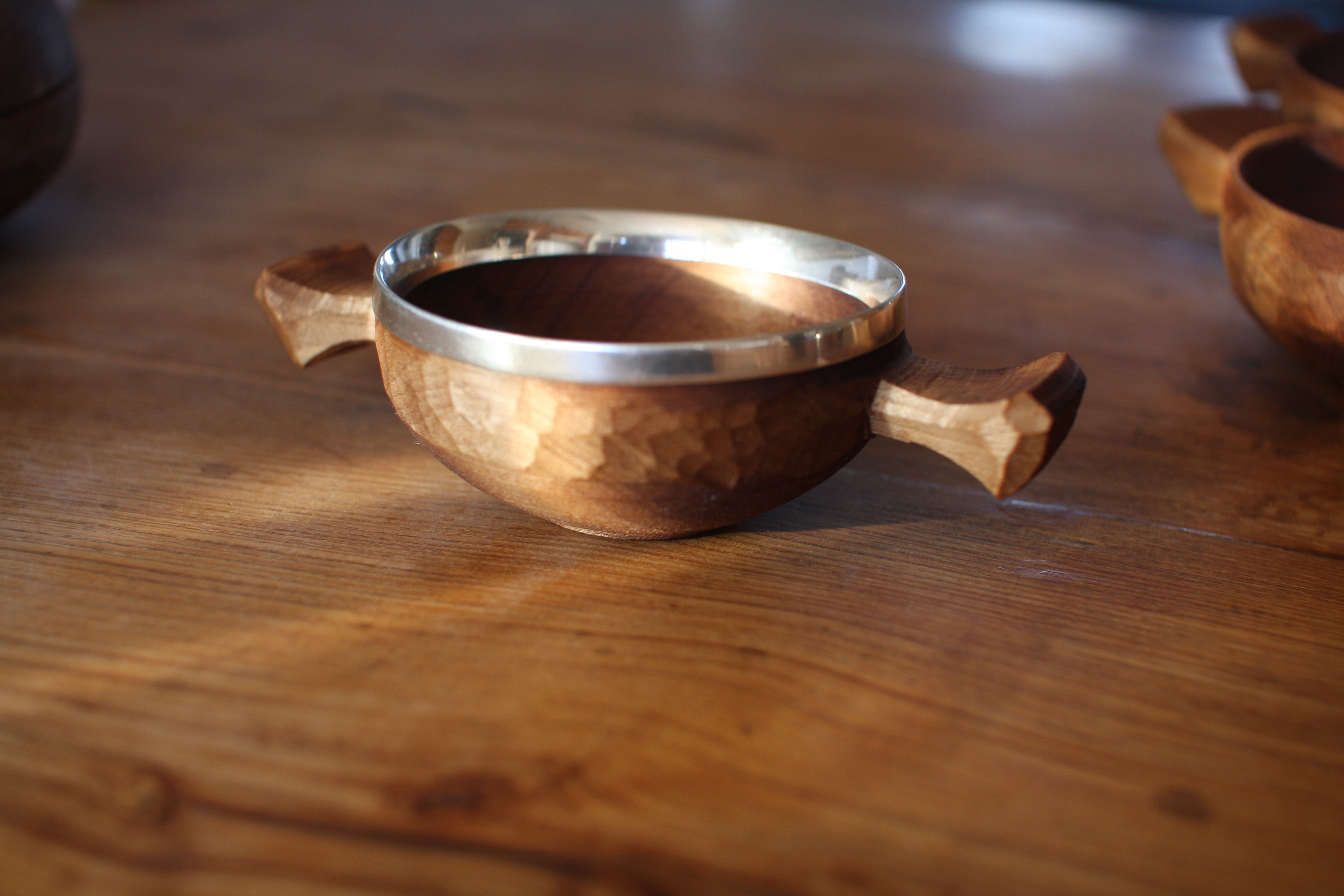
Most drinking vessels are the answer to the question "how should we drink?" — the mouth narrowed to gather aroma, the stem added to hold temperature, the body drawn tall to keep the head on a beer. The quaich begins from a different question: "who should we drink with?" That a footless, stemless bowl was deliberately given a handle on each side is itself the message. Not a cup to lift alone, but a cup to hand across the table with both hands. If Scotland showed the world how to savour whisky most elegantly through the Glencairn, it holds the warmest way to share it in this one old bowl.
Quaich (whisky cup) — Apie / Wikimedia Commons (CC BY-SA 3.0) · Pewter quaich (c.1700) — Auckland Museum / Wikimedia Commons (CC BY 4.0) · Oak quaich — Stewart McCarroll / Wikimedia Commons (CC BY 3.0) · Commemorative quaich — Lajmmoore / Wikimedia Commons (CC BY-SA 4.0) · Maple quaich — Robin-wood / Wikimedia Commons (CC BY-SA 3.0)
Comments
Be the first to leave a comment.