A Turkish day is measured out in two glasses. By afternoon, small waisted tea glasses pass from hand to hand; by evening, the spirit in a tall, slender rakı glass meets water and clouds to the colour of milk. Both are glass, both have no handle, and both hold an entire way of drinking inside their shape.
The Daytime Glass: A Tulip With a Waist
The Turkish tea glass carries a name that is also its shape: ince belli bardak, literally "thin-waisted glass." A curve that pinches in at the middle and flares again at the lip — a tulip, or a pear. It holds only 100–150ml, less than half of an ordinary mug.
It has no handle. The waist serves as one instead. The hot tea pools in the lower bulb while your fingers grip the cooler rim above. The small size is deliberate too: a little tea is drunk quickly before it cools, then poured again at once. In Turkey tea is not a single cup but a ritual that keeps refilling for as long as the conversation lasts.
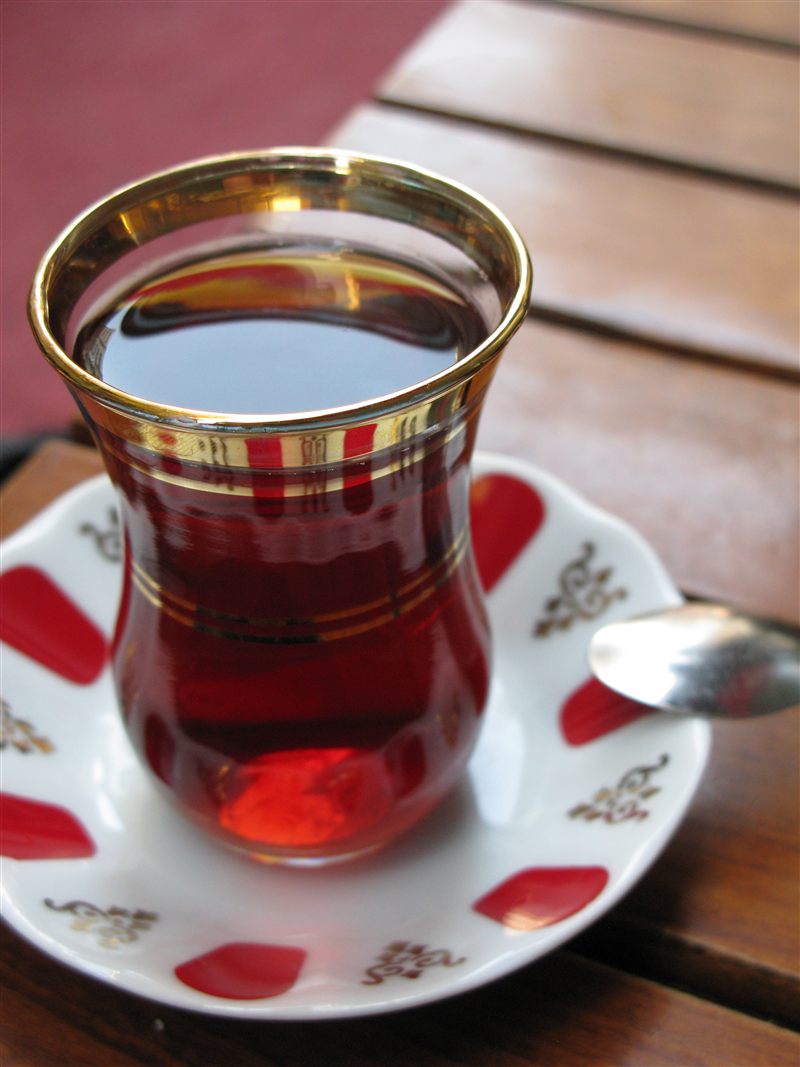
The ince belli bardak — Turkey's tea glass, served with a small saucer, spoon, and sugar cubes. Clear glass reveals the colour of the brew, known as "rabbit's blood" (photo: henribergius, CC BY-SA 2.0)
Where Form Is Function
The clear, transparent glass is no accident. A well-brewed Turkish tea has a colour with its own name: tavşan kanı, "rabbit's blood" — a bright, luminous reddish-brown, neither too pale nor too murky. A ceramic cup would hide it. The glass is also an instrument for judging the strength of the tea by eye.
Tea is brewed in a çaydanlık, a stacked double teapot. Strong tea concentrate sits in the upper pot, boiling water in the lower one, and you mix the two to taste. Lighter is açık; darker is koyu or demli. Everyone fills their own glass from the same pot to their own strength.
The glass always comes with a small saucer and spoon, and sugar cubes alongside. Holding a sugar cube in the mouth while sipping the tea through it — rather than dissolving it in — is called kıtlama. The whole kit is arranged around a single waisted glass.
What is striking is that Turkey has one of the highest per-capita tea consumptions in the world — yet this tea culture is younger than it seems. The drink of the Ottoman era was coffee. When coffee-growing regions such as Yemen were lost after the First World War and coffee prices soared, the young republic planted tea in the Black Sea region of Rize and raised tea into the national drink. The waisted glass became standard in that same era of transition.
The Nighttime Glass: Rakı and the Lion's Milk
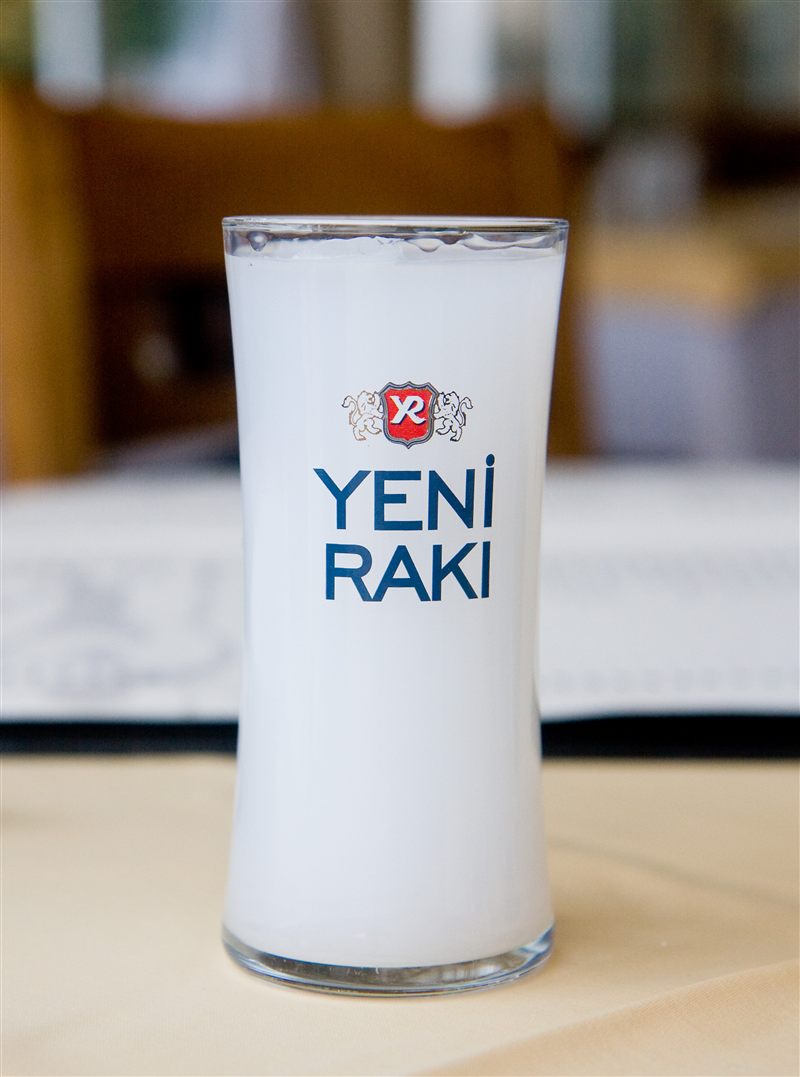
The tall, slender rakı glass (kadeh). Add water and the once-clear spirit clouds to milky white — Turks call it "lion's milk" (aslan sütü) (photo: Garrett Ziegler, CC BY-SA 4.0)
When the sun goes down, the glass changes. Rakı is a roughly 45% spirit distilled from grapes and flavoured with anise — Turkey's national drink. Its glass is the opposite of the tea glass: tall and narrow. The shape of that high glass holds the way rakı is meant to be drunk.
Rakı is not a spirit to be thrown back. You pour the rakı, add an equal measure of cold water or more, and sip it slowly over a long evening. That is why the glass is narrow and high: a narrow mouth keeps the anise aroma from scattering, and the small surface area keeps the drink cold longer. A separate glass of plain water usually sits beside it, accompanied by meze — an array of small plates.
Why It Clouds When You Add Water
Rakı's most dramatic moment is the pour of water. The clear spirit clouds instantly to the colour of milk. Turks call this aslan sütü, "lion's milk."
It is chemistry, not magic. Anethole, the compound that gives rakı its aroma, comes from anise; it dissolves readily in alcohol but barely at all in water. In neat rakı the high alcohol concentration keeps the anethole dissolved and clear. Add water and the alcohol level drops sharply, the anethole can no longer stay in solution, and it comes out as droplets too small to see. These microscopic droplets scatter light in every direction, and the liquid turns opaque white. This happens on its own, with no stirring, and is known as the ouzo effect. Greek ouzo, French pastis, and Levantine arak all cloud for the same reason.
So the tall, slender rakı glass is not just a vessel but the best stage for this change. Watching the spirit cloud inside clear glass is part of the experience of drinking rakı.
What the Two Glasses Say
| Tea glass | Rakı glass | |
|---|---|---|
| Shape | Waisted, small, low | Straight, tall, narrow |
| Handle | None (held by the rim) | None |
| How it's drunk | Emptied fast, refilled | Diluted, sipped slowly |
| What the glass reveals | The colour of the tea | The clouding into "lion's milk" |
| Served with | Saucer, spoon, sugar | A glass of water and meze |
Turkey's two glasses are both handleless clear glass, and both were shaped by their function. The daytime glass is small and waisted so the tea can be emptied and refilled before it cools; the nighttime glass is tall and narrow so the spirit can be sipped slowly and its transformation watched. Everywhere, the shape of a glass records what is drunk from it and how — and Turkey shows this twice a day, in two glasses.
Turkish tea glass — henribergius / Wikimedia Commons (CC BY-SA 2.0) · Rakı glass (lion's milk) — Garrett Ziegler / Wikimedia Commons (CC BY-SA 4.0)
Comments
Be the first to leave a comment.