
While the Glencairn was hardening into "the standard nosing glass," a glass built on the opposite idea emerged in the United States. The NEAT glass — narrowing through the bowl, then flaring back outward at the rim, the Glencairn turned inside out. More interesting still is how it came to be: it was not carefully engineered, but discovered by accident, from a glassblowing mistake.
A Glass Born From a Mistake
In 2003, George Manska — an engineer by background — took up glassblowing as a hobby after meeting the world-renowned glass artist Dale Chihuly. He had little talent for it, and most of his failures ended up shoved in a cabinet.
One day, out of clean glasses, he poured a Scotch into one of those "mistake" pieces — and caught layers of aroma he had never noticed before. That misshapen form, narrowing through the bowl and flaring outward at the rim, was dispersing the burn of alcohol while gathering only the aroma toward his nose.
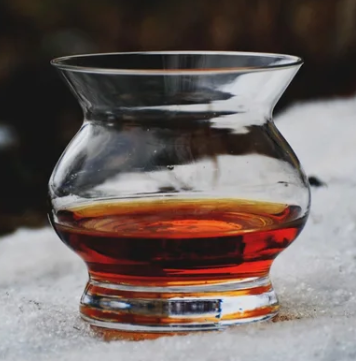
The actual NEAT glass. You can see at a glance how it narrows through the bowl and then flares back out at the rim — the Glencairn turned inside out — The NEAT Glass (Instagram)
The Opposite of the Glencairn — an Everted Rim
The Glencairn and other traditional nosing glasses narrow from bowl to rim (the tulip shape), the better to focus aroma to a single point. But that same structure funnels ethanol vapour to the nose along with the aroma — so the higher the proof, the stronger the alcohol burn, that "nose-on-fire" sensation.
The NEAT rim does the opposite: it flares outward (everts). The light ethanol vapour scatters sideways along the flared edge, while the heavier aroma compounds stay over the centre of the glass and rise to the nose. The drinker can bring their nose closer to the surface and smell the aroma without the alcohol sting.
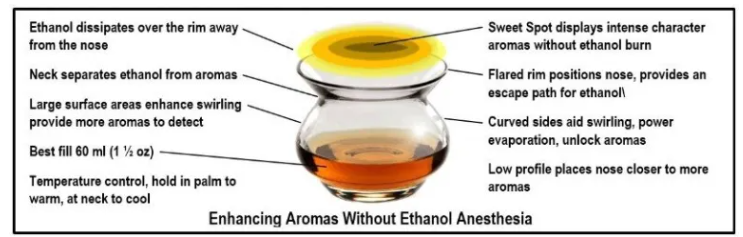
Scientific Validation and Competition Adoption
Manska analysed the phenomenon with help from the Chemistry Department at the University of Nevada, Las Vegas (UNLV). Professor Spencer Steinberg, a specialist in environmental analytical chemistry, confirmed that the NEAT's shape lets a drinker bring their nose closer to the whisky's surface and better inhale the fatty acid ethyl esters — the compounds that make up aroma.
The 2003 accident went through fifty-two design revisions over nine years before launching in 2012 as the patented product NEAT (Naturally Engineered Aroma Technology). In 2018 the data was published in a peer-reviewed beverage journal. Today the NEAT is used as the official judging glass at more than forty major spirits competitions.
An accidental discovery led to nine years of research, a patent, and adoption as the official glass of 40+ spirits competitions — a rare case of a "mistake" becoming an industry standard — Photo: MART PRODUCTION / Pexels
Is It a Glencairn Alternative?
The NEAT's strength is clear. With high-proof, cask-strength whiskies it cuts the alcohol sting and separates the aroma more distinctly. It is especially helpful when nosing high-proof bourbon or rum.
It is not, however, a cure-all. Because the flared rim disperses aroma rather than condensing it to a point, some find that with delicate, lower-proof whiskies the aroma flies off too quickly. Plenty of drinkers still prefer the Glencairn's signature "condensed" nose. And being stemless, it transmits the warmth of the hand — the same limitation as the Glencairn.
In the end, the NEAT does not so much replace the Glencairn as serve a different purpose. When you want to strip the alcohol from a high-proof spirit and study its aroma, reach for the NEAT; when you want aroma gathered to a single point to savour, reach for the Glencairn. Keeping both on the shelf is the most practical choice.
In Summary
The NEAT is a rare glass born "discovery-first" rather than "design-first." A single mistake led to nine years of research, a patent, and adoption by more than forty competitions — proving the proposition that a glass's shape changes its aroma, in the most accidental way imaginable.
If the Glencairn is a glass that gathers aroma, the NEAT is a glass that strips away alcohol. A chance mistake opened up another way of seeing whisky.
NEAT glass photo — The NEAT Glass (Instagram) · Working-principle diagram — santesante88, "Why NEAT Is the Official Spirits Judging Glass," Santé.Food.Wine.Spirits (2024-11-01) · Whisky glass on a bar counter — MART PRODUCTION / Pexels (Free License)
Comments
Be the first to leave a comment.