
The first time you walk into a whisky bar, you tense up a little. Where do I hold the glass? How am I supposed to return the toast? You lean in to smell the thing and get a noseful of alcohol that leaves your nostrils stinging. Everyone's been there.
So let's start with the reassuring part. There are almost no strict rules with a whisky glass. It isn't a fussy ritual like wine, and nobody is grading the way you hold it. We call it etiquette, but really it's less about impressing anyone than about getting the whisky in your glass into its best possible state. Learn a little and the drink tastes better. That's the whole point.
Where to Hold It
Start with the core fact: whisky's aroma rides up on the alcohol. Warm the spirit and the alcohol grows more volatile, carrying more aroma molecules to your nose. Cold, and the nose closes up; gently warm, and it opens. Where you hold the glass is, in the end, a question of how you want to manage that temperature.
If your hand touches the bowl, your body heat goes into the spirit. Sometimes that helps, sometimes it doesn't.
A glass with a stem or a thick base — a Glencairn, a copita — is meant to be held there, the way you'd pinch a wine glass by its stem. The base exists precisely so you can lift the glass without warming the bowl. Hold it this way when you want the aroma steady, exactly as it is, before any warmth gets to it.

But whisky isn't wine. It's a spirit whose closed-up aromas tend to open with a little warmth, so warming it on purpose often pays off. When a high-strength cask-strength dram smells tight and shut, cup the bowl in your palm for a few minutes and the nose comes alive. So "never hold the bowl" is only half true. Hold the base if you don't want to warm it; cup the bowl if you want to wake it up. There's no fixed answer — you match it to the dram in front of you.
What a Few Drops of Water Can Do
The easiest trick you have in front of a high-strength whisky is, of all things, water. Add a drop or two to a cask-strength pour or anything past 50% and the aromas that were shut tight open up noticeably. You're not trying to dilute it. You're releasing the smell.
There's a real reason for this. Some of whisky's best aroma compounds are oily molecules that, at high strength, stay trapped in the alcohol and never make it up to the surface. Add a little water and the alcohol concentration drops just enough for those molecules to float up and reach your nose. At the same time, the sharp sting of the alcohol eases off. More aroma, less burn.
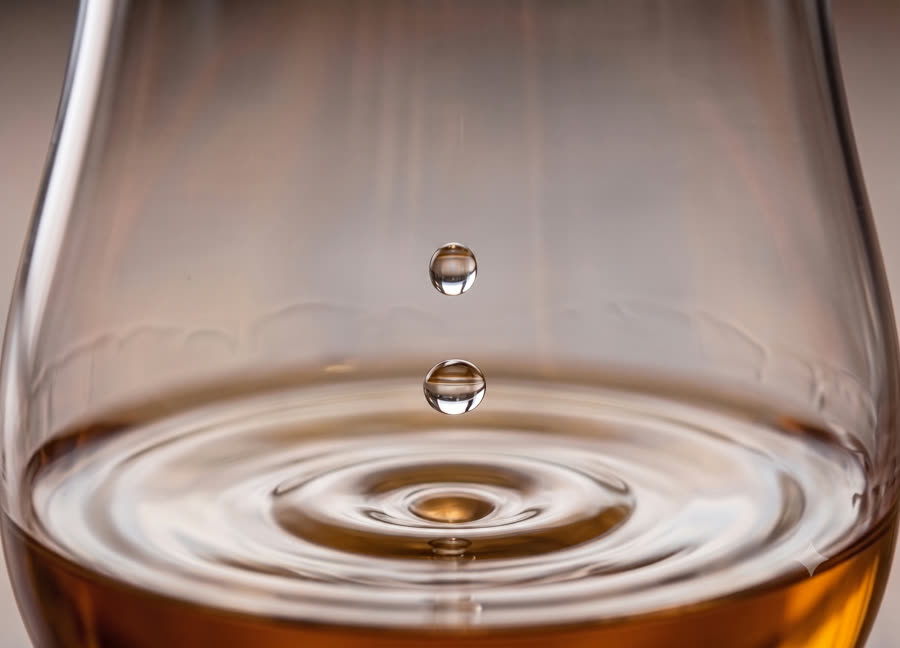
Two things to remember. First, add it drop by drop, not in a splash — you can always add water, never take it back. Second, at an ordinary strength around 40% you usually don't need to bother; the whisky was already balanced for drinking, and water can just leave it flat. Water is for cracking open tight, high-proof drams.
It's worth knowing that ice and water do different jobs. Ice lowers the temperature, which closes the aroma but makes the spirit easier to drink; water keeps the temperature and opens the aroma. If you want to follow a dram's smell all the way through, water beats ice.
When You Nose It
Bury your nose deep in the glass, take a big sharp breath, and it stings. The alcohol vapour rushes up all at once and briefly numbs your sense of smell. Do that once and you'll struggle to pick up anything for the next few minutes.

The fix is almost comically simple. Hold your nose just near the rim and breathe in gently with your mouth slightly open. The open mouth spreads the alcohol's bite between mouth and nose, and the real aromas underneath — fruit, vanilla, peat smoke, whatever's there — come through. Don't try to get it all in one go; take short sniffs, several of them. Your nose tires faster than you'd think.
The aroma isn't a one-time thing, either. Take a first sip, come back, and something different rises off the glass. Your tongue adjusts to the alcohol, and the whisky keeps mixing with air and "opening up." So there's no reason to rush. Leave it a while, smell again, take another sip.
When your nose goes dull, sniffing the back of your own hand resets it reasonably well — a common trick among people who smell for a living.
Two more things. Swirling the glass hard like wine is overkill for whisky; the strength is high enough that agitating it just throws up alcohol. A gentle tilt, letting it run down the wall, is plenty. And if aroma matters at the table, skip the perfume and heavy hand cream — they cover not just your own nose but your neighbour's. For the same reason, it's polite to hold off on a cigarette while people are seriously tasting.
The Toast — Slàinte
Drink whisky with a Scot or an Irishman and you'll hear something that sounds like "slan-juh." Slàinte. It's Gaelic for "health," and it's the closest thing to our "cheers." In Scottish Gaelic it's slàinte, in Irish sláinte — same word, different spelling. Said in full it's Slàinte mhath ("good health"). It looks impossible on the page, but "slan-juh" gets you there.

How people toast varies from place to place. In Scotland you don't have to clink at all; a small lift of the glass with eye contact counts for more. There's a bit of folklore across Europe that says failing to meet eyes during a toast brings seven years of bad luck — not meant seriously, but the eye contact does look right.
How much the Scots value drinking together shows in the fact that they kept a vessel made for sharing: the quaich, the two-handled cup passed hand to hand and drunk in turn. Something of that same instinct — that a dram is better shared — sits underneath the toast.
And one last thing. If you've been handed a good single malt, don't throw it back in one go. Say slàinte, hold a mouthful, take your time. Shooting it like tequila does the spirit a disservice. Someone waited ten or twenty years to put it in your glass.
Keep Water Beside You
One small habit that makes an outsized difference: keep a glass of plain water next to your whisky. Rinsing your mouth between sips keeps the aroma of the next one sharp. It also slows you down on a strong spirit you're drinking over a long evening, and looks after the next morning. It's why a good bar pours you water without being asked.
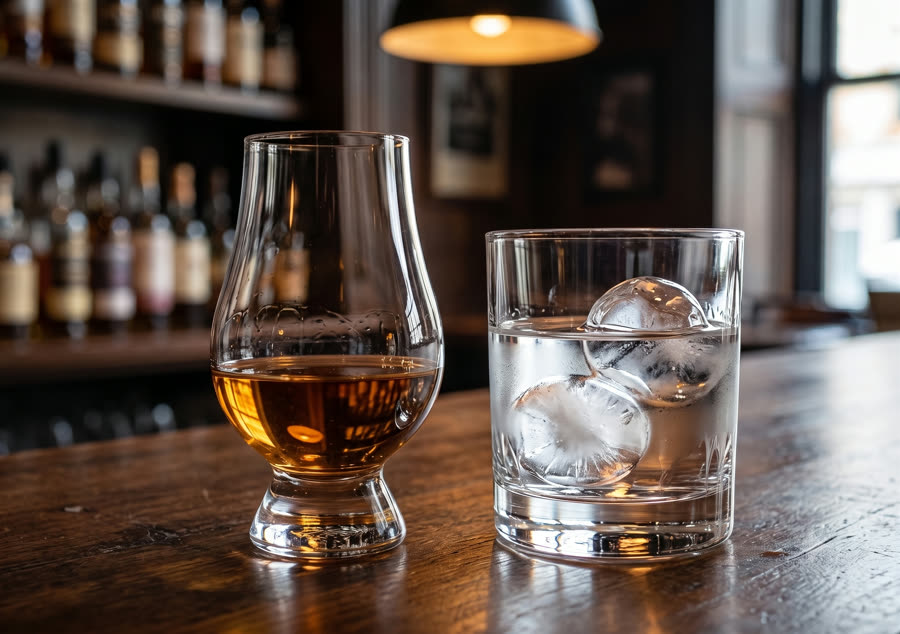
There's nothing to memorise. Base if you want it cool, bowl if you want it warm. A drop of water if it's tight. Nose near the rim, mouth slightly open. Toast with eye contact and a slàinte. The rest sinks in as you drink. The real waste is tensing up over manners and missing the whisky in front of you.
Comments
Be the first to leave a comment.