Few drinks divide people like whisky does over the simple question of what to add. One person insists not a single drop more; another opens up the aroma with a few drops of water; a third pours in half a glass of cola. What's striking is that this choice isn't purely personal taste. How much of what you add to the glass is a culture that differs from country to country — and inside those ratios lies what each society believes whisky is for.
Why Add Anything at All — The Science of Water
Start with the most basic question: why add anything to a well-made whisky? Doesn't it ruin the aroma?
The answer, surprisingly, is chemistry. Whisky comes off the still at around 70% alcohol and is usually diluted to about 40% for bottling. Yet adding just a few more drops of water has long been a drinkers' rule of thumb for making the aroma come alive — and in 2017, Swedish researchers (Karlsson & Friedman) explained why with molecular simulations, published in Scientific Reports.
The key is an aroma molecule called guaiacol, which gives whisky its smoky, savory note. When the ethanol concentration is at or below 45%, guaiacol gathers at the liquid–air interface — the very surface your nose and tongue meet first. Above 59%, it gets surrounded by ethanol and sinks into the bulk of the liquid. The higher the proof, the less the aroma rises to the surface. So adding a little water lowers the strength and floats those aroma molecules up where you can smell them. "A few drops of water" turns out to be interface chemistry, not folklore.
That principle is the starting point for every kind of mixing. But how far and with what you dilute — that's where the world splits onto completely different paths.
Scotland — A Few Drops of Water, and No More
The homeland of whisky is the stingiest with additions. The orthodox Scottish method is a few drops of room-temperature water — not ice, not soda. Just before nosing, you let a drop or two fall from a pipette or a small water jug to nudge the strength down.
The reason is exactly the science above. Cask strength whisky (55–65%), bottled straight from the barrel without dilution, hides its aroma molecules deep in the liquid, so a few drops of water have a dramatic effect: as the proof drops, aromas that were locked away open up all at once. Ice, by contrast, chills the glass and traps the aroma — unwelcome when you're chasing the nose.
There's nothing here you'd call a ratio. It isn't a measurement but a drop at a time, tuned to that day's whisky and your own nose — the most restrained addition of all.
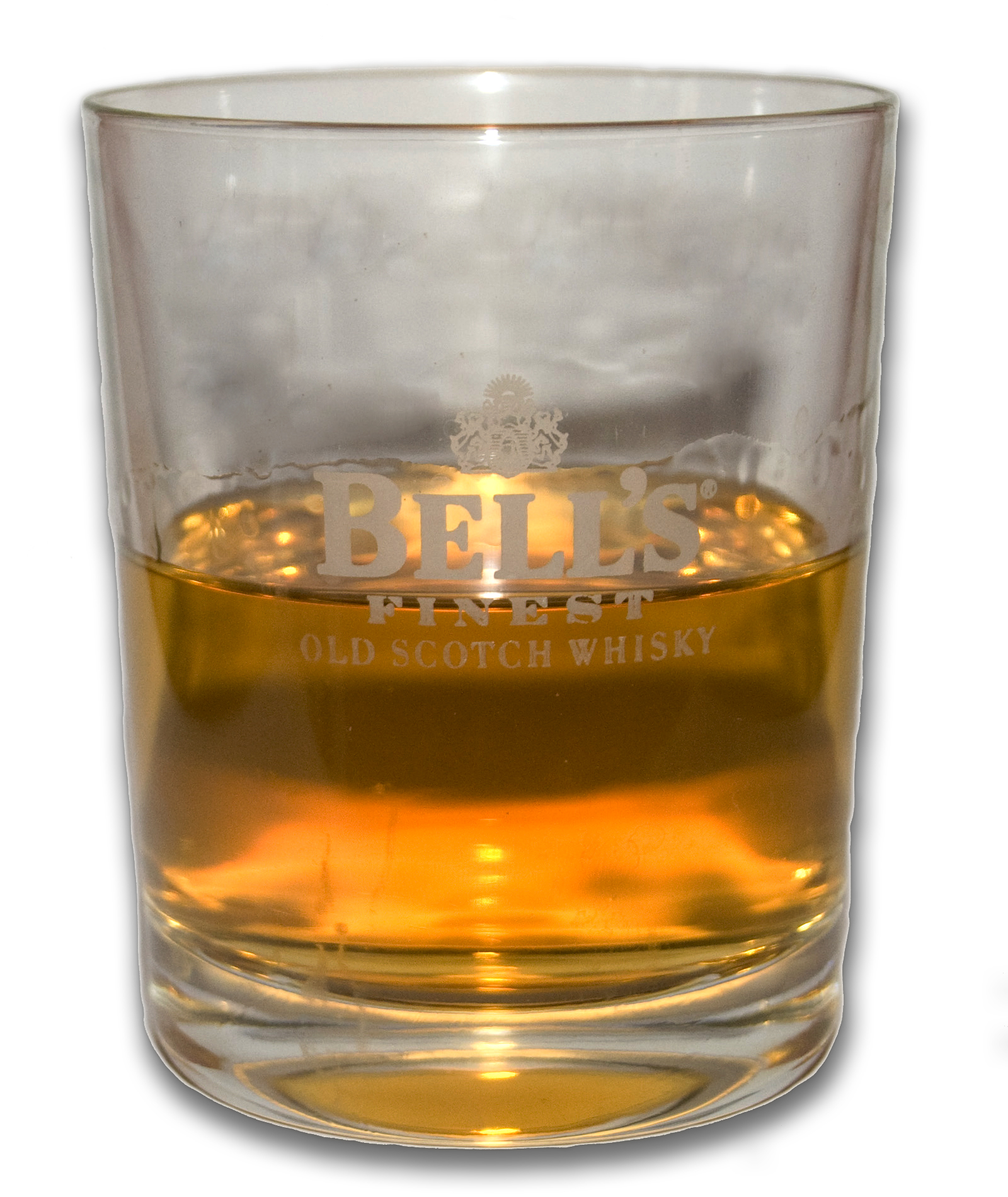
The whole of the Scottish addition — a few drops of room-temperature water to open the aroma. As the strength falls below 45%, the aroma molecules rise to the surface (photo: Chris huh, Public Domain)
Japan — Mizuwari and Highball, Dilution as Art

Japan refined dilution itself into a form. Mizuwari with water, highball with soda — turning whisky into a long drink for the table. Pictured: a Torys highball in Tokyo (photo: nakashi, CC BY-SA 2.0)
Japan went the opposite way, refining dilution into a discipline. It runs along two lines.
Mizuwari (水割り) is whisky cut with cold water — typically 1 part whisky to about 2–2.5 parts water, bringing the strength down to 12–15%. It's a dilution made for sipping slowly with a meal. In winter it becomes oyuwari (お湯割り), cut with hot water instead.
Highball (ハイボール) is cut with soda water. The standard ratio is 1 part whisky to 3–4 parts soda, dropping the strength to around 8–10%. A well-chilled glass, hard clear ice, soda poured gently at the end — Japanese bars have elevated this simple drink to something like ceremony. The carbonation lifts aroma molecules toward the nose and lightens the sweetness, and there's a clear chemical reason even cheap whisky tastes better this way.
India — Measure the Peg, Fill with Soda
India, the world's largest whisky-drinking nation, counts a serving not by the glass but by the peg — a chhota peg (about 30ml) or a bada peg (about 60ml). After pouring, it's topped with soda or water (pani) to be drunk long in the heat. Roughly 1 part whisky to 1–2 parts soda, lowering the strength to 15–20%, makes the everyday "whisky-soda."
Rather than nosing the aroma, this is a way to dilute a 40%-plus spirit into something cool you can sip through an entire meal. It's India's distinctive approach — inscribing drinking culture not in the shape of the glass but in the amount you pour.
America — Cola and Ginger Ale, Sweet and Easy
America took the path of whisky as a sweet, easy long drink. The most famous is the Jack & Coke — Jack Daniel's topped with cola at roughly 1 part whisky to 2–3 parts cola. The Seven & Seven that defined the 1970s mixed Seagram's 7 whisky with 7Up. Whisky-ginger with ginger ale, and versions with lemon-lime soda, are just as common.
Here whisky isn't the object of the nose but closer to a cocktail base. The sweet soda covers the bite of the alcohol and coats it in sweetness, turning it into a casual drink that goes down smoothly. The vanilla-and-caramel notes of American bourbon mesh well with cola's sweetness, which is part of why the pairing took hold.

The American whisky-and-cola is a glass for comfort, not aroma — filled with ice, then topped with cola (photo: R34SkylineGT-R V-SpecⅡNür, CC BY-SA 3.0)
China — Pouring Green Tea Into Whisky
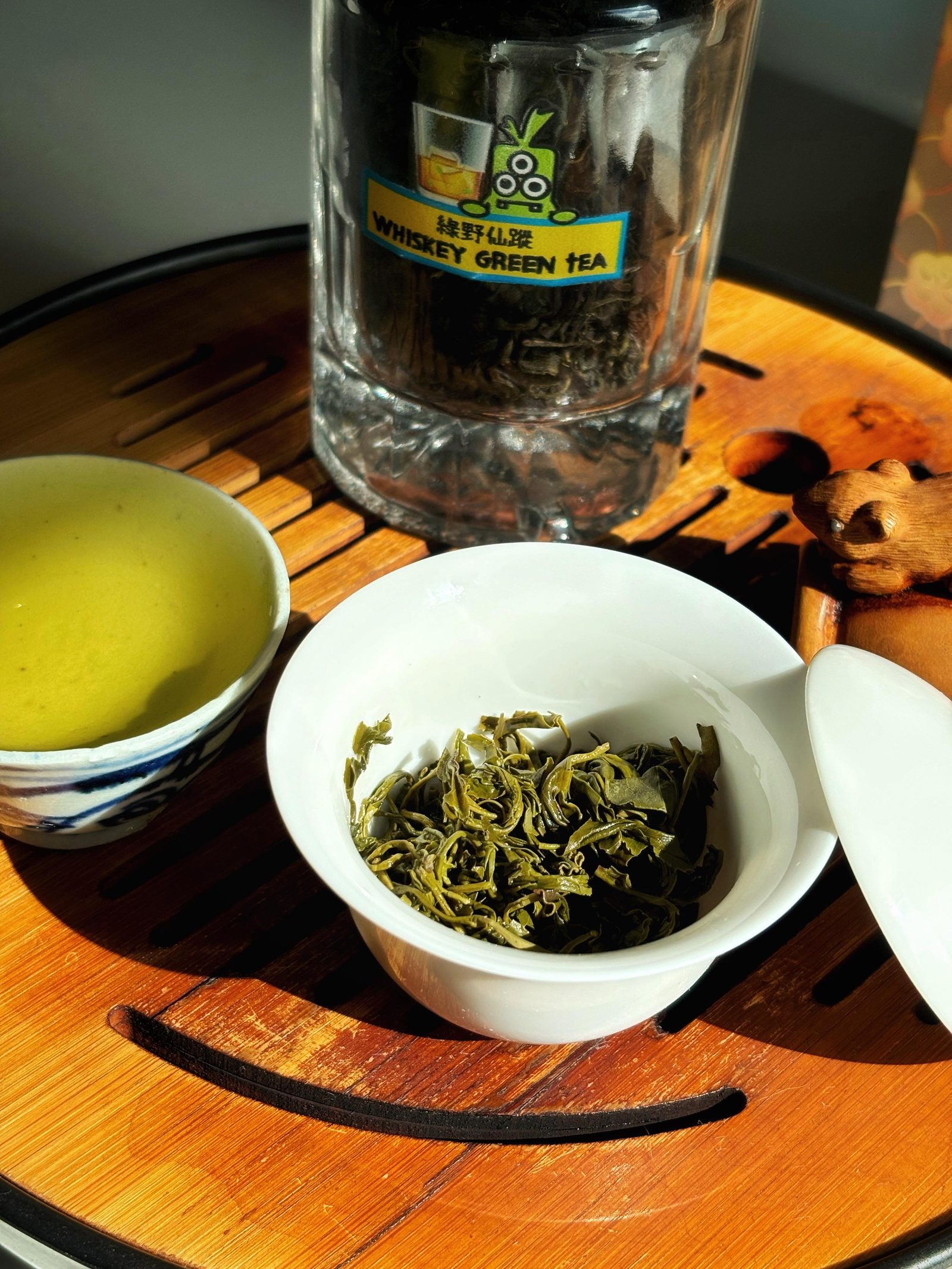
Whisky mixed with chilled green tea. In the karaoke rooms and clubs of 2000s Hong Kong and China, "Chivas Green Tea" was the drink of an era (photo: Reddit)
The most unfamiliar combination is in China. Through the 2000s, in the karaoke rooms (KTV) and clubs of Hong Kong and the mainland, whisky was served with chilled green tea. A bottle of Chivas Regal and a jug of sweet bottled green tea would sit on the table, and a server would mix each glass at roughly 1 part whisky to 2–3 parts tea.
This "Chivas Green Tea" was no mere quirk but the drink of an era. The sweetness and tannin of the tea tamed the rough edge of blended whisky, making it go down far more easily than neat (South China Morning Post). Pernod Ricard pushed a "Chivas Green Tea" concept outright, and its contract outlets grew from fewer than 200 in 2002 to ten times that within a few years (China Daily). It's a Chinese-style dilution where an ancient tea-drinking culture met Western whisky.
Spain — Cubata, a Paradise of Whisky and Cola
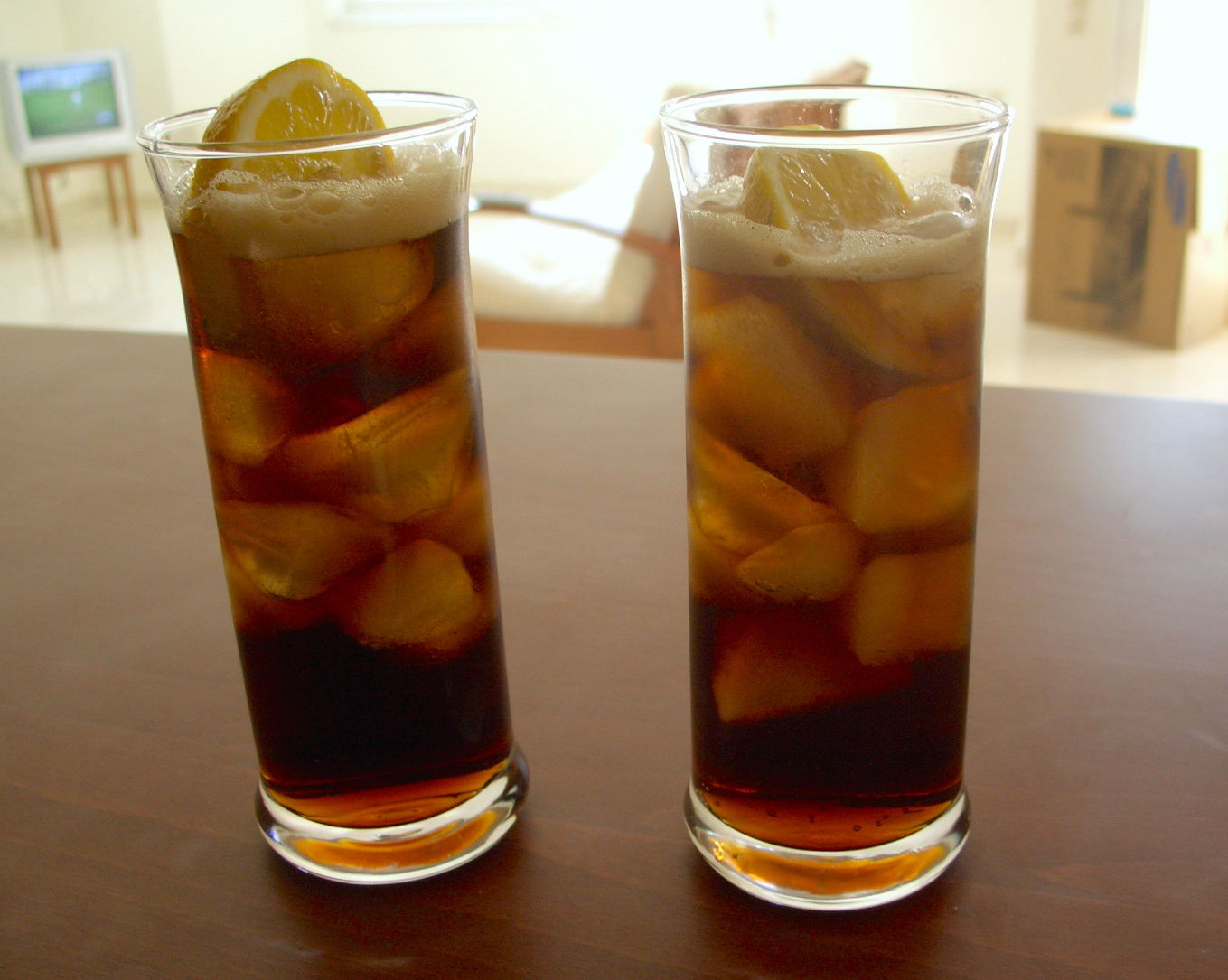
Spain's cubata — a tall glass packed with ice and a generous pour of spirit and cola. Whisky-cola became an everyday long drink (photo: Martin Belam, CC BY-SA 2.0)
In Spain, whisky-cola is less an exception than a national drink. A spirit mixed with a soft drink and served tall over ice is called a cubata in Spain, and the whisky-and-cola cubata is the best known of all (Tasting Table).
The ratio is generally 1 part whisky to 2–3 parts cola, packed with ice and sometimes finished with a slice of lemon or lime. In a Spanish bar, whisky is less a spirit to savor than a long drink to nurse through the night. It's the same combination as America's Jack & Coke, but with more generous measures and bigger glasses, woven deep into everyday life.
Mixers and Ratios at a Glance
| Culture | Mixer | Rough ratio (whisky : mixer) | Approx. final ABV | Purpose |
|---|---|---|---|---|
| Scotland | A few drops of room-temp water | Barely any | Nearly unchanged | Open the aroma |
| Japan — mizuwari | Cold water | 1 : 2–2.5 | ~12–15% | Long with a meal |
| Japan — highball | Soda water | 1 : 3–4 | ~8–10% | Refreshment |
| India | Soda / water (pani) | 1 : 1–2 | ~15–20% | Heat & meals |
| United States | Cola / ginger ale | 1 : 2–3 | ~12–15% | Sweet and easy |
| China | Chilled green tea | 1 : 2–3 | ~12–15% | Rich food & toasting |
| Spain | Cola | 1 : 2–3 | ~12% | Everyday long drink |
Ratios and ABVs are approximations of standard practice and vary by venue and by person.
What You Add Is the Culture Itself
There is no "correct ratio" for whisky. A few drops of water opening the aroma has clear science behind it (below 45%, the aroma molecules rise to the surface), yet half a glass of cola burying that aroma isn't a wrong answer within its own culture. Where Scotland saw whisky as something to nose and savor, Japan took it as a long drink for the table, America and Spain as an easy long drink, and China as an instrument of the toast.
In the end, what and how much you pour into the glass reveals what that society takes whisky to be — an aroma to chase with the nose, a drink to share a meal with, or a glass to clink with others. That's why whisky poured from the same bottle becomes an entirely different drink as it crosses borders.
The science of water — Karlsson & Friedman, "Dilution of whisky – the molecular perspective", Scientific Reports (2017) · China whisky–green tea — South China Morning Post, China Daily · Spain's cubata — Tasting Table · Japanese, Indian, and American serving practices reflect widely documented standard methods.
Image creditsCover (Glencairn glasses and water jug) — Lord van Tasm (CC BY-SA 3.0, Wikimedia Commons) · Scotland (Bell's Scotch) — Chris huh (Public Domain, Wikimedia Commons) · Japan (Torys highball) — nakashi / Naoki Nakashima (CC BY-SA 2.0, Wikimedia Commons) · United States (whisky and coke) — R34SkylineGT-R V-SpecⅡNür (CC BY-SA 3.0, Wikimedia Commons) · China (whisky green tea) — Reddit · Spain (cubata) — Martin Belam (CC BY-SA 2.0, Wikimedia Commons)
Comments
Be the first to leave a comment.