Four Roses
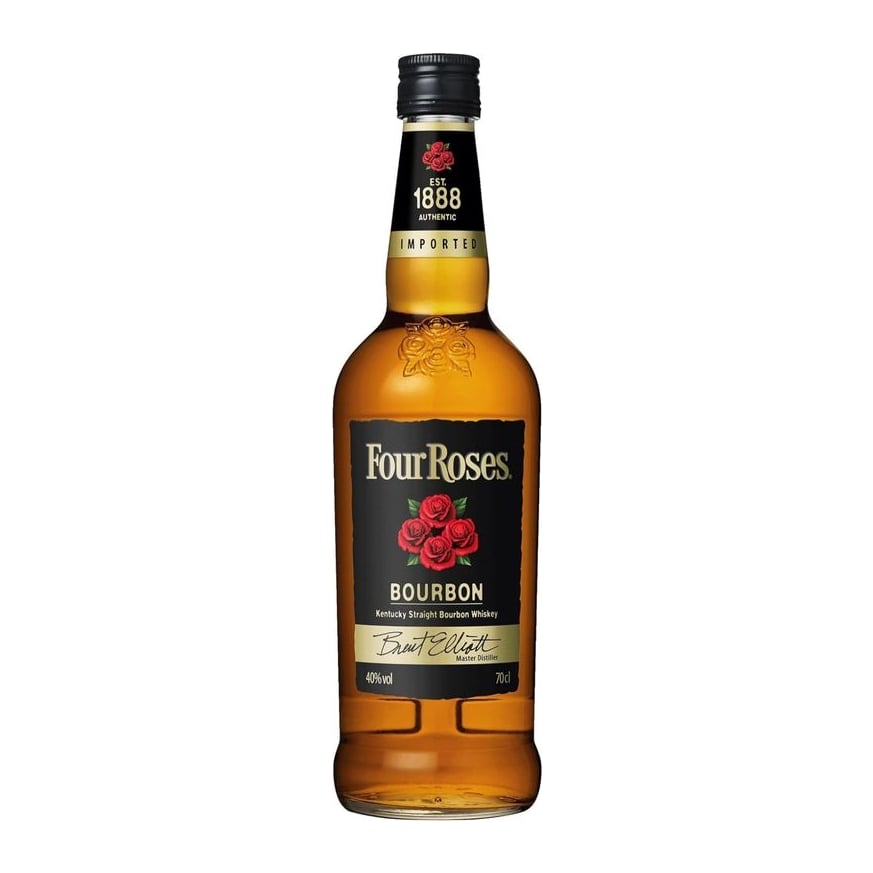
Five yeasts × two mashbills, ten spirits blended — a bourbon once unsellable in its own country.
What sets Four Roses apart from other bourbons is the unusual architecture of its ten recipes. Where most distilleries work from one or two mashbills, Four Roses multiplies two mashbills of differing rye content by five aroma-distinct yeasts to make ten separate spirits. Yellow Label blends all ten, Small Batch picks four, Single Barrel just one. That's why lines from a single distillery taste so clearly different from one another.
There's an odd gap in the brand's history. Through the mid-to-late 20th century, under Seagram, Four Roses sold no good whiskey in its own country. The quality straight bourbon was exported only to Japan and Europe, while the US market got a cheap blended whiskey carrying the Four Roses name. So for a generation the name meant a low-grade drink to American drinkers — and exactly the opposite, a byword for good bourbon, in Japan.
The turn came in 2002. When Japan's Kirin bought the brand, master distiller Jim Rutledge brought premium straight bourbon back to the American market. The real Four Roses, having vanished at home, returned by way of Japanese ownership — a strange story given how American bourbon's identity runs. Today it's counted among the pillars of the Kentucky bourbon revival.
For a first bottle the Yellow Label is an easy starting point. If heavy bourbon feels like too much, Four Roses' light, floral character may sit more comfortably. Step up to Small Batch for more depth, or to Single Barrel to enjoy barrel-to-barrel character. Few bourbons in this price band show so many different faces across a single range.
Four Roses' core is value and consistency rather than scarcity. Yellow, Small Batch and Single Barrel all score well for the price, while only the annual Limited Edition fills the high-end collector tier. The ten-recipe system, giving each line a different grain, is what drives collector interest.
Prices are approximate retail / duty-free · limiteds are volatile — not a personal tasting score
Four Roses' identity is its ten recipes. Two mashbills of differing rye content and five aroma-distinct yeasts combine into ten spirits, distilled separately. Yellow Label blends all ten; Small Batch uses just four; Single Barrel bottles only one. That's why lines from one distillery read so differently. Overall it's a light, fresh bourbon — closer to pear, apple and blossom than to heavy oak.
It began in 1888 when Paul Jones Jr. trademarked the Four Roses name — said to come from a sweetheart who answered a proposal with a corsage of four roses. Under Seagram in the mid-to-late 20th century the US saw only a cheap blend under the name, while the good straight bourbon was exported solely to Japan and Europe. In 2002 Japan's Kirin acquired it and brought premium straight bourbon back to the American market.
Four Roses was long a favourite bourbon in Japan — kept in steady supply there even in the years it went unsold at home. Light and smooth, it works well as a highball or cocktail base. In other markets its sensible price and gentle profile make it a frequent beginner's bourbon, while the Single Barrel is popular with enthusiasts who chase barrel-to-barrel character.
A light, fresh bourbon, it takes neat, on the rocks or as a highball equally well. Yellow and Small Batch open slowly over a single big cube or mix happily with soda; higher-proof lines like the Single Barrel reward a Glencairn or copita and a few drops of water to open the floral notes. The vanilla and spice fall cleaner when chilled down over ice.
Sources · Production & range — fourrosesbourbon.com · History — Wikipedia 'Four Roses' · Product image — Four Roses