
Glen Grant
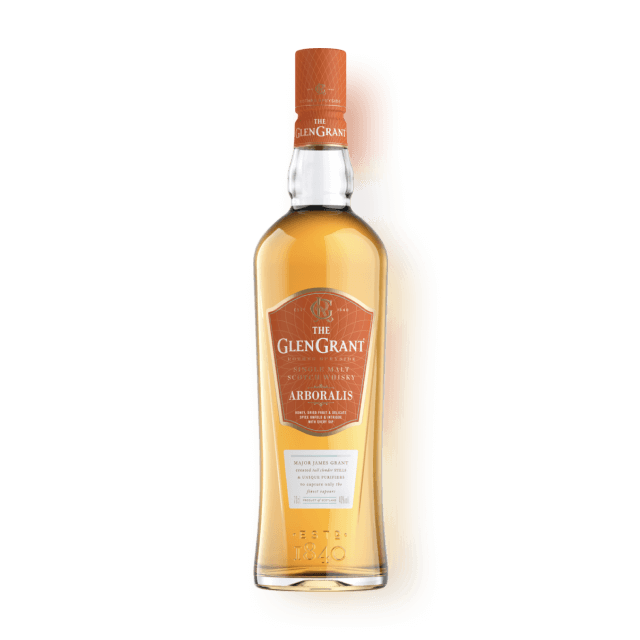
The clean, light single malt that conquered the Italian market.
You can't talk about Glen Grant without talking about Italy. From the 1960s and 70s, Italians took to drinking young, light whisky almost as an aperitif, and Glen Grant became a country's national single malt. To this day a large share of Italy's single-malt market belongs to this one brand — a rare case of a Scotch's success being built not at home but across the Mediterranean.
That lightness is no accident; it's engineering. Tall stills and neck-mounted purifiers strip out the heavier compounds, leaving a clean spirit closer to apple and blossom. Where Macallan builds weight with sherry casks, Glen Grant does the opposite — it pares away. That makes it an easy first whisky, and at the same time a touch plain for anyone hunting for body.
Price tells the rest of the story. A 10-year-old costs less than most Speyside malts of similar age, meaning there's little name-premium stacked on top — and on value-for-money it actually scores well. It's no surprise critics have repeatedly handed the Glen Grant 10 a best-value award.
The old vintages are another world. Decades-old 1940s and 50s Glen Grant from Gordon & MacPhail sells for tens of thousands at auction, but that's a sliver of the collector market. For most people Glen Grant is the bottle you bring home without a second thought and empty, lightly, on an ordinary evening.
Decades-old 1940s–50s Glen Grant vintages bottled by Gordon & MacPhail trade in the tens of thousands at auction. But the brand's real strength isn't the top end — it's the broad popularity of a sensibly priced core range that has long led the Italian market.
Prices are approximate retail / duty-free · Vintages at auction / limited price (volatile) — not a personal tasting score
Glen Grant's identity is lightness. Tall stills give the vapour a long run, and purifiers on the necks send heavier compounds back to the pot. The spirit lands clean and fresh — apple, pear, blossom. Maturation is bourbon-led (American oak), placing it at the opposite pole from the sherry bombs.
Founded in 1840 by brothers John and James Grant in Rothes, Speyside. Its position near the railway helped it grow early, and under grandson Major James Grant it gained a reputation for showy innovation — among the first in the Highlands to install electric light. Since 2006 it has been owned by Italy's Campari Group.
Glen Grant is so dominant in Italy it is effectively the national single malt — the clean style matching an Italian habit of drinking young whisky almost as an aperitif. Elsewhere it carries less of a name, but its low price and gentle profile make it a quiet recommendation for beginners. For anyone wary of heavy sherry or peat, it is a safe starting point.
Light and delicate on the nose, it suits a glass that gathers the aroma — a Glencairn or copita. The 10yo is 40%, fine neat, opened by a single drop if shy. Higher-proof lines like the 15yo batch strength open dramatically with a few drops of water. Being a light whisky, it's a shame to shut the aroma down under a big lump of ice.
Sources · Production & range — glengrant.com · Vintages at auction / limited price · Product image — Glen Grant