
Hakushu
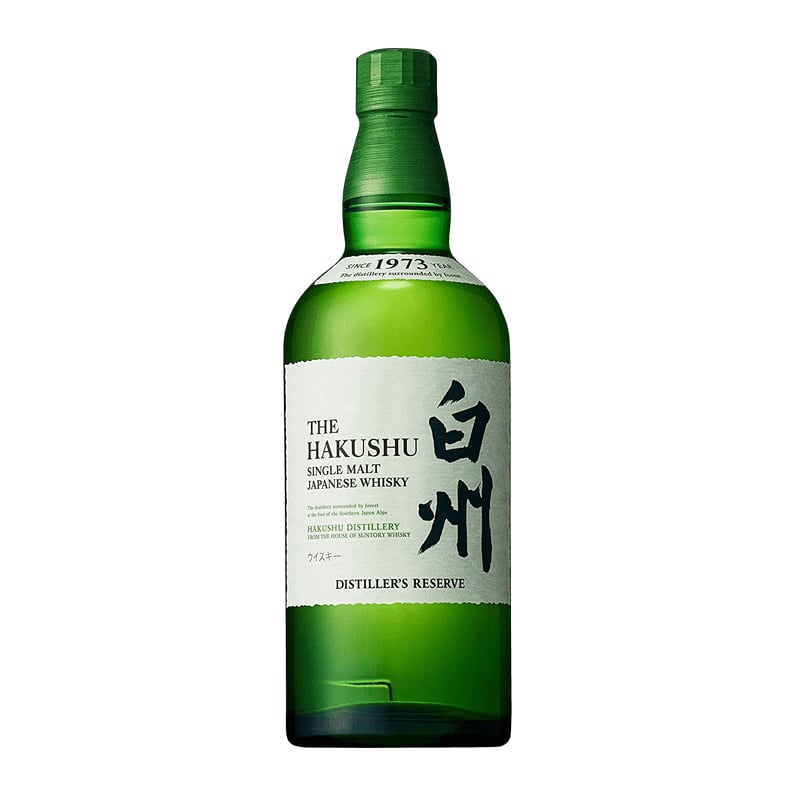
Yamazaki's counterpart, the 'forest whisky' — Suntory's crisp single malt built in a high-altitude forest.
The quickest way to understand Hakushu is to set it beside Yamazaki. After founding its first distillery at Yamazaki in 1923, Suntory built a second one — in 1973, the company's 50th anniversary — somewhere entirely different. Where Yamazaki sits in a well-watered valley near Osaka, Hakushu is up in forest at 700m on the foothills of the Southern Alps. It was a deliberate choice to add a second, opposite character to the house, and so Hakushu was designed from the start as "the one that isn't Yamazaki."
The core of that difference is light peat. Japanese whisky tends to summon an impression of soft and fragrant, but Hakushu lays a little smoke underneath. That faint thread, running below green apple and mint, gives it a wholly different cast from Yamazaki despite both being Suntory single malts. It isn't the heavy Islay kind of peat either, so people who find peat off-putting often accept this much with an "if it's only this, fine."
Scarcity is hard to leave out of any account of the brand. As Japanese whisky won global recognition through the 2010s, demand outran supply, and around 2018 the 12yo was paused for a stretch when stocks ran short. It came back, but buying at list price is still far from easy, and market prices several times above list are common. In that same window Suntory pushed the mint-finished "forest highball" as a summer serve, leaving Hakushu with a double image — a scarce bottle and, at once, the face of a cool, easy highball.
For a first bottle the Distiller's Reserve is the realistic starting point — no age statement, but better on price and availability than the 12, and Hakushu's crisp character shows clearly even here. And there's no reason to keep this whisky to neat pours: fill a tall glass with ice, build it cold with soda, drop in a mint leaf, and a single glass explains why Japan reaches for a Hakushu highball every summer.
Like Yamazaki, Hakushu saw scarcity set in at the heart of the 2010s Japanese-whisky boom. Even the 12yo trades at several times list, and the 18 and 25 are high-end collector territory. But the brand's core is less the auction record than the broad popularity it earned as an everyday, crisp highball.
Prices are approximate retail / duty-free (volatile due to scarcity) — not a personal tasting score
Hakushu is Suntory's second single malt, the counterpart to Yamazaki. Set in forest at around 700m on the foothills of the Southern Alps, its cool climate and soft water make a light, crisp spirit. The decisive difference is a faint peating: under green apple, mint and herbs runs a thread of gentle smoke. Where Yamazaki builds weight with sherry, Hakushu paints the freshness of the forest.
Suntory built it in 1973, for the company's 50th anniversary, as its second distillery in the forests of Yamanashi. It inherited the Suntory approach of running stills of varied shapes to make many spirit styles in one place. After Japanese whisky reached the world stage in 2003 alongside Yamazaki, demand surged in the 2010s boom and the 12yo was paused for a time before returning.
If Yamazaki is the weight of sherry and mizunara, Hakushu represents green freshness and light smoke. In Japan it is especially loved in summer as the 'forest highball.' It is popular in other markets too on the back of the Japanese-whisky boom, though scarcity makes buying at list price hard. For anyone weary of heavy sherry or strong peat, it's a crisp alternative.
Light and crisp on the nose, it suits an aroma-gathering Glencairn or copita when taken neat. But Hakushu truly shines as a highball — fill a tall glass with ice, top with soda at roughly 1:3–4, and finish with a mint leaf for the 'forest highball.' Most bottlings sit around 40%, so water is rarely needed; the light smoke and grassy notes ride the bubbles and spread cool.
Sources · Production & range — house.suntory.com · Product image — Suntory