
Monkey Shoulder
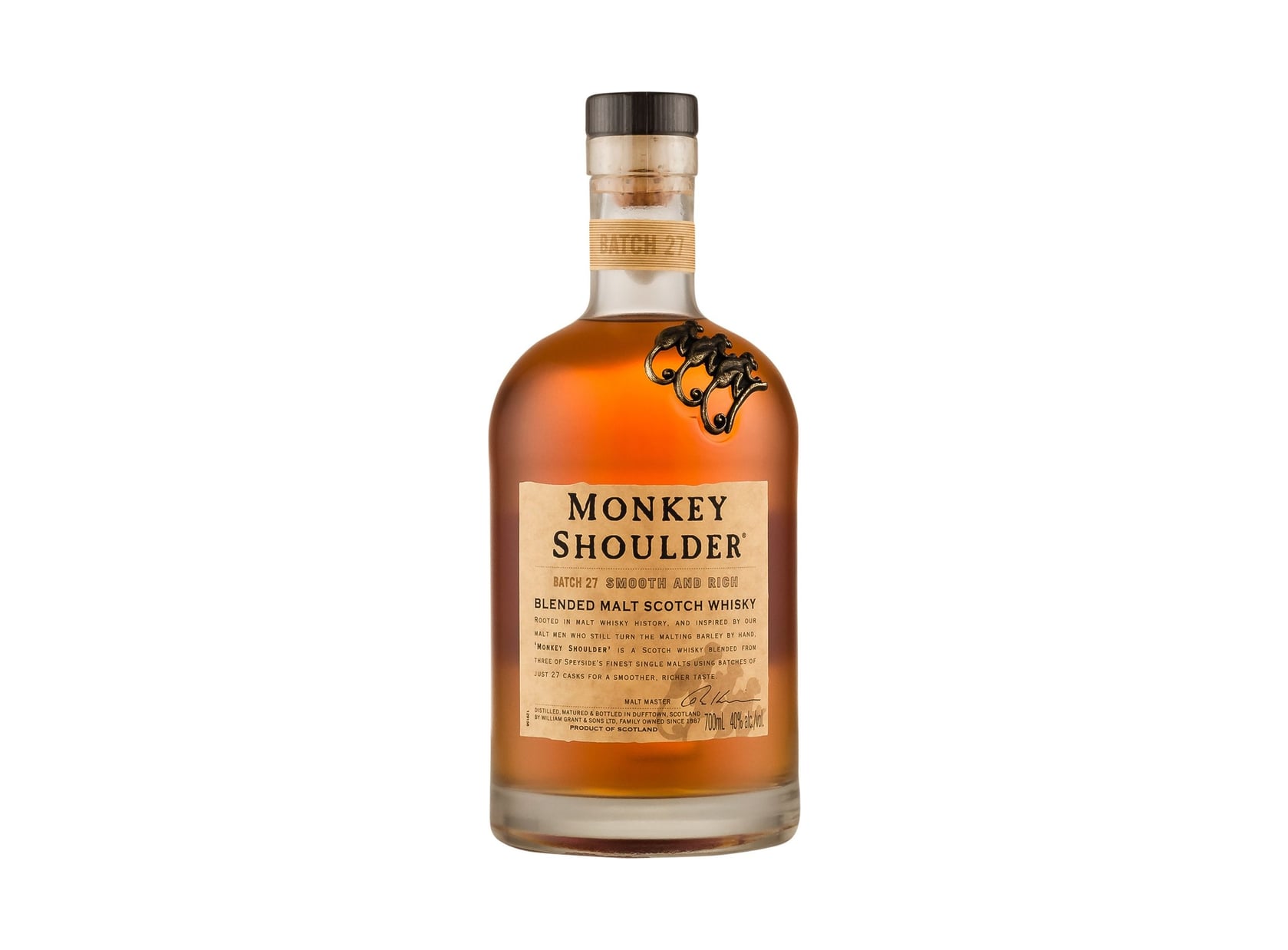
Three malts, no grain — a blended malt designed for cocktails and highballs.
Monkey Shoulder needs its name explained first. Whisky and monkeys have nothing to do with each other; the phrase comes from an old maltman's injury. Turning a floor of barley with a shovel for days on end would leave one shoulder drooping and the arm stiff, and the trade called it "monkey shoulder." Taking the hardship of hand-malting as a brand name means that, for all its breezy image, the roots are quite traditional.
Look at how it's made and its place becomes clear. Monkey Shoulder is a blended malt — three Speyside single malts woven together with no grain whisky. Because malts from the William Grant family such as Glenfiddich and Balvenie go in, it has more depth than a run-of-the-mill blend. And yet it's priced below a single malt bottle. Keep the depth, lower the barrier: the intent is unmistakable.
The most common misread is that it's "a lesser whisky than single malt." Monkey Shoulder was built in 2005 specifically with cocktails and highballs in mind, so its starting point differs from sipping solemnly neat. Its worth shows most in an Old Fashioned or Whisky Sour, or built cold into a highball. Judge it by the standard of a neat single malt and you've got the wrong address.
For a first bottle the Original is plenty, and there's no reason to insist on neat. Fill a tall glass with ice and build it cold with soda, and one drink explains why bartenders reach for it as a base. Want a little smoke — switch to Smoky Monkey and pour it the same way. As a starting point for whisky you mix without fuss, few options are this good.
Monkey Shoulder's value is purpose, not age or scarcity — a malts-only blend that gives depth yet is priced to mix freely in cocktails and highballs. Among bartenders it's a widely used whisky-cocktail base.
Prices are approximate retail / duty-free — not a personal tasting score
Monkey Shoulder is a blended malt of three Speyside single malts with no grain whisky. Glenfiddich, Balvenie and Kininvie — all under the same owner, William Grant — form its backbone, giving it more malt depth than a typical blend while landing on a soft vanilla, honey and marmalade. The point is purpose: it keeps a single malt's grain but is pitched, in price and flavour, to mix freely in cocktails and highballs.
A relatively young brand, launched in 2005 by William Grant & Sons. The name comes from 'monkey shoulder,' the strain injury maltmen got from turning barley by hand. From the start it was positioned not as a whisky to drink solemnly but as one to mix, quickly winning over bartenders and a younger drinking crowd.
Monkey Shoulder holds a clear spot as the 'mixing malt.' It's a widely used whisky-cocktail base in bars and fit the highball boom well. In other markets its easy price and soft profile make it a home-bar and beginner favourite. Anyone after a serious neat single malt may find it light — but that's the design, not a flaw.
Made to be mixed, the highball and cocktail are its real stage. Fill a tall glass with ice and build with soda at roughly 1:3–4, or use it as the base for an Old Fashioned or Whisky Sour. To nose it neat, a Glencairn or copita suits; at 40% water is rarely needed. The vanilla and marmalade ride the bubbles light and fresh.
Sources · Production & range — monkeyshoulder.com · History — William Grant & Sons · Product image — Monkey Shoulder