Tullamore D.E.W.
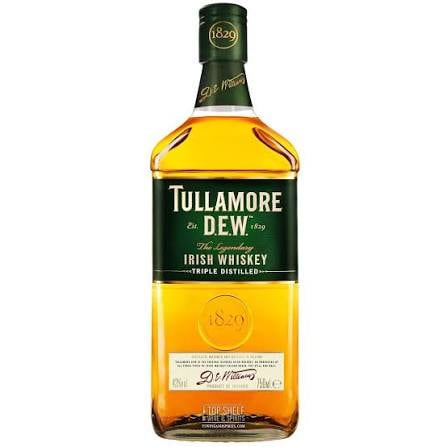
Ireland's number two after Jameson — a smooth triple blend of all three styles of Irish whiskey.
The D.E.W. sitting in the middle of the name is, in fact, a man's initials. Daniel E. Williams started at this distillery as a stable boy in the 19th century and ended up running it; he stamped his initials onto the whiskey, and a punning slogan — "Give every man his Dew" — followed. The name is, in effect, one man's rise from nothing, which is part of why the brand carries such local weight in Ireland.
What's interesting is that the where and the name drifted apart for a long while. The original Tullamore distillery closed in 1954, and for years the whiskey was made elsewhere. Only the brand survived, passing through several hands, until William Grant & Sons bought it in 2010 and built a new distillery in Tullamore in 2014 — finally making it in its home town again. After sixty years, the place the label names and the place it's actually made lined up once more.
"Triple blend" sounds like marketing, but there's substance to it. Irish whiskey splits broadly into three strands — pot still, malt and grain — and Tullamore D.E.W. combines all three. With no single strand dominating, the character resolves round rather than sharp. If you're hoping for heavy sherry or peat it can read as plain, but that very evenness is a real advantage as a highball or cocktail base.
For a first bottle, the Original is plenty: cheap, and chilled with soda it sits comfortably at any table. When you want more of the spirit's own grain, step up to the 12yo and meet the toffee and nut sweetness the sherry and bourbon casks add. Setting it beside Jameson is a good move too — both are smooth Irish whiskeys, but which one suits your palate is something only a side-by-side will tell you.
Tullamore D.E.W. rests on the broad popularity of a sensibly priced core range rather than top-end auctions. The Original is a value daily and highball pour, while aged and single-malt limiteds like the 18yo form the premium tier.
Prices are approximate retail / duty-free — not a personal tasting score
Tullamore D.E.W.'s signature is the triple blend. It combines all three strands of Irish whiskey — pot still (barley), malt and grain — for a smooth balance that doesn't lean any one way. Add the Irish tradition of triple distillation and it lands lighter and smoother than Scotch. It's a design aimed at an easy, rounded drink anyone can enjoy rather than a bold, singular character.
Founded in 1829 in Tullamore, in the Irish midlands. The brand's D.E.W. stands for Daniel E. Williams, who started as a stable boy and rose to run the business. The distillery closed in 1954, but the name lived on; in 2010 William Grant & Sons acquired it and, in 2014, opened a new distillery in Tullamore — making it at home again.
Tullamore D.E.W. is Ireland's number-two whiskey after Jameson, and sells especially well across the US and Europe. Light and smooth, it's used more as a highball or cocktail base than sipped neat. It carries less of a name than Jameson in some markets, but its low price and gentle profile are quietly widening its place as a beginner's and home-bar pour.
Light and smooth enough to take neat, it was made above all to mix easily. To read the aroma, reach for a Glencairn or copita; for a highball, fill a tall glass with ice and top with soda at roughly 1:3–4, served cold. The Original is 40%, so water is rarely needed. Aged lines like the 12 and 18 reward a neat pour in an aroma-gathering glass, where the toffee and sherry sweetness comes through.
Sources · Production & range — tullamoredew.com · Product image — Tullamore D.E.W.