
"A light bulb factory that started making drinking glasses" usually turns out to be a story a brand invented. With Shotoku Glass (松徳硝子) of Tokyo, it is simply what happened. And the fact is still there in the thickness of the glass.
Usuhari (うすはり) is 0.9mm thick. Thinner than a fingernail. What makes whisky drinkers talk about it isn't a nose-concentrating shape or a refractive index — it's the single sensation of the rim touching your lip and registering as almost nothing at all.

It started with light bulbs
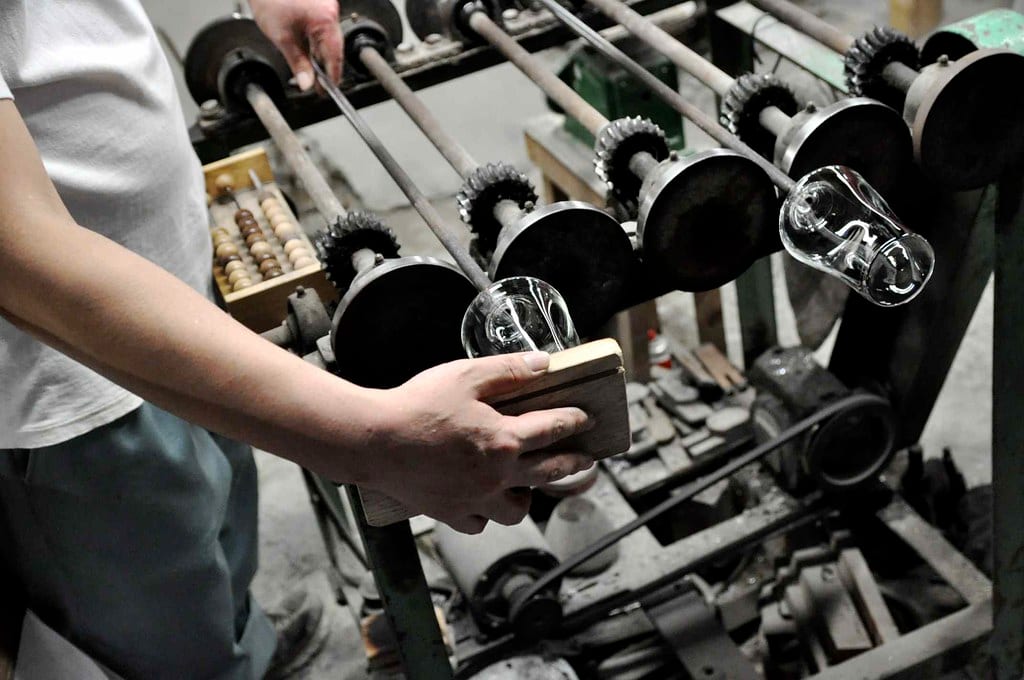
In 1922, Muramatsu Shotaro founded Marusa Valve Manufacturing in Tokyo. The product was glass for light bulbs. Bulb glass has to be thin, even in thickness, and free of bubbles. Too thick and it can't take the heat; thicker on one side and that's where it cracks. People blew it by mouth to that tolerance.
The company moved to Sumida ward in 1928, was folded into an electrical-glass venture with Matsushita Electric in 1942, and lost both its Tokyo and Osaka plants to the war in 1945. It re-formed as Muramatsu Glass in 1946, and in 1958 — the year the founder died — became Shotoku Glass, the name it still carries. By then machines had taken over bulb production. The skill of blowing glass thin by hand had nowhere to go.
Turning that skill toward tableware produced Usuhari in 1989. The name is a registered trademark, and the glasses are still mould-blown by hand. The company relocated to Minami-Senju in Arakawa ward in 2020; the method didn't change.

What 0.9mm actually changes
The claim that a thinner glass makes whisky taste better is only half true. Glass has no flavour of its own. But the way rim thickness intervenes in tasting is real. A thick rim meets your lip first and alters the angle and speed at which the spirit reaches your tongue. At 0.9mm that intervention nearly vanishes.
The point isn't lightness so much as the loss of a boundary. Tilting the glass, you don't feel a stage where the liquid crosses a rim — it simply arrives. That drinking sensation is why kappo restaurants and bars in Japan have used these glasses for decades.
The material is barium crystal: a lead-free crystal that gets its clarity and lustre from barium instead. Unlike European crystal with a high lead content, there's no leaching question hanging over it. The trade-off is that you also lose the heft and the bright ringing note that lead crystal gives you. An Usuhari glass makes almost no sound when you set it down, and almost no impression of weight in the hand. Some people find that thrilling. Some find it insubstantial.
For whisky, the Old line
The Usuhari range for whisky is the Old (オールド) series, in three sizes.
Old S — 65mm diameter × 75mm tall, about 180ml brimful
A good size for drinking neat. A 30ml pour sits shallow at the bottom, and the small bowl keeps aroma close. One or two cubes is the practical ice limit. Around ¥2,000 in Japan.
Old M — 77mm × 90mm, about 300ml brimful
The safe choice. Works neat, and takes a single large cube for a rocks pour. The list price sits around ¥2,200, which is why most people start here. If you're buying one glass, buy this one.
Old L — 87mm × 100mm, about 400ml brimful
Sized for a sphere of ice and an on-the-rocks serve. That combination comes with a caveat — see below.
For highballs, the tumblers
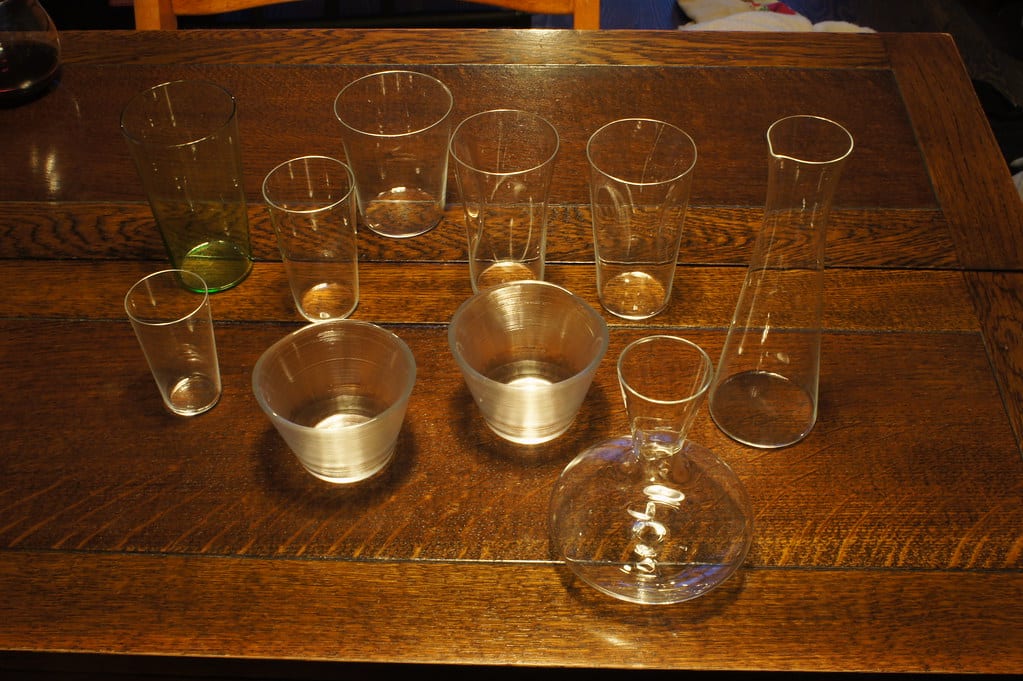
What Usuhari actually sells in volume in Japan is beer and highball glasses. The tumbler line runs across five sizes.
- SS — about 85ml. Aperitifs, a single neat mouthful
- S — about 150ml. Chilled sake
- M — about 260ml. Comfortable for building one whisky highball at a time
- L — about 375ml. The highball standard; room for ice and soda
- LL — about 510ml. Beer territory
Thin glass has a clearer advantage with carbonation. With no resistance at the lip, the bubbles break in your mouth exactly as they should. Set against the usual criteria for choosing a highball glass, Usuhari is the extreme that gives up insulation entirely in exchange for how it drinks. Because your hand's warmth transfers straight through, hold it low rather than wrapping your palm around the bowl.
Know this before you buy
It cannot go in a dishwasher. The maker says so outright. Hand wash only — and washing is where most of these glasses die. Push a sponge into the bowl and lean on it, and the wall goes. Following the standard glass care routine covers it, but this is undeniably a glass that asks for attention every day you use it.
It doesn't get along with ice. Thin glass is vulnerable to a localised knock. If you're in the habit of dropping cubes in, these won't last. Tilt the glass and slide the ice down the side instead. And because the wall is so thin, pre-chilling the glass buys you very little — the cold doesn't stay, so ice melts faster. Splitting duties works better: Usuhari for neat pours and highballs, a heavier glass for a rocks serve you intend to nurse.
It is not a nosing glass. The Old is essentially a cylinder, near-identical in diameter top and bottom, with no aroma-collecting geometry at all. To bury your nose in a glass and analyse, a Glencairn or copita is far better. Usuhari is built for how the drink arrives, not for reading it. Judged by nosing standards it will disappoint.
Where, and how much
The Japanese list price is around ¥2,200 for the Old M. As glasses go, that isn't expensive. The cost climbs on the way out of Japan: between official importers, parallel imports, and the packaging a fragile item demands, paying close to double the domestic price is common.
If you're ordering from abroad, take the two-piece paulownia box (kiribako) rather than singles. Usuhari's boxed sets are well established, breakage rates are visibly lower, and the box doubles as gift packaging. Where the Kagami Edo Kiriko among Japan's crystal houses builds value through cut pattern, Usuhari builds it in exactly the opposite direction — no decoration whatsoever, value carried entirely by thickness.
This is a glass you buy accepting that it will eventually break. If what you need is something rugged for daily hard use, this article isn't much help. But if you have the kind of evening where a measure gets poured and drunk slowly, very few glasses offer this much of a different experience for the money. Knowing what "thin is better" actually means is also the only way you'll start noticing the thickness of every other glass you own.