
Anyone who grew up in the Soviet Union has held this glass. Thick, heavy, with vertical cut facets running around its sides. The same one sat in canteens, at railway stations, in kitchen cupboards, and on street vending machines. Its name is the granyonyi stakan (гранёный стакан) — literally, "the faceted glass." It looks like nothing special, yet almost the whole everyday life of twentieth-century Russia fits inside this one cup.
The facets are not decoration
The vertical cut faces along the sides — gran (грань) in Russian — were not made to look pretty. First, the facets make the glass strong. The flat faces and edges spread out stress, and together with the thick base they let the glass survive a fall that would shatter most others. Its reputation as the cup that rolls off the table and stays whole comes from here.
The facets also make it easy to hold. It won't slip from a wet or greasy hand, and the edges keep it from rolling across the table. Catch the light and each face splits the reflection, lending even cheap pressed glass a little sparkle. Strength, grip, no rolling — a form that came from use rather than from design.
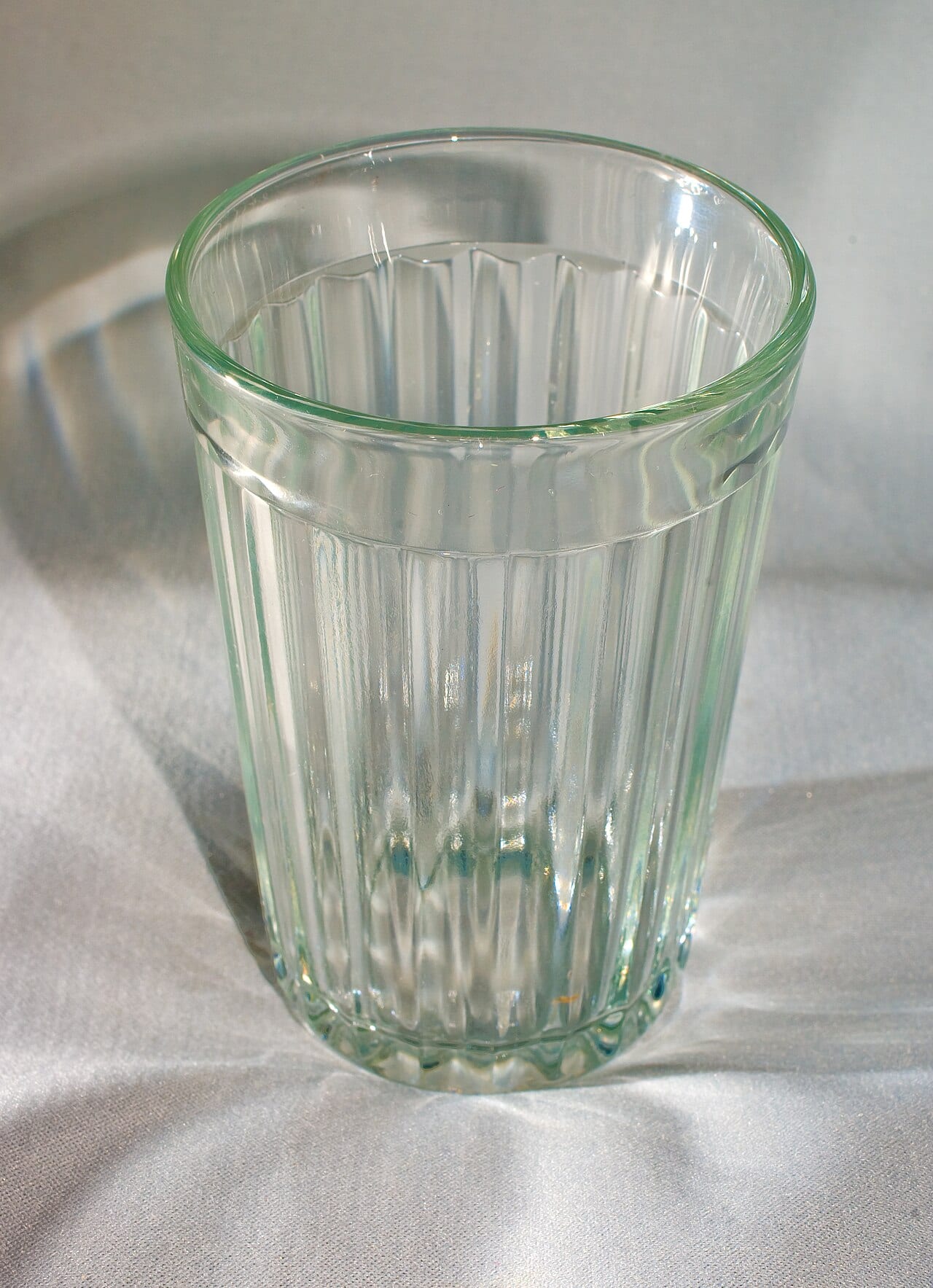
Vertical facets with a smooth band around the top. The number of faces was usually sixteen, but versions with ten, twelve, and twenty existed too. The facets are about strength and grip, not looks.
The smooth, facet-free band around the top wasn't left there by accident either. It softens the rim against the lips, and at the same time it works as a measuring line. That band is the key to the next part of the story.
A promise called 200 millilitres
The granyonyi stakan was a glass with a fixed standard. Filled to the smooth band, it held 200 millilitres; filled to the very brim, 250. Every Soviet citizen knew those two numbers in their hands.
Soviet cookbooks measured quantities not in cups but in stakany. "Two stakany of flour, one of sugar." Since every kitchen had the same glass, the glass itself became the standard measure. One cup of uniform size kept an entire country's recipes in agreement.
The standard carried into drinking, too. Vodka was sold in half-litre bottles, and split among three people it filled three granyonyi stakany to about the same level. From this came the phrase "soobrazit na troikh" (сообразить на троих) — literally "to figure it out among three." It meant three strangers pooling their coins outside a shop for a single bottle, then sharing it on the spot.
In an era that policed public drinking, this way of quickly dividing a bottle three ways became a custom of its own. The standard of the glass even decided the number of people. The granyonyi stakan was a vessel for drinking and, at the same time, a unit of sharing.
Who designed it — the Mukhina legend
Almost every account of this cup's design names one person: the sculptor Vera Mukhina (Вера Мухина) — the very artist behind Worker and Kolkhoz Woman, the colossal statue that symbolises Moscow. The standard story goes like this: in 1943, Mukhina redesigned the glass to be thick and sturdy enough to survive the new Soviet canteen dishwashers, and on 11 September that year the first ones came off the line at the glassworks in Gus-Khrustalny. That is also why Russia calls 11 September the "Day of the Faceted Glass."
But the story mixes fact with legend. Mukhina was certainly involved in Soviet glass and ceramic design in that period, yet the primary evidence that she personally designed this cup is thin, and historians dispute it. The dishwasher explanation, too, is often repeated but hard to pin down. What is clear is that in 1943 a glass of this standard began to be mass-produced at Gus-Khrustalny, and that its form became the Soviet standard for the next half-century.
An older lineage
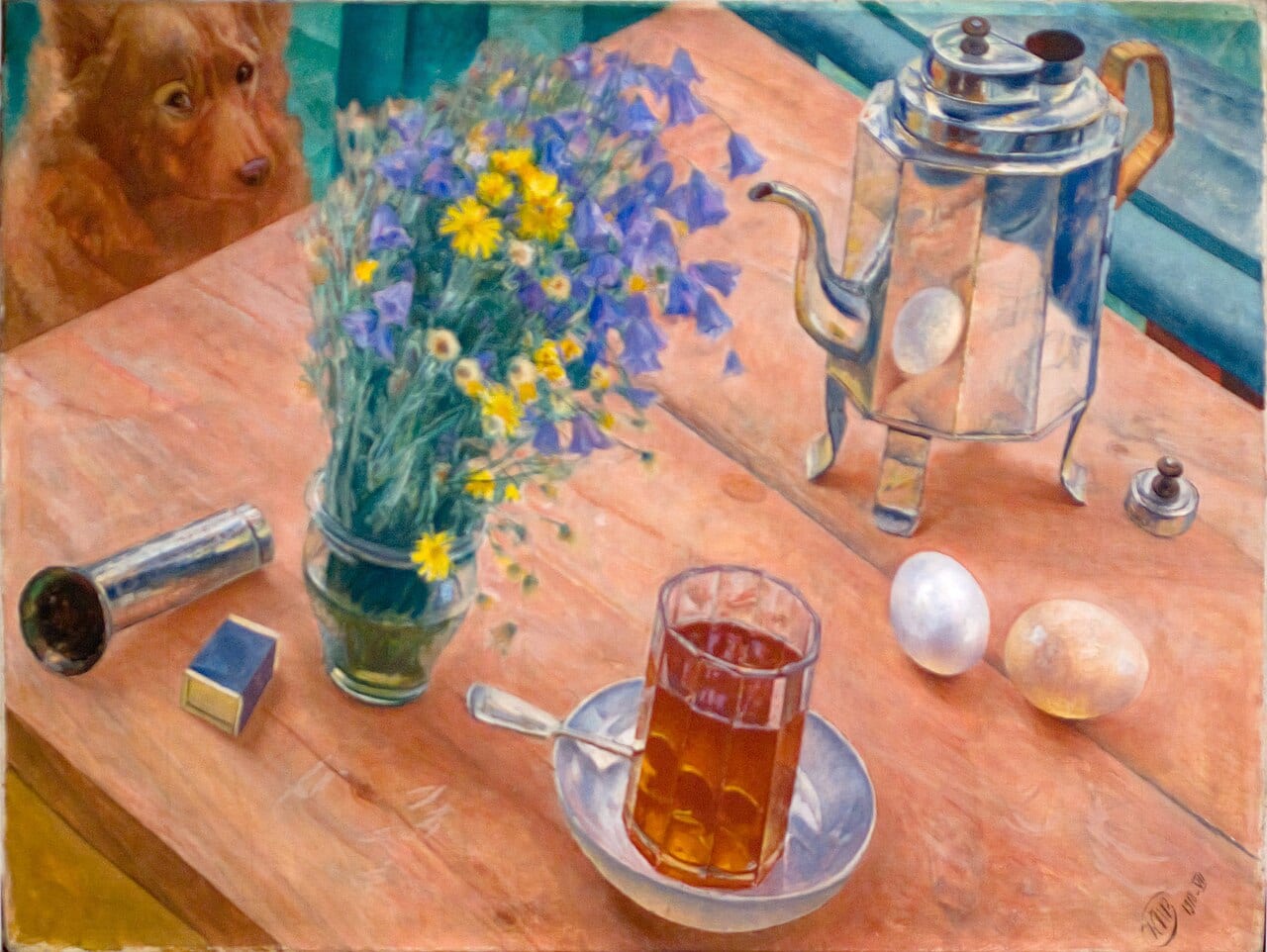
Kuzma Petrov-Vodkin, Morning Still Life (1918). The glass of tea on the saucer is a faceted one — already on Russian tables long before the Soviet standard was ever set.
The faceted glass itself was not a Soviet invention. Thick glasses with cut faces existed back in Imperial Russia. A faceted glass appears clearly in Morning Still Life, painted by Petrov-Vodkin in 1918 — well before the Soviet standard ever existed.
An older legend trails along with it. In the time of Peter the Great, the story goes, a glassmaker presented the tsar with a faceted glass, claiming it was unbreakable; Peter drank it dry and hurled it to the floor, where it duly shattered. Even so, the tsar is said to have liked the cup — and supposedly declared that "the glass shall be." It gets cited as the origin of the Russian custom of smashing glasses at the table. How much is true, no one can say, but it is clear that the faceted cup was already familiar in Russian hands long before the USSR. The Soviets did not invent it; they only standardised it.
The communal glass chained to the street
The granyonyi stakan was at its most Soviet out on the street. Across the cities stood soda-water vending machines: drop in a coin and out came carbonated water, plain or with syrup. There were no paper cups. Instead a single granyonyi stakan stood beside the machine, sometimes chained to it. You rinsed it upside-down on a little fountain there, and the next person drank from the same glass.
Strangers drinking from the same cup dozens of times a day — alarming by today's notions of hygiene, but ordinary then. A glass that belonged to no one and to everyone. Few objects capture Soviet collectivism as neatly as this shared cup.

A street soda-water (gazirovannaya voda) machine in the Soviet era. In place of paper cups, people drank from a communal granyonyi stakan — one person rinsed it, the next drank from the same glass.
It was the same in the canteens (stolovaya), where hundreds of identical glasses stacked up to hold tea, kissel, and compote. Cheap, sturdy, everywhere, and belonging to no one — the granyonyi stakan was itself a small specimen of the equality the Soviet Union aspired to. No costly glasses, no precious ones; everyone drank from the same cup.
What the ordinary left behind
When the Soviet Union fell, this cup left the stage with it. Disposable cups and a variety of glassware arrived, the habit of drinking from a shared glass disappeared, and the vending machines vanished along with it. A cup that once filled the tables of a whole country became something you now see only at flea markets and in a grandmother's cupboard.
Yet it is precisely that ordinariness that turned the granyonyi stakan into an object of nostalgia. The thickness that wouldn't break, the familiar weight, the promise of 200 millilitres, the single glass shared with strangers on the street. Inside it sit the thrift and the collective feeling of an entire era. A glass is usually remembered by the drink it held; this one is remembered by the time it held. A nation's daily life, etched into sixteen cut facets.
Faceted glass (granyonyi stakan) — George Shuklin / Wikimedia Commons (CC BY-SA 1.0) · Morning Still Life (1918), Kuzma Petrov-Vodkin — Public domain (Wikimedia Commons)