
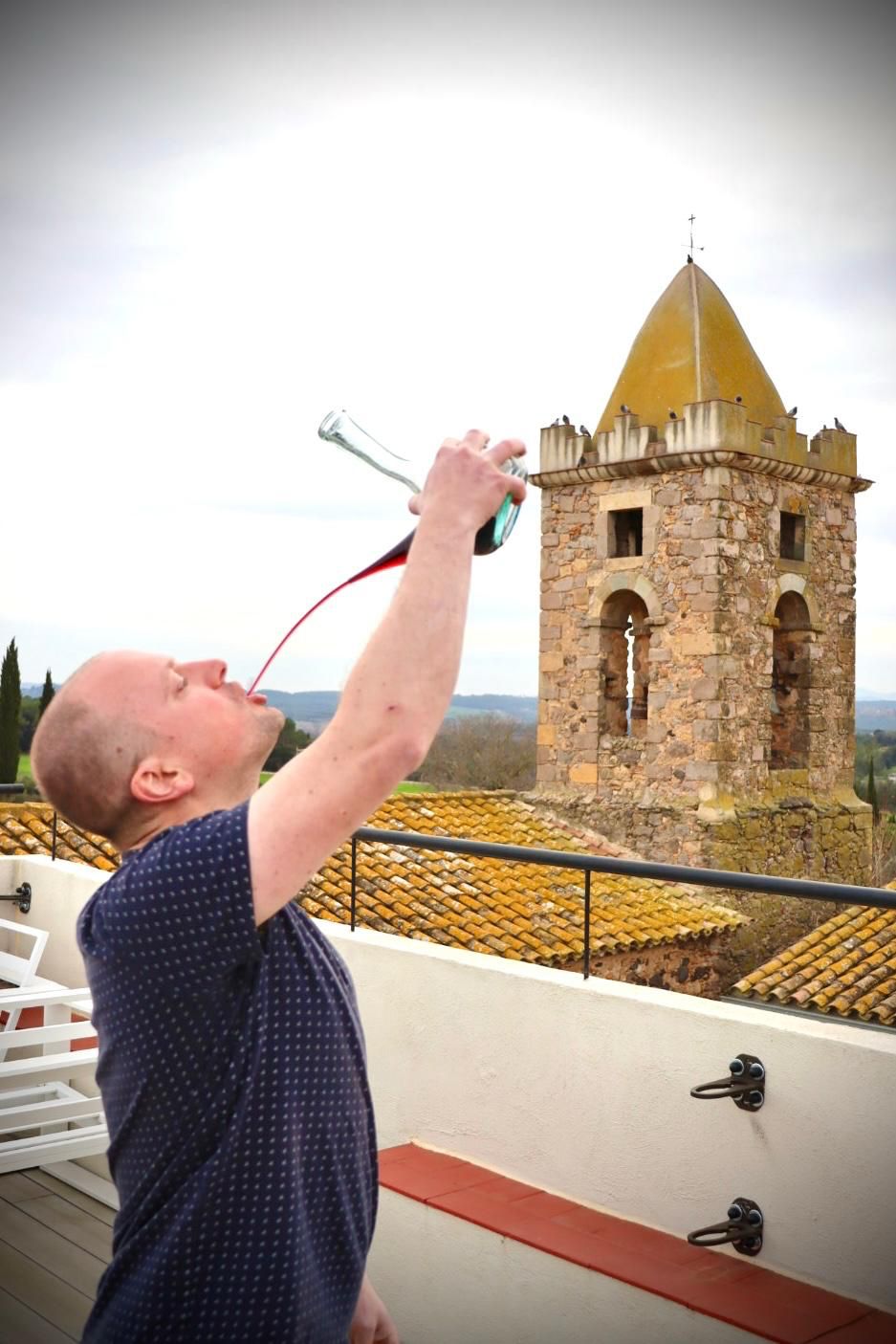
When a glass pitcher starts moving hand to hand around a table near Barcelona, first-timers usually freeze. You hold this long, pointed pitcher a hand's width from your face and catch a thin stream of wine in your mouth. Your lips never touch the spout. This is the porrón (Catalan: porró), a wine vessel used for generations across Catalonia and other parts of Spain.
It looks like a stunt, but it's a deeply practical object. No separate glasses are needed, one container serves a whole table, and nobody's mouth ever touches the spout. That seemingly showy way of drinking is, in fact, the entire point of the thing.
The pour is the first test
The technique is simple to describe. Hold the porrón with the pointed spout aimed at your mouth and start with it close to your lips. Once the stream is steady, slowly extend your arm and move the vessel away from your face. The farther it goes, the longer the arc of wine — and that arc is half the fun. To stop, bring it back toward your mouth and tip your wrist up to cut the stream.
The trouble is that it's only simple on paper. A beginner's first attempt almost always ends with wine running down the chin and onto the shirt. In Catalonia that pink stain is treated as a kind of rite of passage. Nobody mocks the person who drinks well; everyone laughs with the one who spills — and that laughter is exactly what loosens up the table. The porrón is a drinking tool and an icebreaker at the same time.
Not everyone was won over. George Orwell, writing in Homage to Catalonia (1938) about his time in the Spanish Civil War, grumbled about the porrón at length. He described it precisely — "a sort of glass bottle with a pointed spout from which a thin jet of wine spurts out whenever you tip it up; you can thus drink from a distance, without touching it with your lips, and it can be passed from hand to hand" — and then admitted the things looked to him "altogether too like bed-bottles, especially when they were filled with white wine," and that at first he went on strike and demanded a cup. Read nearly a century later, you can still feel a newcomer's discomfort in every line.
Why it has two spouts
Look closely and a porrón has two openings. The wide one on top is for filling it with wine; the long, slender, pointed spout drawn out from the side — pitorro in Catalan — is the one you drink from. That tip has to be narrow so the wine comes out as a thin, even stream; too wide and you couldn't catch it. The base is broad and heavy, so it stands on a table without tipping.
Most are made of glass — part of the appeal is watching the wine and the stream right through it. Some are earthenware, though, and clay keeps the wine cool through evaporation, which earns its place at an outdoor lunch in the midday summer heat.
This "drink without touching" method isn't unique to the porrón. Spain has the bota, a leather wineskin you squeeze to send a stream into your mouth from a distance, and Catalonia has the càntir, a clay jug used to drink water the same way. They're all one family sharing a single idea.
From the Roman horn to the porrón
It's hard to say exactly when the porrón appeared. The oldest surviving examples are dated to the late 14th and early 15th centuries, from around the monastery of Poblet in Tarragona, Catalonia. But the underlying idea — catch a stream in your mouth without touching the vessel — is far older. Joan Amades, the folklorist who spent a lifetime documenting Catalan customs, traced the porrón back to the Roman drinking horn, the ritón (rhyton). Examples have been excavated with a hole pierced at the tip, suggesting they served as both cup and pourer. The Mediterranean world, in other words, had been sharing wine this way for a very long time.
The glass porrón we know owes a great deal to Catalan glassmaking. From the 15th century the region adopted Venetian techniques — façon de Venise — and peaked in the mid-16th century, and it was in that current that the porrón shifted from clay to glass. A rough vessel once carried into the fields became a clear, mouth-blown bottle. One such Venetian-style glass porrón, thought to have been made in Barcelona, survives today in the collection of the Metropolitan Museum of Art in New York.
Not touching it with your lips
In the end the porrón comes down to this one thing: no mouth ever touches the vessel. So a dozen people can pass one around without a second thought. No mixed saliva, nothing to put anyone off, and no need to line up a glass for every guest. Long before any of us said the word hygiene, this vessel had already solved "share a drink without it being gross" with nothing but its shape.
The etiquette follows from that. Don't let your lips touch the spout. The moment one person does, everyone after them is stuck, and the whole reason a porrón is a porrón is gone. And when you're done, cut the stream cleanly before handing it on. It's barely a set of rules — just the minimum agreement that makes drinking together possible.

The vessel that circles the table
The porrón is most at home at an informal meal. Go to a calçotada — the Catalan springtime feast where you eat charred calçots (a kind of sweet long onion) with your hands, dipped in sauce — and the porrón is never far away. Hands are messy with sauce, there are a lot of people, and the mood is loud. A single porrón doing laps of the table suits that scene far better than filling and passing individual glasses.

It was pushed aside for a while as something old-fashioned, but lately bars and restaurants in Barcelona have been deliberately bringing the porrón back. People rediscovered that passing one container around gets strangers talking fast. Sharing a single vessel has that effect.
If Scotland has the quaich, passed with both hands, Spain has the porrón, which circles without touching anyone. The quaich is a cup of trust handed person to person; the porrón is shared at a distance. The two reach sharing from opposite directions, but they land on the same conclusion: a drink isn't meant to be had alone.
You learn it with your body in the end. Start close, then move farther out as you gain confidence. Lips off the spout, and cut the stream cleanly when you're done. Accept that a few pink stains come with the territory. Orwell never did warm to the thing — but the fact that he disliked it and still described it in such loving detail tells you how striking it must have been. So when the porrón comes around at a Spanish table, don't try too hard to look good — spill once on purpose. That's where joining the table actually begins.
Orwell's description of the porrón — George Orwell, Homage to Catalonia (1938) · On the porrón's origins (the ritón and Joan Amades), the oldest surviving examples (Poblet), and Venetian-style glass — drawing on Wikipedia "Porron" and the Metropolitan Museum of Art's catalogue entry.