

Have a look at this first.
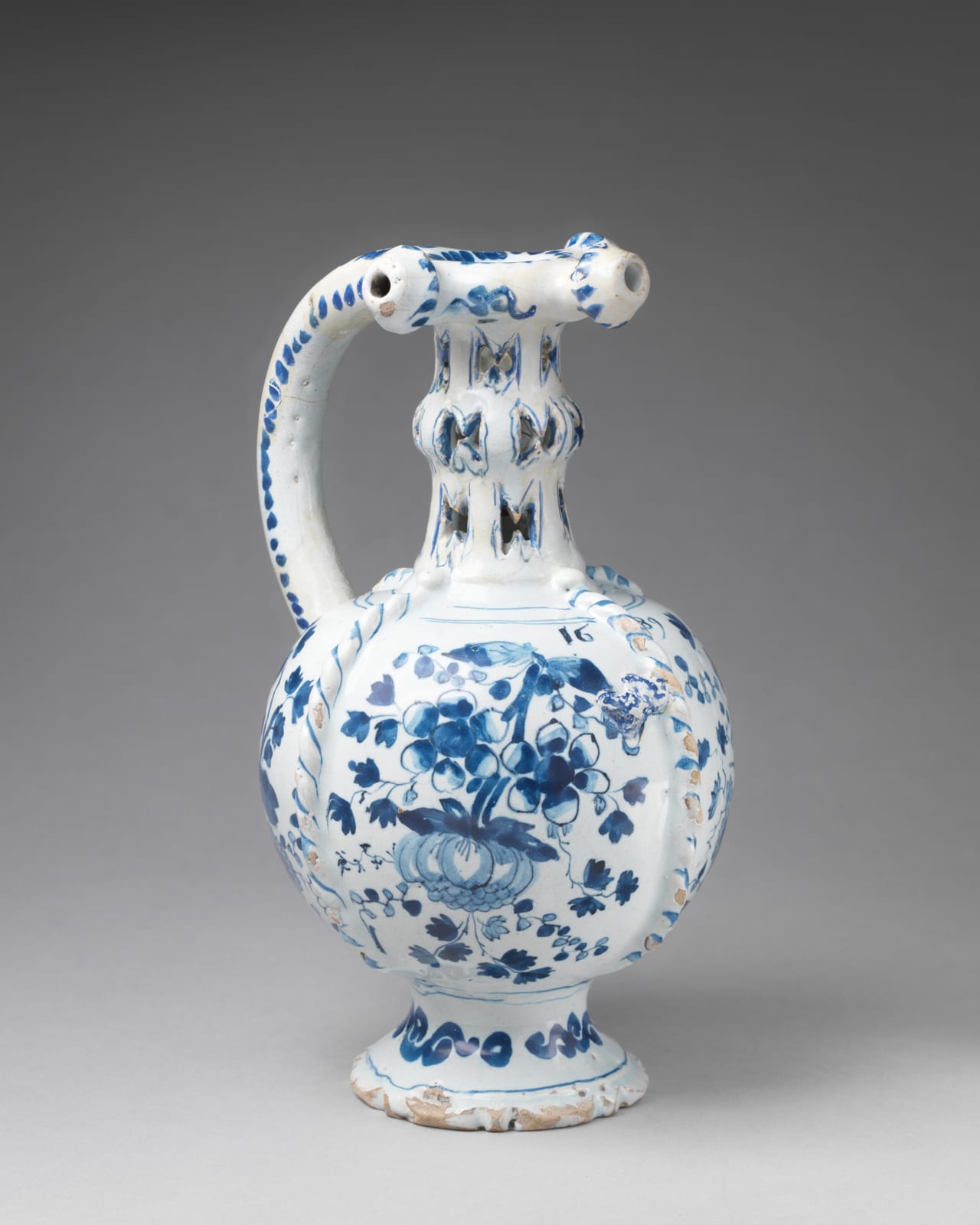
A round-bellied pottery jug. But something's off about the neck. It's pierced with rows of holes, so it's less a neck than a basket. On the rim sit three little tubes, like teapot spouts shrunk down.
Say someone fills this with beer and puts it in front of you. One condition: drink it without spilling a drop.
Tip it, and the beer pours out through the holes. Try to drink from the mouth and it's the same story. To reach your lips the beer has to get past the neck, and the neck is mostly holes.
Have a think about how you'd do it before reading on.
The handle is a straw
You suck on a spout. But not just any old way.
The rim of a puzzle jug is a hollow tube. It runs all the way round the mouth, and the little spouts on the rim all connect to it. The tube then runs down into the handle, which is hollow too. And the bottom end of the handle opens into the body of the jug, close to the base.
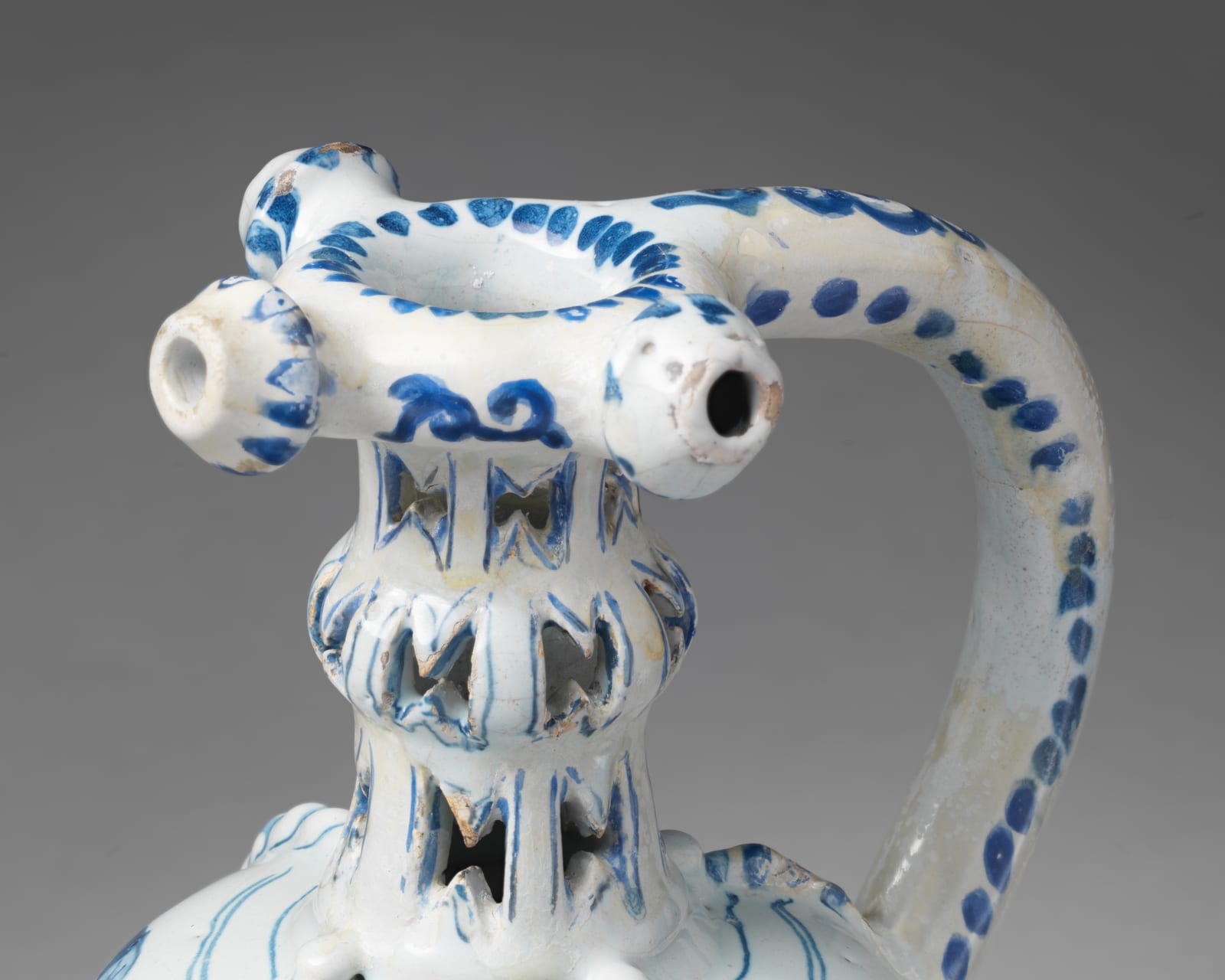
So the whole jug is one bent straw. You draw the drink from the bottom, up through the handle, round the rim and out of a spout.
The trouble is that this straw has several holes in it. With three spouts you can only put your mouth on one, so the other two let air in. And if a straw has a hole in its side, you can suck all you like and you'll just get air. Anyone who's tried knows.
So you cover the other spouts with your fingers. That's still not enough. Somewhere on the handle there's one more tiny hole, usually somewhere you won't notice, like the inner face near the top or the joint at the bottom. Only once that's covered too is the tube sealed, and only then does sucking bring the drink up.
The London Museum sums up the method in a line: cover every spout but one, plus the small hole at the base of the handle.
If you're thinking you've run out of fingers, you've understood it. One hand holds the jug, the fingers of the other cover two spouts and the hole in the handle, and your mouth takes the last spout. The odds of a newcomer working that out in a pub are not great.
It isn't a siphon
Plenty of descriptions say the handle works "like a siphon". Strictly speaking, it doesn't.
A siphon only runs on its own if the outlet is lower than the surface of the liquid, and once it's going you don't have to do anything. On a puzzle jug the outlet, the spout, is up on the rim, above the drink. Stop sucking and the drink sinks back down the handle. When you suck you lower the pressure in the tube, and the air pressing on the surface of the drink inside the jug pushes it up. That's a straw. It's also why the hole in the handle has to be covered: leave it open and the pressure never drops.
There is a drinking cup that really runs on a siphon, and that's the Korean gyeyeongbae. Pour past the line and the drink runs through a U-shaped tube in the post inside the cup and drains out of the bottom. The gyeyeongbae takes the drink away from someone who got greedy. The puzzle jug soaks the shirt of someone who didn't know the trick. Both look like toys, but they're saying different things.
I'll hold a wager
Many puzzle jugs have verses painted on the body. Usually they're a dare.
A Liverpool jug from around 1765–1770 in the Victoria and Albert Museum reads:
"Here Gentleman come try your skill / I'll hold a wager if you will / That you dont drink this Liquor all / Without you spill or let some fall"
A jug from the same museum, probably made in Bristol around 1770–1775, keeps it shorter:
"TRY HOW TO DRINK / AND NOT TO SPILL / AND PROVE THE / UTMOST OF YOUR SKILL"
The "Here Gentlemen come try your skill" verse turns up with small changes on a number of Liverpool jugs. A Liverpool jug of about 1755 at Colonial Williamsburg carries a verse that starts "Fill me with Ale Wine or Water", and the foundation notes that it was popular enough to appear on several examples. Potters, in other words, reused lines that sold.
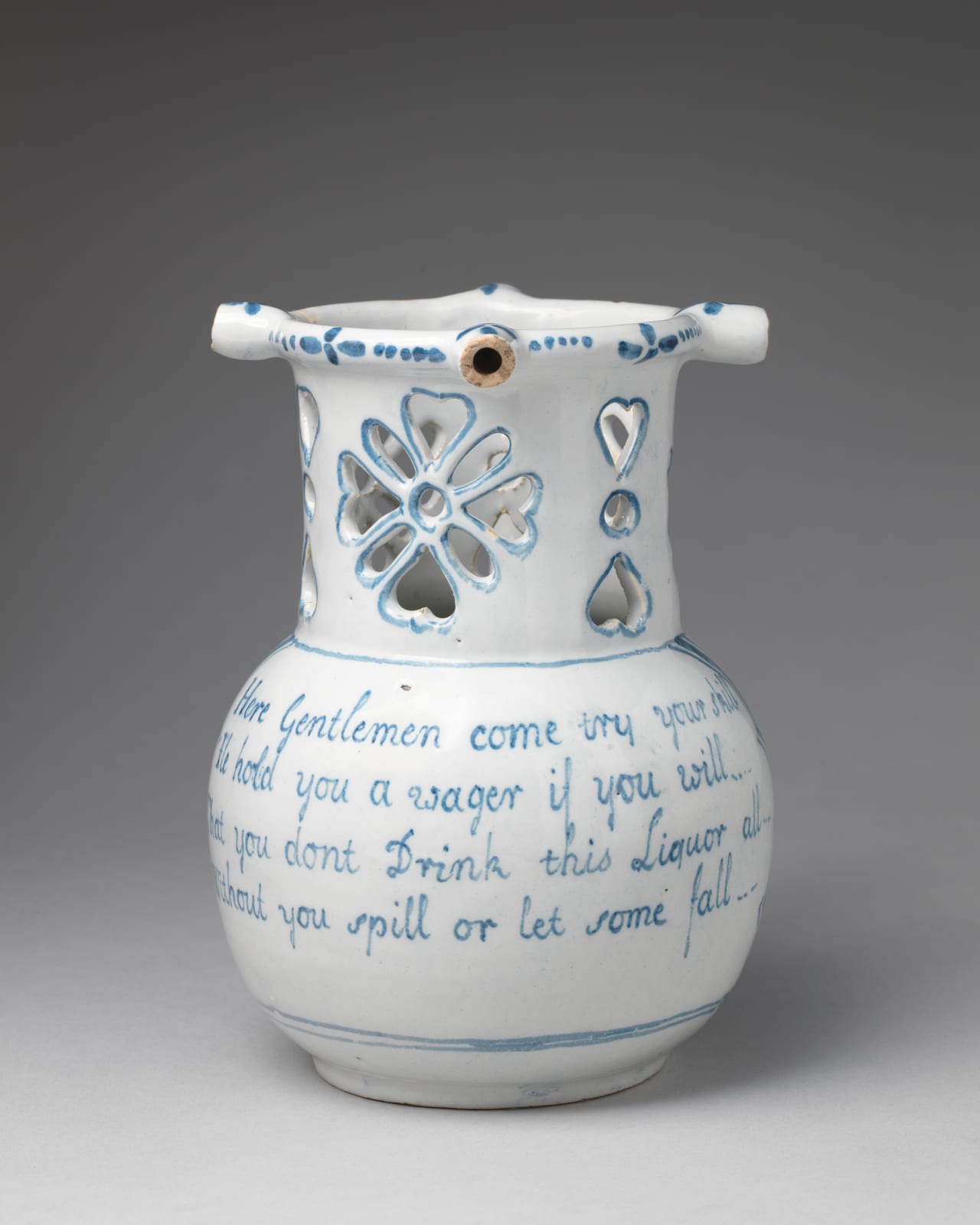
What the verses tell you is that this was a tavern object. A regular offers a newcomer a drink, the newcomer pours beer down his front, everyone laughs and the regular collects the bet. In England they were also called teasing pitchers or wager jugs. Some had an extra hole hidden below the neck or under the handle, to catch out people who thought they already knew the answer.
A joke that became a wedding present
That doesn't mean they were thought of as cheap novelties.
In the 17th century a lot of puzzle jugs were made south of the Thames in London, around Lambeth and Southwark. They're delftware: tin-glazed to a white surface and painted in blue, a technique that came over from Delft in the Netherlands, where potters had been imitating Chinese blue-and-white porcelain.
The London Museum has one of these, inscribed "I N M 1655". The museum thinks it marks the wedding of John Noate and Margaret Champion at St Peter, Paul's Wharf, on 8 August 1655. "I N" is John Noate and "M" is Margaret. A trick jug as a wedding present. Perhaps it came out every time someone visited the newlyweds.
The Gardiner Museum in Toronto has a jug with a portrait of Charles II and the letters "CR2", which the museum thinks was probably made for his coronation in 1660. The year the monarchy came back, someone made a drinking-wager jug with the king's face on it. As ways to celebrate go, it's a cheeky one.
It started with cups stuck together
The puzzle jug has a relative called the fuddling cup. To fuddle is to make someone drunk.
It's three or four little vase-shaped cups joined together with twisted handles. Inside, the cups are linked by holes in their bodies, so if you try to drink from one, the others drain through it too. You can't have just one: it's all or nothing. The fuddling cup at the Fitzwilliam Museum in Cambridge was made in London around 1630–1650, and the one at the Gardiner Museum is dated 1639.
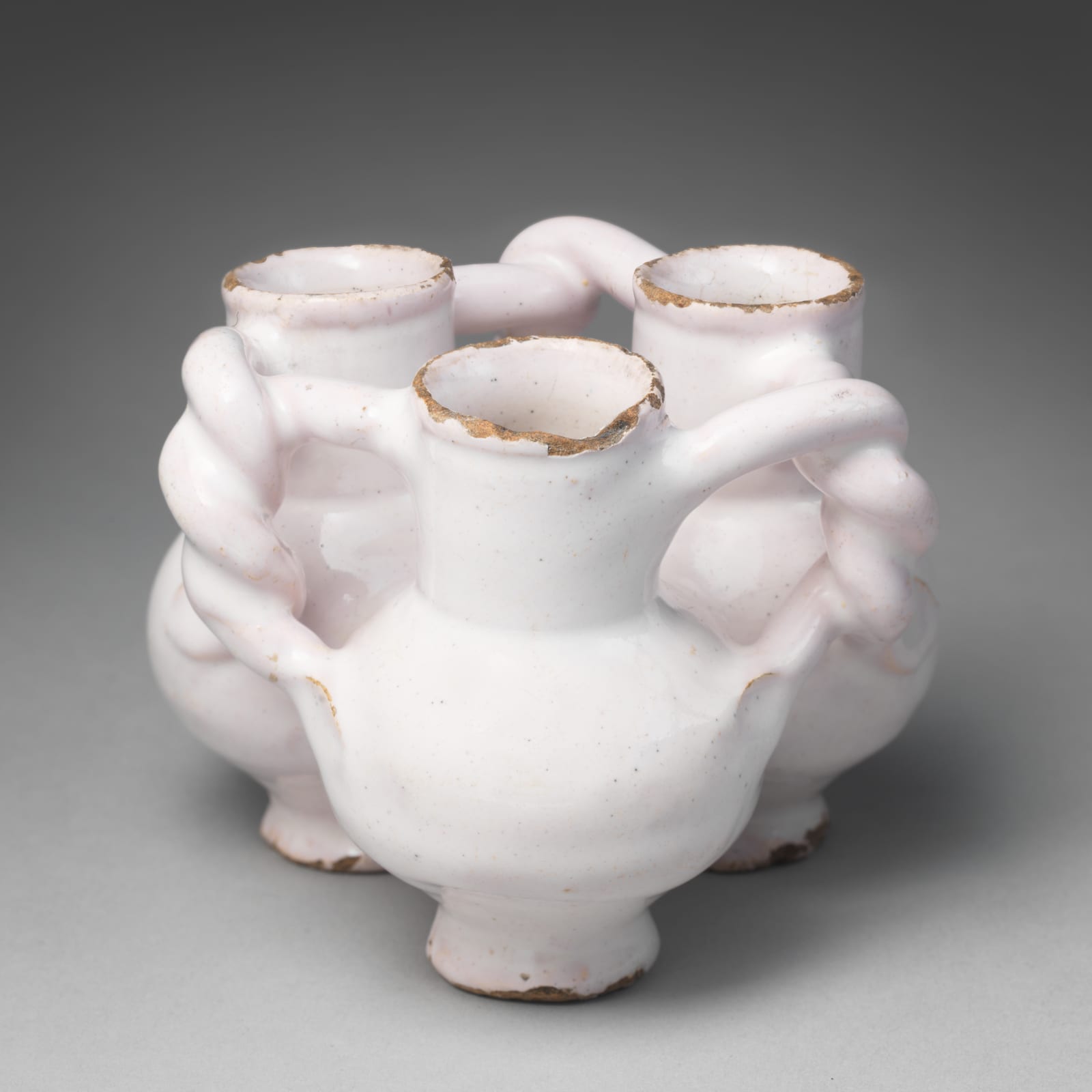
The fuddling cup is a joke on "just the one", and the puzzle jug is a joke on "I know how to drink". The same potters in the same part of town made both, at the same time.
A 700-year-old jug that mocks bishops
The jug usually named as the oldest puzzle jug in England is the Exeter puzzle jug at the Royal Albert Memorial Museum (RAMM) in Exeter, Devon. It was made around 1300 in the Saintonge region of western France and crossed the sea to Exeter. It was found in pieces in South Street, Exeter, in 1899 and put back together by a British Museum conservator in the 1930s.
The body is a tower several storeys high. Young women lean out of the windows, and on the lower level musicians play. And there are two bishops holding croziers. According to the museum, these bishops, inside the jug, are naked. It reads as a dig at the morals of the medieval clergy. The museum suggests its owner might have been a bishop with a sense of humour, or someone who wanted to poke fun at the Church.
The museum is also clear that this isn't strictly a puzzle jug. It has none of the concealed holes that make the drink spill. It just has a hollow handle the drink can flow through. And the 1930s restoration was heavy: X-rays show that parts of the handle and some of the figures are 20th-century additions. So the title "oldest puzzle jug" comes with a footnote. It's more of an ancestor of the trick jugs that followed.
Still being made
Puzzle jugs went on being made across England and northern Europe, with a revival in the late 18th and early 19th centuries. They sat on tavern tables and, in time, came into people's homes for drinking games with guests. Many are simple country pieces, like those from the potteries at Buckley in Wales.
Potters in Britain and the US still throw them today. The V&A filmed the ceramicist Michelle Erickson recreating a jug from its collection, including the moment she makes the hidden hole and passage under the handle. Even knowing how it works, watching someone put that hole in is a little annoying.
If you ever come across a puzzle jug in a museum, look at the handle first. Somewhere there'll be a hole about the size of a pinprick. Three hundred years ago, the people who didn't find it went home with wet shirts.
Victoria and Albert Museum, puzzle jug records (Liverpool c. 1765–1770; Bristol, 275-1896) and "How was it made? A puzzle jug" · Michael Archer, Delftware: The Tin-Glazed Earthenware of the British Isles, V&A, 1997 · London Museum, puzzle jug (1655) record · Gardiner Museum, Charles II puzzle jug and fuddling cup records · Fitzwilliam Museum, fuddling cup record · Royal Albert Memorial Museum, Exeter Puzzle Jug record · Colonial Williamsburg Foundation, puzzle jug (c. 1755) record · The Metropolitan Museum of Art, puzzle jugs (45.12.10, 30.70.3) and fuddling cup (38.73.11) records