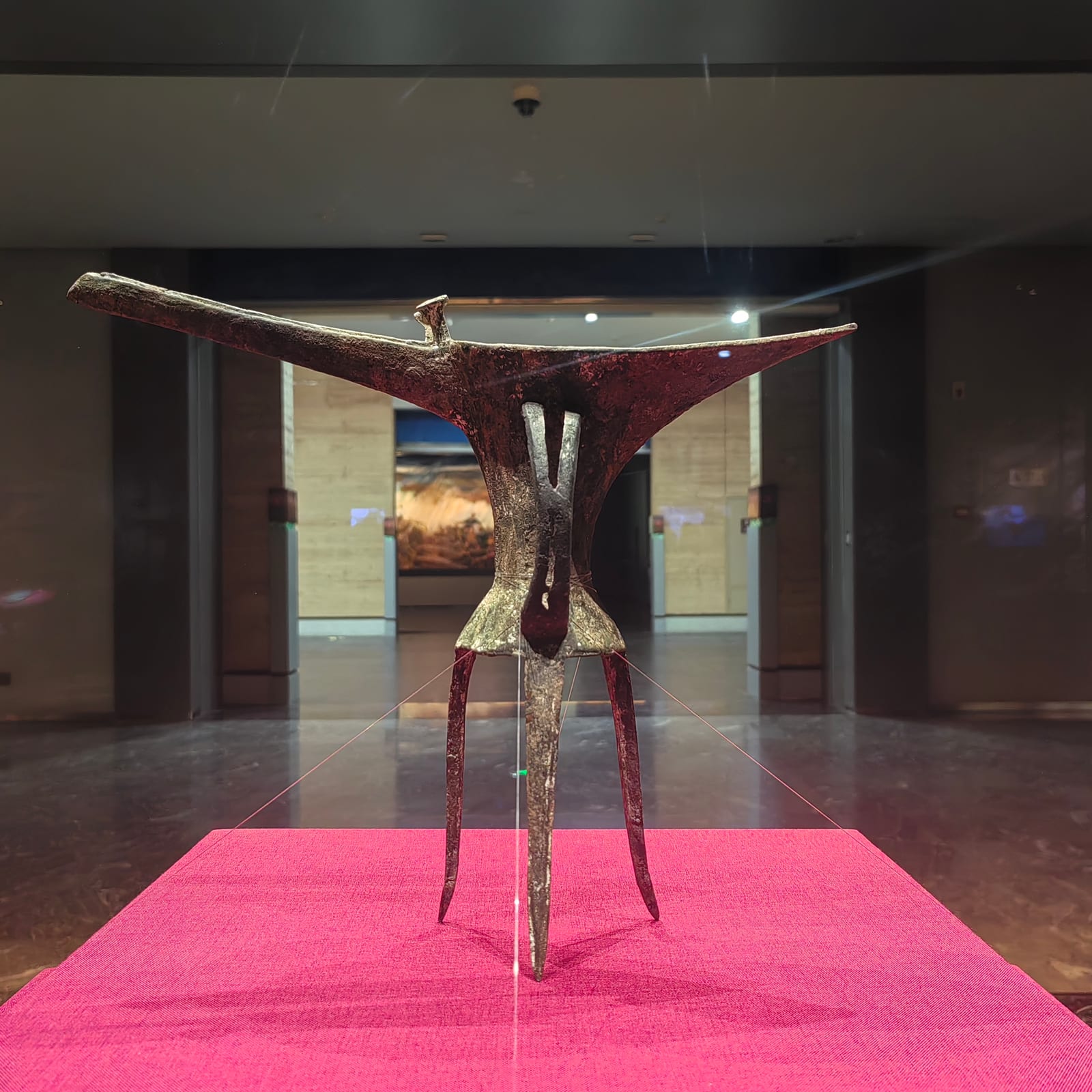
Spend any time in a museum of Chinese art and you'll run into this bronze. Three thin legs splayed outwards. A long spout on one side, a pointed tail on the other. A handle on the flank. And on the rim, just where the spout begins, two little posts sticking up like mushrooms.
It's called a jue (爵).
There's a story that always comes with it. Those two posts, people say, are there to make you drink in moderation. Put your lips to the spout and tip your head back to finish it off, and the posts catch your face. The bridge of your nose, your eyebrows, your eyes. So you're meant to sip, not drain.
It's a good story, and quite an old one. Whether it's true is another matter.
The eyebrow line comes from the Qing
One of the first people to put this clearly in writing was the Qing scholar Duan Yucai. In the late eighteenth century, annotating the ancient dictionary Shuowen Jiezi, he wrote under the entry for 爵:
"Checking against the ancient jue that survive today, when the two posts touch the eyebrows, the wine is finished… One empties it without raising the head; the measure is taken from the posts touching the brows."
Touching the eyebrows, then, not stabbing the eyes. Throwing your head back was bad manners, so the vessel was built so that you could finish it by tilting only as far as the posts meeting your brows. That reads less like a warning against drunkenness and more like a note on how to drink with dignity. Somewhere in the retelling it seems to have grown into "the posts block your face" and then "the posts poke your eyes".
The idea of moderation goes back further. The Shuowen Jiezi itself, compiled in the early second century, says this:
"The jue is a ritual vessel. It imitates the shape of a sparrow… The vessel is made like a sparrow for its call, jie jie zu zu."
The word for the vessel, 爵, and the word for sparrow, 雀, were related and sometimes interchangeable in old texts. And the sparrow's chirp, jie jie zu zu, written 節節足足, can be read as "restrain, restrain; enough, enough". A pun, essentially. So people in the Han dynasty were already reading moderation into this vessel. By then, though, nobody had used a bronze jue for over a thousand years.
It may not have been a drinking cup at all
Whether you were ever meant to put your mouth on a jue is itself an open question.
Think about it for a second. The spout is long and narrow. Put your lips to it and the wine would run down the channel into your mouth, but not comfortably. The handle sits on the side, so when you lift and tilt, the spout points forward. It's shaped for pouring.
The legs are odd too. Why would a cup need three legs, long ones splayed outwards at that? The answer is on the bottom. Jue excavated from Shang sites in Zhengzhou, Henan, have soot on their bases. They were put over a fire. Some early ones from Erlitou even have holes near the base to let the smoke draw. The jue warmed wine.
That's why many scholars now see the jue as a ritual vessel for warming and pouring wine: heating it to offer to the spirits, or pouring it out on the ground. The historian Sun Ji argued that the idea of the jue as a "drinking vessel" was something later centuries settled on. And it's hard to picture putting your lips to bronze that has just come off the fire.
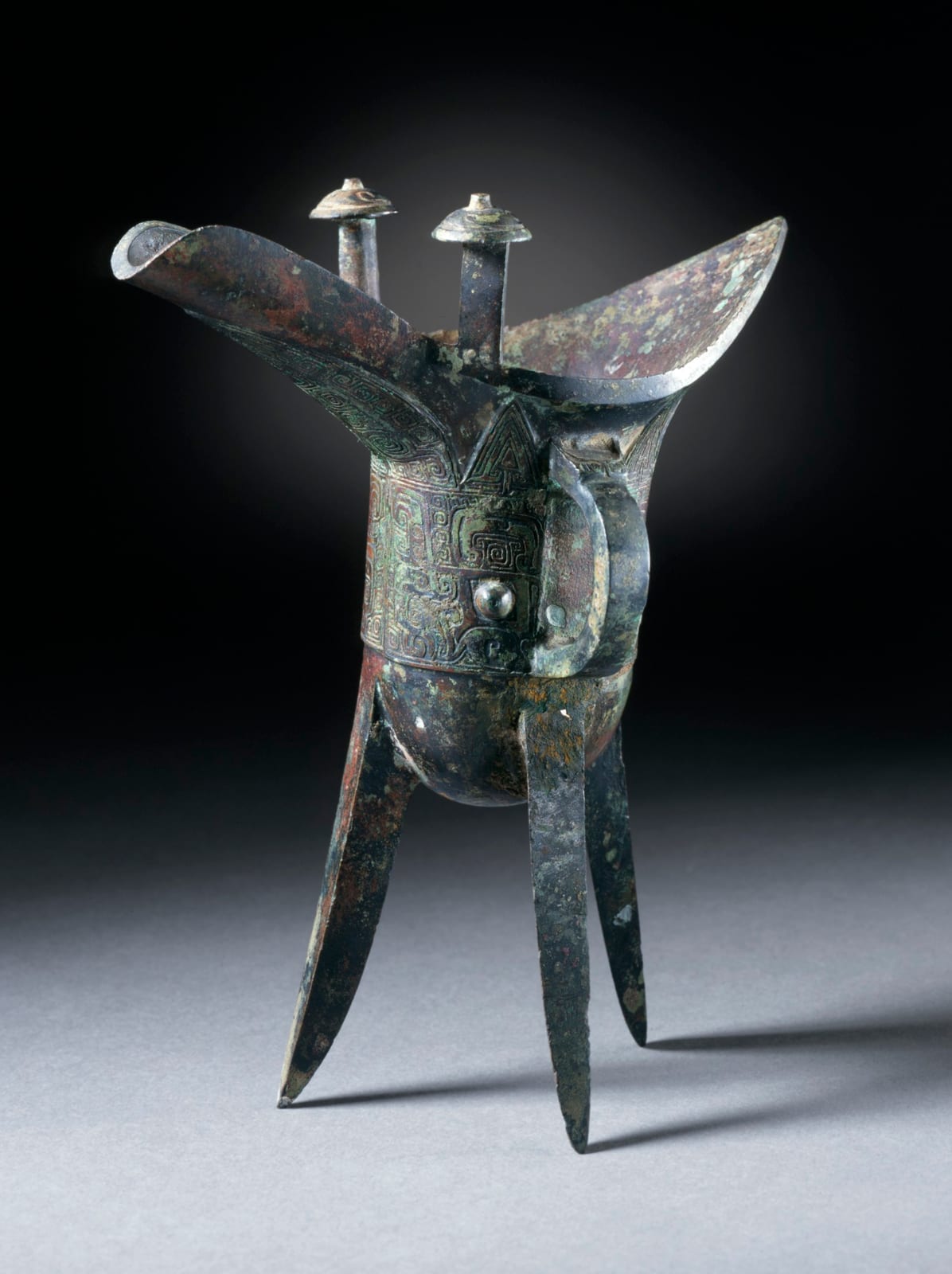
So what were the posts for?
Nobody knows. That's the honest answer. There are a few theories, though.
Lifting handles. A jue warmed over a fire gets hot, too hot to grab by the handle. So you'd hook a stick or tongs under the posts and lift it that way. The researcher Jia Hongbo argued that as the jue was used more and more for warming wine, the posts grew taller and more practical. A related idea has them holding a cord for hanging.
A filter rack. This one comes from Ma Chengyuan, the bronze specialist and former director of the Shanghai Museum. Wine at the time wasn't clear. It was a cloudy brew with grain husks floating in it. Drape a cloth over the posts, pour through it, and the dregs stay behind.
Just decoration. There's pushback on both. The posts often sit nowhere near the vessel's centre of gravity, and some are far too small to lift anything with. And if the wine was for aristocrats, surely it was strained beforehand rather than in the cup. So some think the posts didn't do anything much and were there for the look.
None of these is settled. But they all stand on firmer ground than the moderation story, which only works if people drank directly from the jue, and that's exactly the part in doubt. Besides, the Shang were famously relaxed about drink. The Zhou, who overthrew them, blamed the fall of the Shang on alcohol and left an entire proclamation against it, the "Announcement about Drunkenness" in the Book of Documents. A Shang anti-binge device would be a little out of character.
The name came later too
One more thing. It isn't even certain the vessel was originally called a jue.
Most of the names we use for Chinese bronzes today were assigned by Song-dynasty scholars. In the eleventh century, collecting and studying ancient bronzes dug out of the ground became a serious pursuit, and books like Lü Dalin's Kaogu tu (1092) matched vessel names from the classics to actual objects one by one. The classics mention a wine vessel called jue, the Shuowen says it's sparrow-shaped, so this bird-like thing with a beak of a spout and a tail became the jue.
They probably got it right. The oracle-bone character for 爵 looks just like this vessel, posts and all, and a Western Zhou piece known as the Marquis of Lu jue carries an inscription saying "the Marquis of Lu made this jue". Still, it was Song scholars who gave it the name, and by the time they were looking at these things there was nobody left who had used one.
Started 3,700 years ago, gone by the late Western Zhou
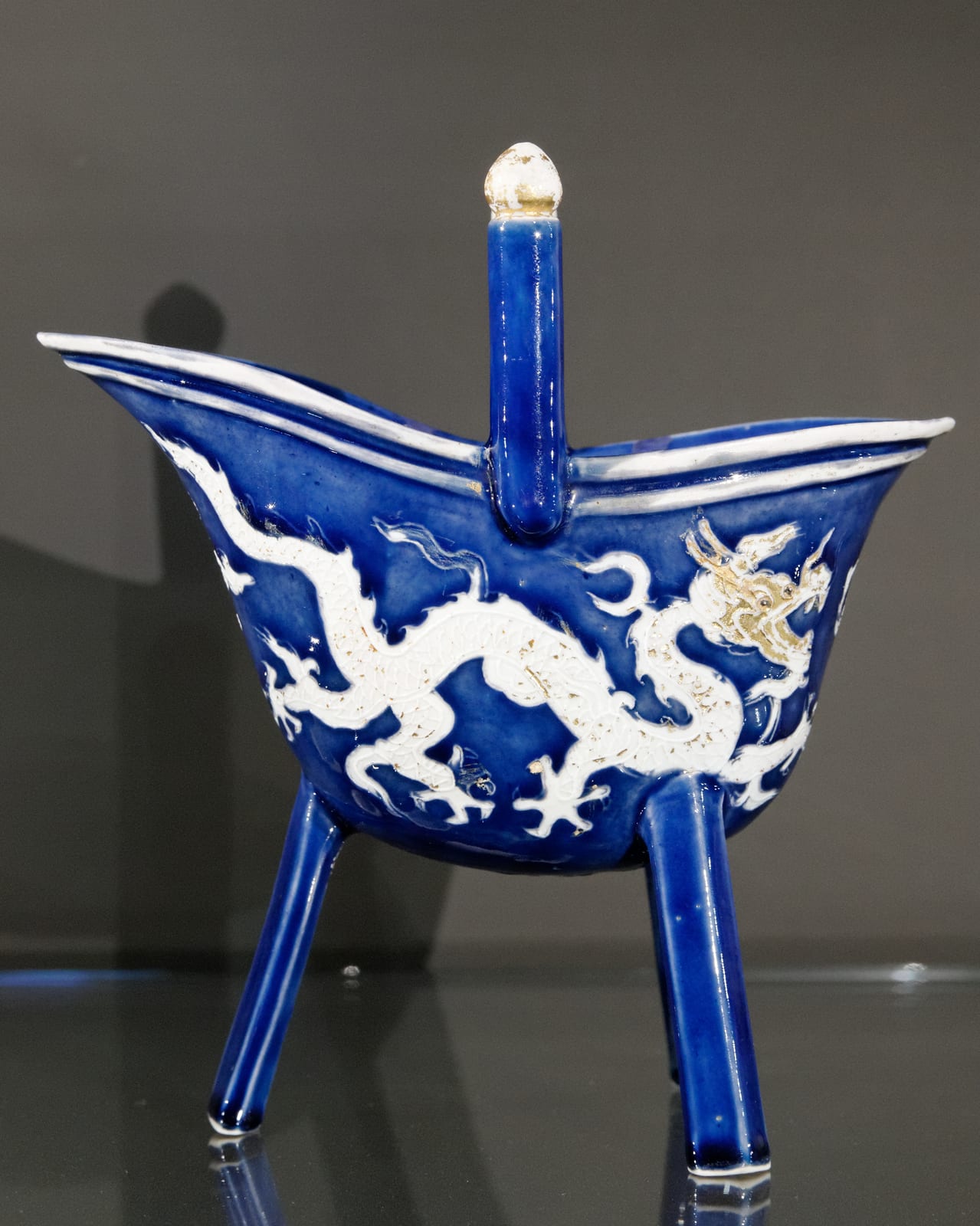
The first bronze jue appear at Erlitou, near Luoyang in Henan, around 1700 BCE. It's the site often identified as the capital of the Xia, China's first dynasty in the traditional histories. The studded jue in the photo above came from there. It's among the oldest bronze vessels found in China. Among the very first things cast in bronze there, in other words, was a pot for warming wine.
The jue hit its peak under the Shang. The tomb of Fu Hao, consort of the Shang king Wu Ding and a military commander in her own right, held 40 jue and 53 gu, the tall flared beakers they were paired with. A jue and a gu together were the basic set for the grave.
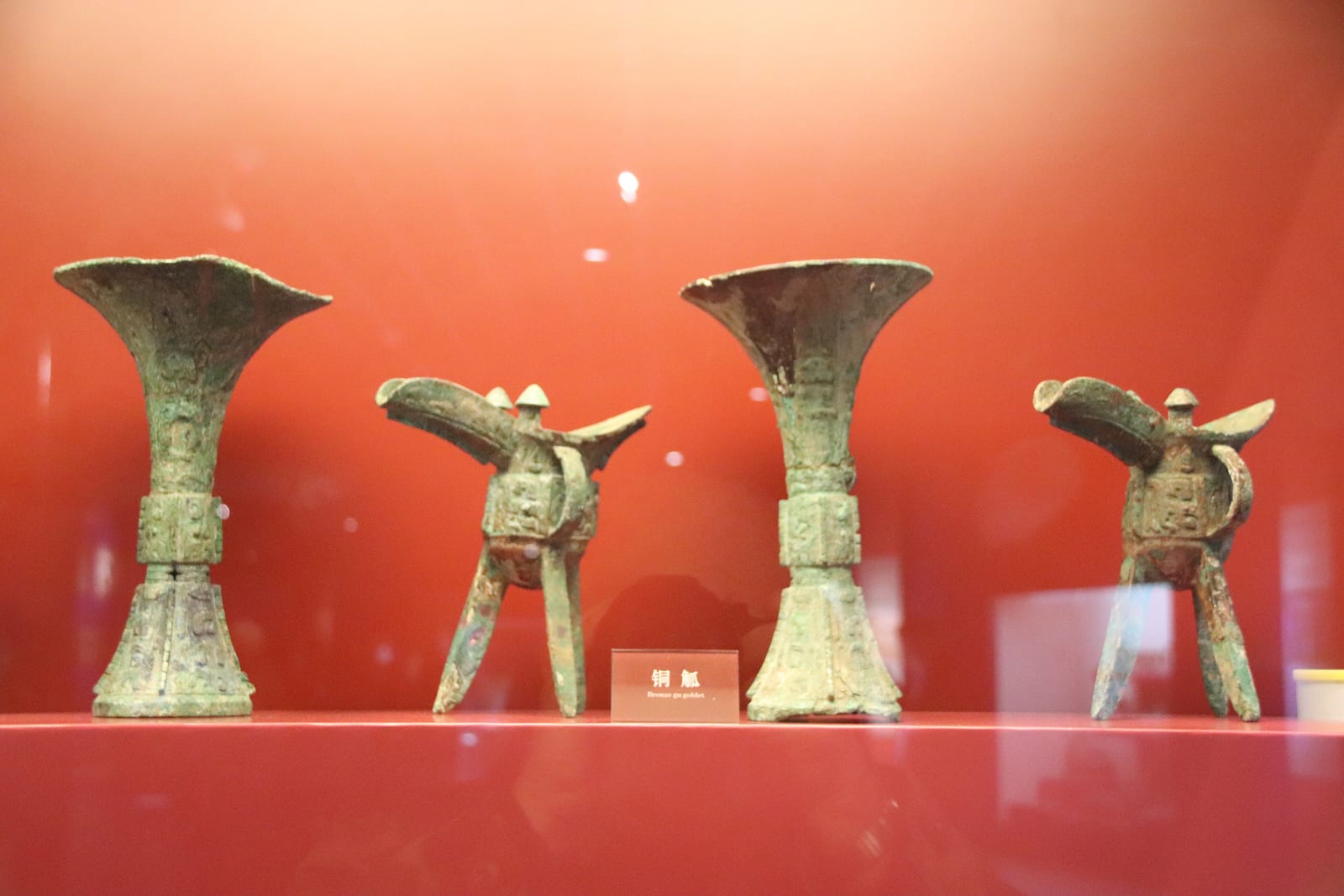
Then, during the later Western Zhou, the jue disappears. Whether that was the Zhou's wariness of drink or a change in how sacrifices were done isn't clear. By the Han, people drank from flat, eared cups called erbei, and the three-legged bronze jue survived only underground.
The cup that became a rank
The jue's most lasting trace isn't an object. It's a word.
In Chinese, the five ranks of nobility, roughly duke, marquis, count, viscount and baron, are all written with 爵 on the end. The Book of Rites says that "at sacrifices in the ancestral temple, the noble offer wine with the jue; the lowly offer it with the san." Which vessel you held at the ritual was your place in the hierarchy. The name of the vessel came to mean the rank itself.
When Japan, and later Korea, needed words for European titles, they borrowed this system. So when a Korean or Japanese subtitle calls someone a countess, the character doing the work goes back to a wine-warming pot from Erlitou, 3,700 years ago.
Whether it was ever a cup of moderation, I don't know. What's certain is that who held it mattered more than how much was in it.
If you want a cup that was actually designed to stop you overfilling, that's the Korean gyeyeongbae, which drains itself if you pour past the line. And for what people in China drink from today, see the piece on the Moutai glass.
Xu Shen, Shuowen Jiezi · Duan Yucai, Shuowen Jiezi zhu · Lü Dalin, Kaogu tu, 1092 · Sun Ji, "The jue was not necessarily a drinking vessel: the jue as ritual object and its historical development" · Liji (Book of Rites), "Liqi" · Shangshu (Book of Documents), "Jiugao" · Institute of Archaeology, CASS, Yinxu Fu Hao mu, 1980