

This site has said much the same thing about glasses many times. You should be able to see the colour. The aroma should gather. The rim that touches your lips should be as thin as possible.
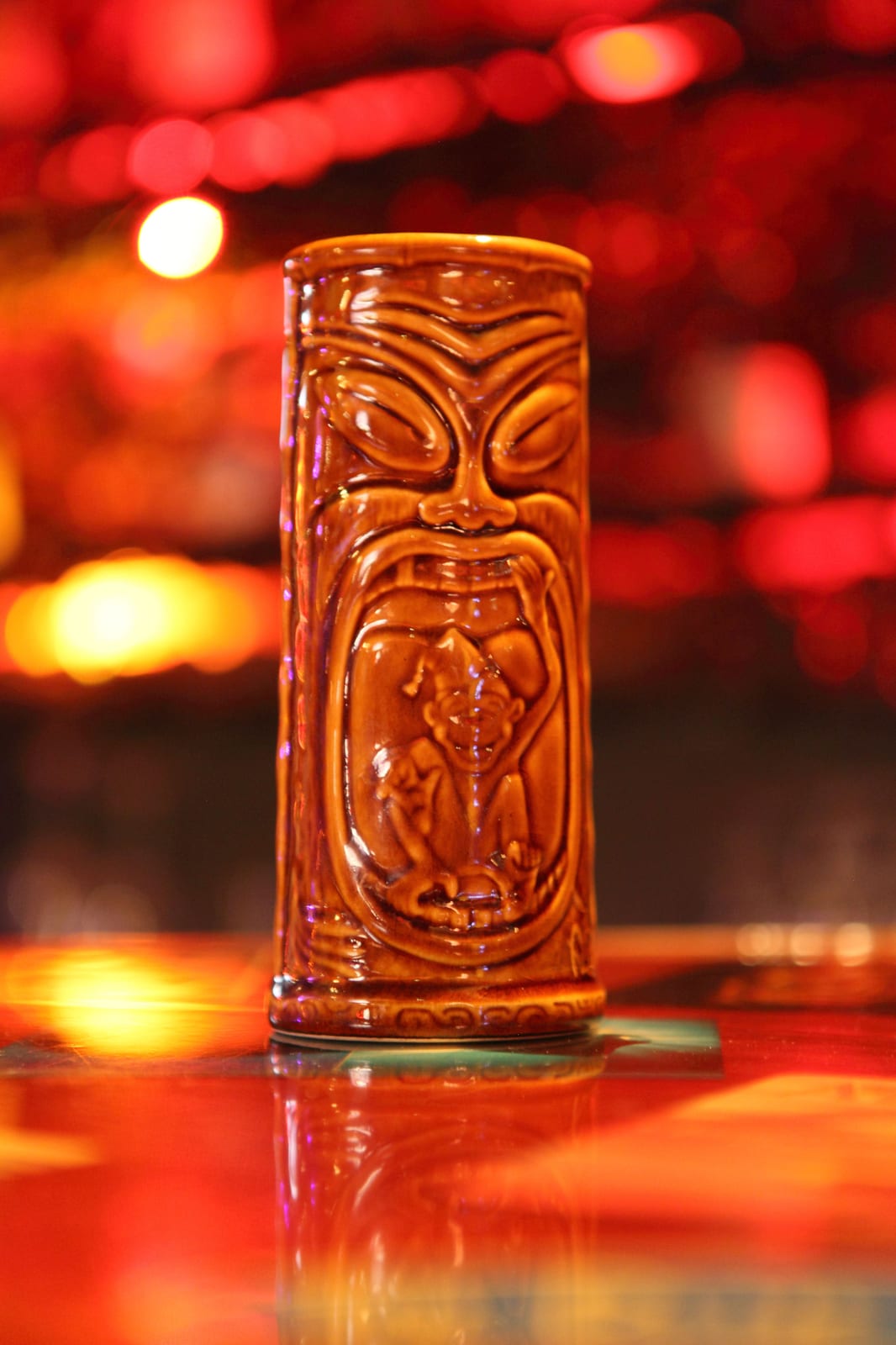
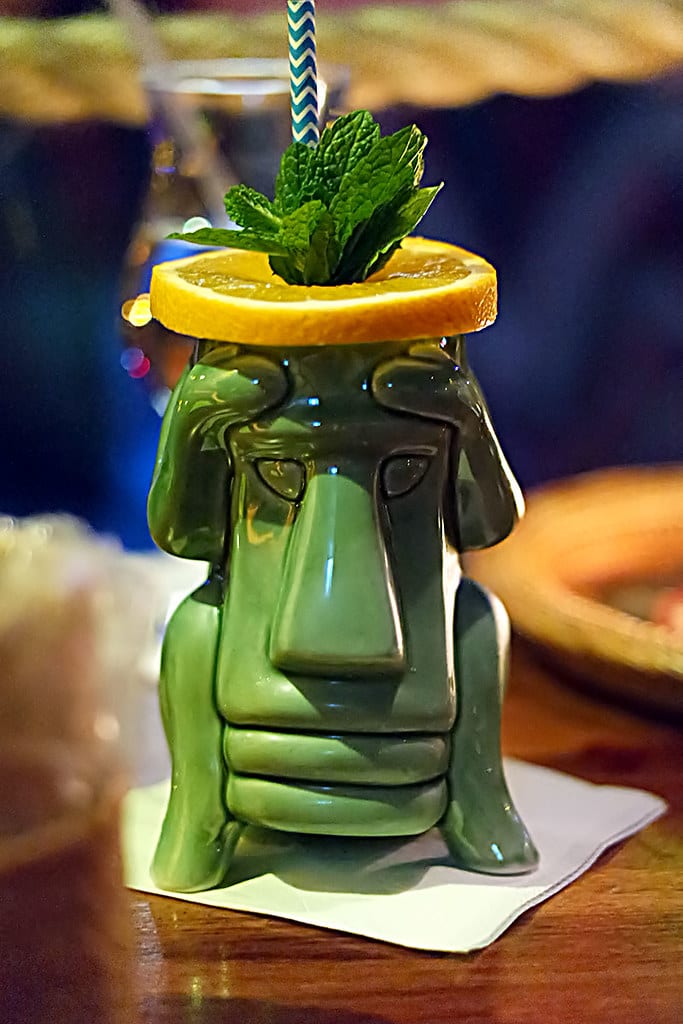
The tiki mug breaks all three. It is thick ceramic, so you can't see inside. The top is piled with fruit and mint and you drink through a straw. The rim is as thick as a finger. And yet this vessel has collectors of its own, and the dear ones change hands for thousands of dollars.
The year Prohibition ended
The story starts in Hollywood in 1933. A man named Ernest Gantt opened a small bar on McCadden Place and hung out a sign reading Don the Beachcomber. Trading on his own past drifting around the South Pacific, he filled the place with bamboo, fishing nets and props that looked salvaged from a shipwreck. He later changed his name to Donn Beach. It was the very year Prohibition ended. People had spent thirteen years drinking in hiding, and now here was a bar that offered escape to another world.

The drink was rum. He served strong cocktails that mixed several rums with fruit juices and spiced syrups, and kept the recipes in code so that even his staff didn't know them. What rum had been before that is covered in navy rum and grog.
The following year in Oakland, Victor Bergeron opened a restaurant called Hinky Dinks. After a visit to Don the Beachcomber he redid the place in a South Seas style and renamed it Trader Vic's. The two became the twin poles of the American tiki bar.
At first it was glass
Here is the surprising part. The early tiki bars had no tiki mugs.
According to Wikipedia's entry on the tiki mug, the thirty drinks on an early Donn Beach menu mostly came in glassware, and none of the vessels showed a tiki face. The only unusual containers were hollowed-out baby pineapples and green coconuts. A 1941 menu was much the same.
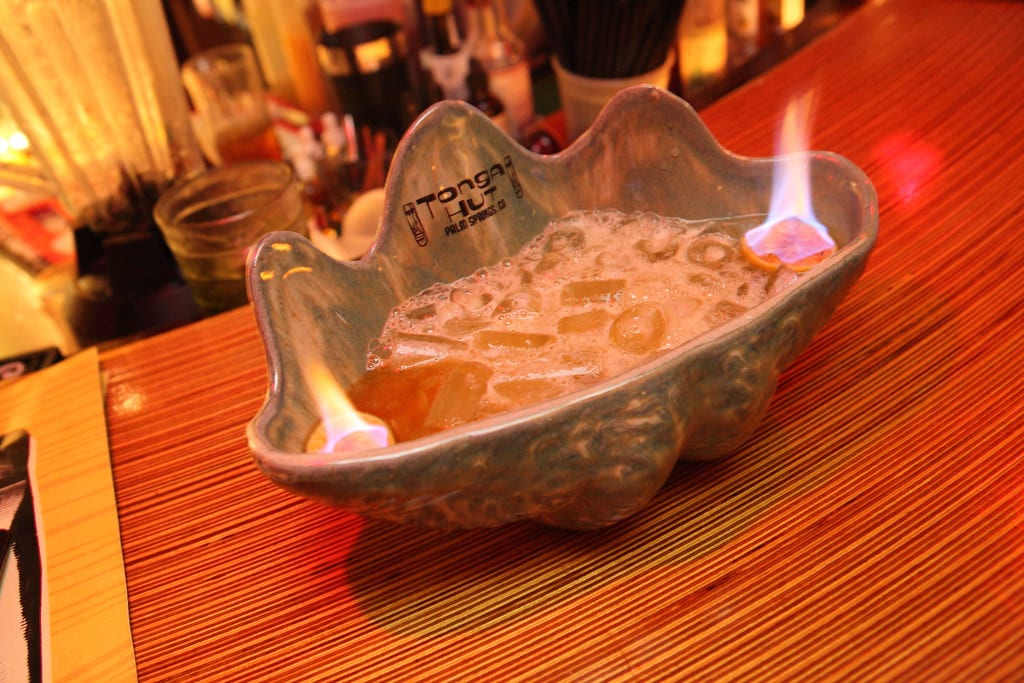
Ceramic turns up in the record in 1947. Trader Vic's Bartender's Guide illustrated thirty vessels, four of them ceramic: a skull mug, a scorpion bowl, a kava bowl and a tall Fog Cutter mug. Still no carved "tiki".
Who was the first tiki mug?
Collectors have argued over this for a long time. Wikipedia says it is "debated and has not been decided". There are a few candidates.
The earliest one known so far isn't American. It is the "Ruru and Weku" mug made in 1949 by the New Zealand pottery Crown Lynn, modelled on Māori carving.
The one most often named in America is Tiki Bob, from San Francisco in 1955. He was the mascot of a bar opened by Bob Bryant, who had worked at Trader Vic's, and he has a simple face: two eyes and a straight slot of a mouth. Collector sites regard him as the first mass-produced tiki mug, or the first to actually be called a "tiki".
Mugs that looked like tiki carvings spread properly in the United States in the late 1950s. Shapes based on the moai of Easter Island were especially common. Thor Heyerdahl's Kon-Tiki voyage of 1947 and his 1957 book Aku-Aku had made Easter Island fashionable.
A glass made to be taken home
The mug spread because of business, not flavour.
Most tiki mugs were mass-produced as souvenirs carrying the name of the bar. A mug the customer carried out and put on a shelf at home became an advertisement for the place. The two biggest producers were Orchids of Hawaii and the Otagiri Mercantile Company, and the pieces were mostly fired in Japan and Taiwan. Many are unmarked, and copies of a competitor's design were common. In the 1960s one company even sold moulds so people could make them at home.
For the drink itself, an opaque vessel isn't all loss. This is my guess, not something the sources say: a drink built from three or four rums plus juice and syrup easily comes out a murky brown. It looks poor in clear glass. For bars that kept their recipes in code, a vessel that hides the drink may also have suited them. And thick ceramic holds crushed ice for a long time. There is something in common with the mint julep, where a metal cup is packed with ice.
People also taste with the vessel. Lift a heavy, showy mug in both hands and the drink inside feels special too. There is a longer piece on that in the brain tastes the glass.
From the junk shop to the display case
In the 1970s tiki became tacky. The bars closed and the mugs scattered. The original Hollywood Don the Beachcomber shut in 1985.
Through the 1980s and 1990s vintage tiki mugs were plentiful in junk shops. The people who picked them up cheaply were the starting point of the tiki revival in the 1990s. In 2003 Duke Carter catalogued the mugs systematically for the first time in a self-published book. Around 2008 the fashion came round again with the cocktail boom.
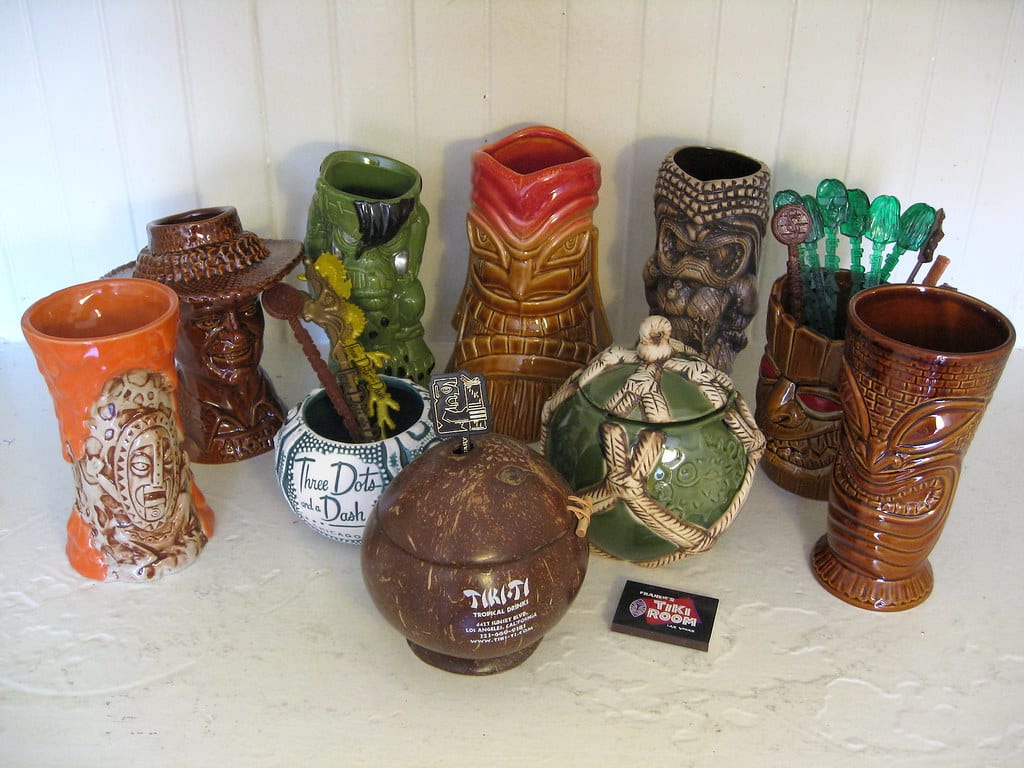
Now they have prices. Wikipedia notes that a 2019 estimate valued the "Parksmith Fertility Goddess Decanter" at over 5,000 dollars. New mugs keep coming as well. Numbered limited runs are common, and the faces have widened from tiki idols to film characters and real people.
The criticism the mug faces
The word tiki comes from Māori. It is the first man of the myths, and it also means a figure carved in human form. So the image comes from someone's ancestors and beliefs, and a rum cocktail is being drunk out of it.
That discomfort has been voiced openly inside the trade in the last few years. In 2020 the cocktail site PUNCH ran a conversation among drinks professionals of Pacific Islander heritage. Samuel Jimenez, who is of Samoan descent, said: "The drinks genre itself is rooted in colonialism and imperialism." Mariah Kunkel, whose father is CHamoru from Guam, said she had once thought "just, like, get rid of the mugs", but added that she didn't mean slash and burn, only that each thing should be examined. The bartender Chockie Tom said her team would like to switch from "tiki" to "tropical".
There is a counter-argument: tiki was never the real Polynesia, but a made-up South Seas invented by Americans. Some bars today keep the drinks and the mood and drop only the vessels with an idol's face. Parrots, pineapples, shipwrecks, skulls. Mugs without the face.
The tiki mug was not made for the sake of the drink. It was made so you would remember the bar. Some seventy years on, that purpose still works. What gets moulded into the clay is the part now being chosen again.
Wikipedia, "Tiki mug"; "Tiki bar" · The Search for Tiki, "Tiki Mug Hall of Fame: Tiki Bob" · Imbibe Magazine, "Who Is Tiki Bob?" · PUNCH, "The Problem With Tiki", 13 August 2020; "The Evolution of Tiki in Four Eras" · Trader Vic, "Bartender's Guide", 1947