
Most of the glasses resting in a whisky enthusiast's cabinet share one distinct feature: a tulip shape that narrows at the rim. From the ubiquitous Glencairn, which has dominated the market since 2001, to the traditional copita used by master blenders, modern tasting glassware has been designed almost exclusively for Scotch single malts. They are engineered to collect and channel light, delicate malt esters directly to the nose.
But American Bourbon is a different beast entirely. Built on a sweet, viscous corn mash bill and aged in heavily charred new American oak barrels, bourbon carries dense, volatile wood lactones, rich vanillin, and heavy caramels that are far heavier than Scotch malt compounds. Moreover, most premium bourbons sit at or above 45% ABV, with cask-strength releases reaching 60% and higher. When this bold, high-proof spirit is forced into a narrow tulip glass, the light, volatile ethanol gas gathers at the rim, overwhelming the nose and causing a sharp "nose burn" before the richer wood esters can even escape.
Melbourne-based design duo Denver Cramer and Liely Jennings questioned this Scotch-centric status quo. "Why is there no glass designed specifically for one of the most popular spirits in the world?" This simple inquiry led to the creation of the Denver & Liely Bourbon Glass, introducing a striking hybrid design to the whisky community.
Lessons from the Kentucky Pilgrimage
The two designers didn’t just sketch shapes at their desks in Australia; they flew directly to the heart of bourbon country in Kentucky. They visited historic distilleries like Maker’s Mark, Buffalo Trace, and Woodford Reserve, interviewing master distillers to grasp the molecular chemistry of bourbon.
What they observed was that bourbon requires two things to open up: surface area and oxidation. Unlike the delicate, floral esters of a Speyside Scotch that float effortlessly, bourbon’s wood-derived esters and heavy sugar compounds are dense and viscous. They need maximum contact with air to awaken.
A narrow glass essentially traps these heavy molecules while letting the harsh ethanol escape first. Bourbon didn't need the delicate constriction of a tulip glass; it needed a new hybrid vessel that combined the wide ease of a rocks tumbler with the sensory precision of a tasting glass.
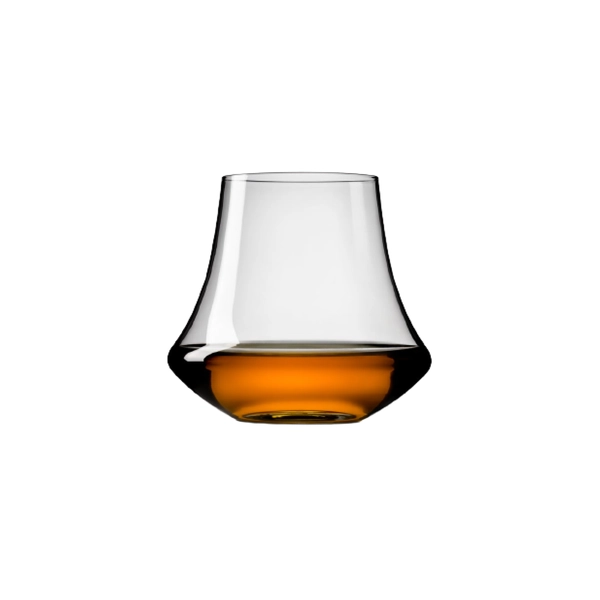
The Denver & Liely glass features a maximized surface area to wake up rich wood esters and complex notes — Photo: Denver & Liely Official
Physics and Aesthetics of the Design
At first glance, the Denver & Liely Bourbon Glass resembles a heavy rocks tumbler with a very wide base. However, moving upward, the glass narrows gently in the middle before extending straight up to the rim, creating a calculated three-stage curve.
1. Maximized Liquid-to-Air Interface (Wide Base)
The diameter of the base is nearly twice that of a standard Glencairn. When you pour a standard 1.5 oz (45ml) dram, the liquid spreads thin across a massive surface area. This rapid exposure to air coaxes the wood lactones, maple syrup notes, and rich vanillin out of their compressed state and into the glass's bowl.
2. The Choked Waist and Straight Chimney
To prevent these newly liberated aromas from dispersing too quickly, the glass narrows slightly at the waist. However, instead of continuing to narrow to a point like a Glencairn, the rim flares straight up in a vertical chimney. This straight chimney lets the highly volatile, nose-stinging ethanol molecules rise along the outer walls and dissipate out of the glass. Consequently, you can lower your nose deep into the glass without being blinded by alcohol vapor, allowing you to appreciate the underlying toasted oak, leather, and rye spice.
3. Palate Distribution
When drinking from a glass that narrows at the rim, the liquid is channeled into a thin stream that lands on the center of the tongue. With high-proof spirits, this targeted stream can overstimulate specific taste buds, emphasizing the burn of the alcohol. The wide, straight rim of the Denver & Liely glass delivers the bourbon in a broad flow that coats the entire tongue and palate. This even distribution balances the oak tannins against the sweet corn profile, making high-proof cask strength bourbons feel noticeably softer and more rounded.
Hand-Blown Crystal: Sensory Value in Weight
The value of this glass is felt as much by the hand as by the palate. Rather than machine-molded soda-lime glass, it is crafted from mouth-blown, hand-cut lead-free crystal.
A single glass weighs approximately 330g to 350g—nearly four times the weight of a standard Glencairn (85g).
The massive crystal base acts as an insulator, keeping the heat from your palm from warming the liquid too quickly. Swirling a dram in this glass feels satisfyingly substantial; the slow, viscous legs of the bourbon sliding down the clear crystal walls offer a slow, hypnotic visual pleasure.
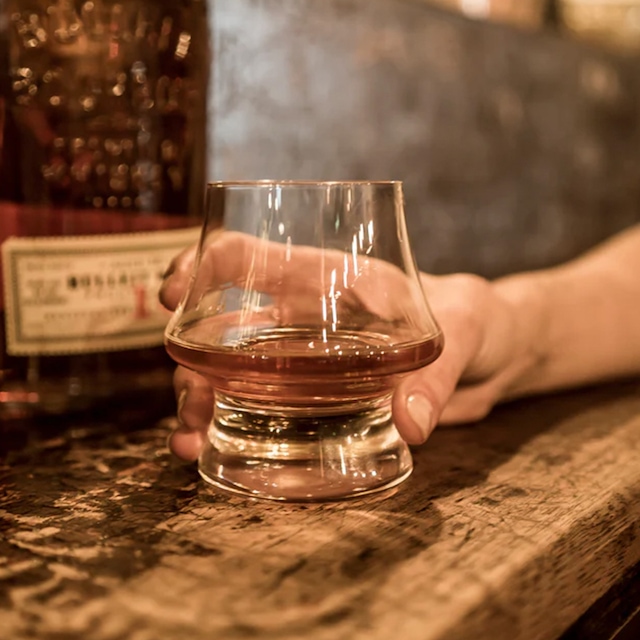
The authentic Denver & Liely Bourbon Glass. Its unique profile merges the weight of a heavy tumbler base with the curves of a tasting vessel — Photo: Denver & Liely Official
Specifications and Comparison
| Feature | Denver & Liely Bourbon Glass | Standard Glencairn Glass |
|---|---|---|
| Manufacturing | Mouth-blown, hand-cut crystal | Machine-molded glass |
| Material | Lead-free crystal | Soda-lime glass or crystal |
| Weight | ~330g - 350g (Very heavy) | ~85g (Lightweight) |
| Rim Design | Straight, wide chimney | Narrowing tulip shape |
| Best Used For | Neat high-proof bourbon, or with a single large sphere | Neat single malts (small measures) |
| Price Point | ~$80 - $100 USD | ~$15 - $20 USD |
Practical Limits and Drawbacks
No piece of glassware is without its compromises, and the Denver & Liely is no exception.
First is maintenance. Hand-blown crystal is delicate, and the glass's thin upper walls mean it is strictly hand-wash only. It should be washed in warm water with a soft sponge and dried carefully with a lint-free linen cloth. Drying the deep inside corners of such a wide base requires patience and care.
Second is specialization. While it performs beautifully with bold, oaky, and high-ester spirits like bourbon, rye, or heavily sherry-casked whiskies, it is less suited for delicate, low-proof single malts (such as a light Lowland Scotch). The wide mouth disperses the delicate floral and grassy aromas too quickly, leaving them flat. This is a specialized tool tuned for intensity.
Conclusion: The Study Bar Ritual
The Denver & Liely Bourbon Glass is not just a container for alcohol. It is a thoughtful design response to the raw intensity of Kentucky bourbon and the heavy sweetness of charred American oak.
If you enjoy sitting under the warm light of a study or home bar, slowly savoring a pour of a high-proof pour like Wild Turkey Rare Breed or Russell’s Reserve Single Barrel, this glass elevates the experience into a sensory ritual. The premium price tag and the chore of hand-washing are easily offset by the substantial, luxurious feel of hand-blown crystal in your palm.
Denver & Liely Product Photos — Denver & Liely Official Site.