
The Glencairn is a Scottish glass. It was designed in Scotland in 2001, and the Scotch industry adopted it as a de facto standard. Ask someone to picture a single whisky nosing glass and most will draw a Glencairn.
But whisky isn't only Scotland's. Across the water in Ireland sits Irish whiskey, which once dominated the world market. It nearly vanished over the course of the 20th century, then entered a revival in the 2010s as distilleries reopened one after another. New distilleries, new whiskeys, and people gathering again to drink them — and at that point Ireland realised something. It had no glass of its own to put its whiskey in.
The Túath glass was made to fill that gap.
The Name "Túath"
Túath is an old Irish word, pronounced roughly "too-a." In Gaelic society a túath was a small kingdom — the territory a single tribe ruled and the people who belonged to it. It means the land and, at the same time, the people of that land.
The choice of this word as a glass name is deliberate. Where the Glencairn began as a company's product name, the Túath set out from the start to be a symbol uniting everyone who drinks Irish whiskey. If Scotch has its Glencairn, Irish whiskey has its Túath — that is the framing the name reaches for.
Why Ireland Needed Its Own Glass
The story of how Irish whiskey was once the world's number one and then collapsed deserves an article of its own. In short: by the mid-20th century, the number of working distilleries in Ireland had dwindled to a handful. The industry all but stopped.
That reversed in the 2010s. New distilleries multiplied quickly, and Irish whiskey became one of the fastest-growing whisky categories in the world again. The problem was identity. A revived industry needs symbols to explain itself — yet at every tasting, people were pouring Irish whiskey into Scottish glasses.
The Túath targets that contradiction. More than a claim to be a functionally better glass, its first argument was emotional: Irish whiskey deserves an Irish glass. That is why Ireland's landscape and history are written into the design.
The Shape — A Conical Bowl and a Skellig Michael Stem
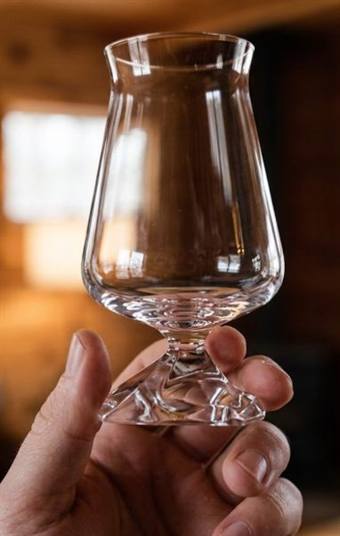
The Túath is a conical nosing glass. Its bowl is narrow at the bottom and flares outward toward the top. The narrow lower section gathers the aroma compounds, while the wide opening lets alcohol vapour escape. It concentrates scent but releases the burn — the opposite direction from the Glencairn, which curls its rim inward to trap aroma.
The most striking part is the stem that supports the bowl. Its angular form is drawn from Skellig Michael, the steep rocky island in the Atlantic off Ireland's southwest coast, a UNESCO World Heritage site where medieval monks built a stone monastery that still stands. The pyramid-like, stepped stem echoes that island's stone steps and peaks.

A Glass That Lies on Its Side
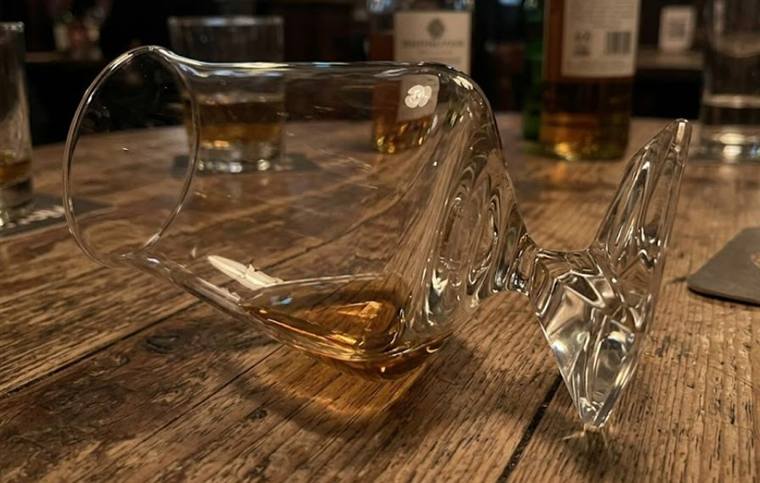
The Túath's stem has a functional purpose too. Its angular shape lets you rest the glass on its side rather than standing it upright. The bowl tilts and holds steady at an angle.
In that position the whiskey spreads across more of the bowl's inner wall. The surface in contact with air grows, so the whiskey opens faster while the glass sits tilted for a moment. It does, with a single tilt, what decanting or swirling does — something a Glencairn can't do at all.
How to Hold It
The Túath is designed to be held by its base, not its bowl. You rest thumb and forefinger on top of the base and tuck your middle finger underneath. Three fingers, lightly pinching it up.
Held this way, your palm never touches the bowl. The intent is to keep body heat from reaching the whiskey. Palm warmth is a recurring complaint among long-time Glencairn users, and the Túath avoids it structurally by giving you a stem and a base to hold instead.
What's Different from the Glencairn
| Glencairn | Túath | |
|---|---|---|
| Origin | Scotland (2001) | Ireland (2010s revival) |
| Form | Stemless tulip | Angular stem + conical bowl |
| Rim | Curves inward | Flares wide and open |
| Held by | The bowl, directly | The base, with three fingers |
| Lies on its side | No | Yes (opens whiskey faster) |
| Capacity | ~180ml | ~210ml (21cl) |
| Material | Lead-free crystal glass | Stölzle European crystal |
| Symbolism | De facto standard of Scotch | Aspires to symbolise Irish whiskey |
On aroma concentration alone, the inward-curling Glencairn or the copita family is still sharper. The Túath's wide opening is built to release alcohol gently rather than focus scent to a single point. That is also why people report it burns the nose less on higher-proof whiskeys.
On the Phrase "Official Glass"
The Túath is often introduced as the "official Irish whiskey glass." That phrase deserves a little care.
The Glencairn holds a genuine status as the nosing glass recognised by the Scotch Whisky Association. The Túath's "official," by contrast, is less an institutional certification than a brand identity and a name the market has settled on. In practice, plenty of Irish distilleries and whiskey events have adopted it, and it functions as something close to a symbol. But if someone asks "did an accredited body designate it?", the answer is that it doesn't hold official status in the same sense the Glencairn does.
That is how symbols take hold. The Glencairn wasn't a standard from day one either — the industry used it long enough that it became one. Whether the Túath reaches that place is a story still in progress.
Who It's For
The Túath isn't the glass for someone hunting the sharpest possible aroma concentration. For that, a copita or a Glencairn is more precise.
It matters in other cases. Someone who drinks Irish whiskey often and feels drawn to its identity; someone who wants less alcohol burn on a high-proof pour; someone who likes resting the glass on its side to open the whiskey slowly. And above all, someone who wants even the glass to carry where the whiskey came from.
Just as reaching for a Glencairn feels natural with Scotch, reaching for a Túath when you pour a Jameson or a Redbreast — that scene is, in the end, exactly what the Túath was aiming for.