
There are a few half-finished bottles of whisky on the shelf. One was opened on a birthday last year. You can't remember when you opened the other. Is it still OK to drink?
It's fine to drink. Nothing over 40% ABV goes off, because bacteria can't live in it. The real question is whether it still tastes the same, and that's where it gets interesting.
The usual advice
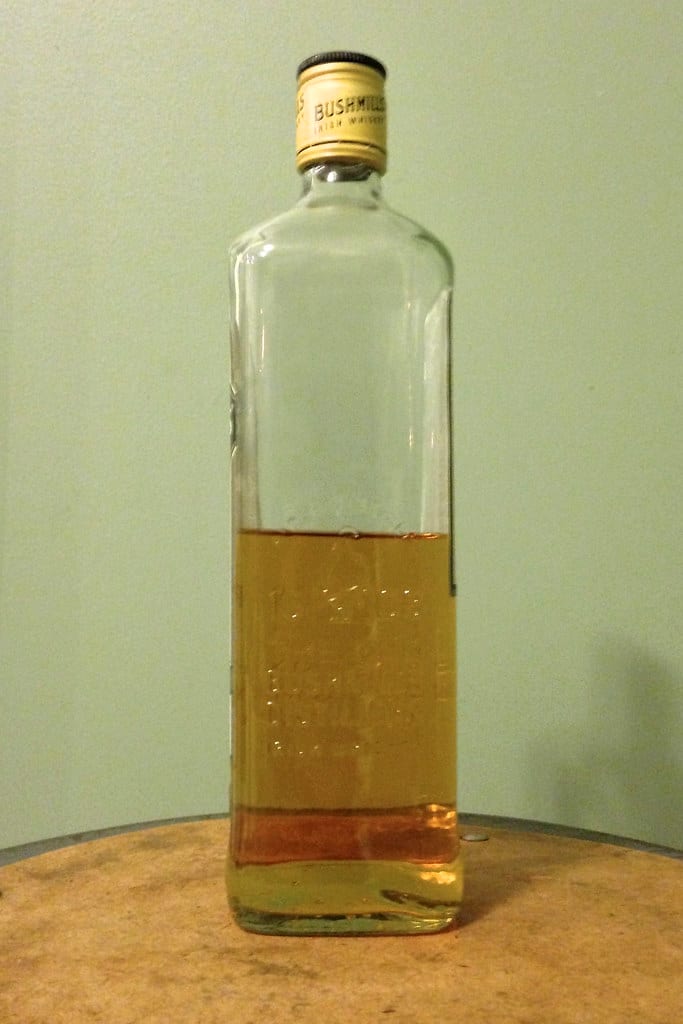
What whisky companies tell you is broadly the same: once a bottle is about half empty, move it into a smaller bottle or drink it soon. Ballantine's says to finish it within six months to two years depending on how much is left. Arran says a well-stoppered bottle that's at least half full will keep its flavour for anything from a few months to two years.
Jim McEwan, then master distiller at Bruichladdich, said on a promotional tour in 2005 that once a bottle is half empty you've got about six months before it changes noticeably. The Australian whisky blog Whisky & Wisdom passed that on with a caveat: "noticeably" is subjective, and nobody accurately remembers what something tasted like six months or a year ago.
Fair point. So before the numbers, it's worth looking at what actually changes.
We call it oxidation, but
When a bottle has been open a while and tastes flat, everyone says it's "oxidised". Thinking of wine, that makes sense. Open a bottle of wine and it reacts with oxygen and turns sour within a day or two.
Whisky is different. At that strength it doesn't react with oxygen nearly as readily as wine. There is some reaction, but not much. Whisky & Wisdom calls actual chemical reactions "very minor in the big picture", with one exception: sulphur compounds. The struck-match note you sometimes get in sherry-cask whisky comes from sulphur, and that gets oxidised and fades over time. The phenols that make peated whisky smoky are also fairly easy to oxidise, so an Islay whisky that's been open a long time loses its smoke first.
Most of the rest isn't really oxygen. It's just air. Once there's space in the bottle, some of the whisky's aroma compounds evaporate into it. The small, light esters behind the fruity and floral notes go first. And every time you open the bottle, that aroma-laden air goes out and fresh air comes in. Every pour throws a little bit of the aroma away.
Alcohol goes too. Ethanol evaporates more easily than water, so the air space fills with vapour that's richer in alcohol. The whisky analysis site Whisky Analysis explains that this slowly dilutes the whisky left behind, very slightly. It's careful to say this is plausible in theory, not something it has measured.
The bigger the air space, the bigger the effect. In a full bottle there's a finger's width of air above the whisky. With a dram or two left in the bottom, the bottle is almost all air. That's why "half full" keeps coming up as the line.
What blind tastings show
So how much does it actually change? There are some amateur but careful experiments.
The US bourbon site Breaking Bourbon split one bourbon into samples stored in different conditions for two years and tasted them blind at six, twelve and twenty-four months. A dark closet, a fridge, direct sunlight, and bottles that were periodically opened and poured from, like a bottle you're actually drinking. Fill levels were full, two-thirds and one-third. There were three tasters.
After 24 months the conclusion was that air had less effect than expected. The whisky hadn't been ruined so much as nudged in a different direction, and the write-up says the evidence suggests "only a minimal impact". The closet sample filled to one-third was picked by all three tasters as the best in its flight. The bottles that were opened and poured from regularly hadn't changed much either.
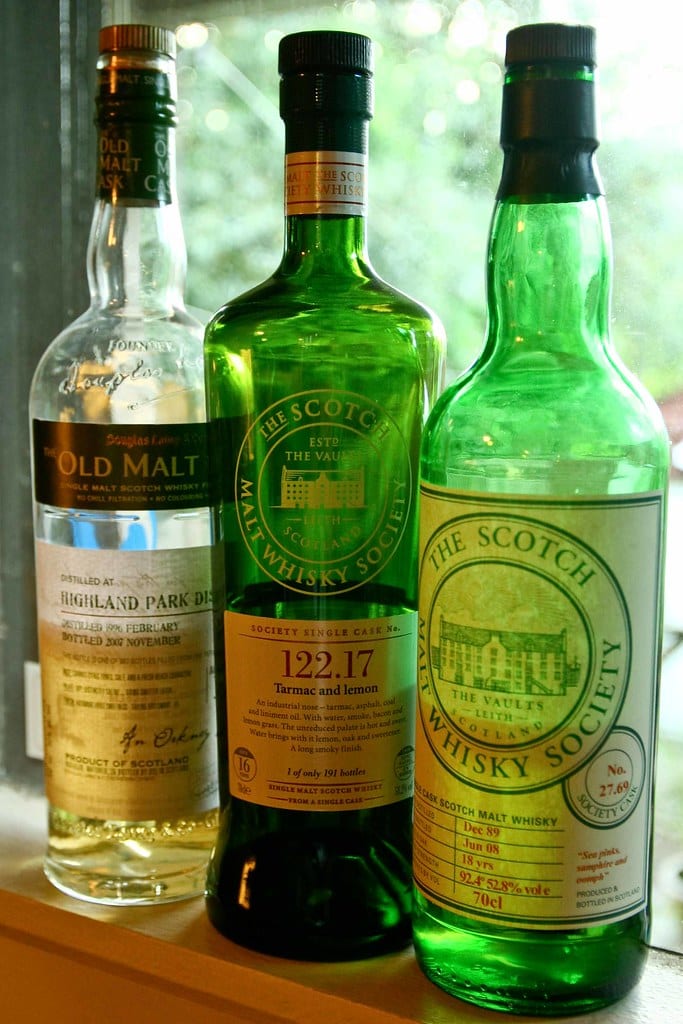
What did go wrong was the sunlight. Clear bottles left in direct sun picked up notes of rubber, plastic, rotten apples and paint thinner, and lost a lot of colour. The sunlit bottle filled to one-third came last every time. Amber glass did much better in the same sun. The experiment also found that air and sunlight together were worse than either alone.
Whisky Analysis also summarises two other blind tests. In one, ten people did a triangle test with a bottle that had been open for a year against a fresh one, and not one of them picked the odd glass out. Lab analysis found no meaningful difference in the major compounds either. The other ran for six months, and two of six tasters got it right, which is what you'd expect from guessing.
A commenter pointed out that gas chromatography only picks up volatile compounds, and there weren't many tasters. Still, the direction is clear. Until there's more air in the bottle than whisky, and as long as it's kept out of the sun, changes over six months to a year are hard to spot blind.
Sometimes it gets better
It's common to hear that the first few pours from a new bottle are hot and closed, and that two or three weeks later it's softened. Whisky & Wisdom puts this down to harsh volatile compounds that sat in the neck escaping. In the Breaking Bourbon experiment, the six-month tasting also found that some exposure to air seemed to help the closet and fridge samples.
On the other hand, delicate whiskies fall apart faster. Whiskies built around subtle floral notes, those diluted down to 40%, and very old whiskies aged 25 years or more. Bold whiskies, heavily peated, cask strength or finished in wine casks, hide the changes much better.
So how should you store it?
Keep it upright. Wine lies on its side so the cork stays moist. Whisky is the opposite. A strong spirit sitting against a cork for a long time breaks the cork down, and the whisky picks up the taste.
Keep it out of the light. That was the clearest cause of damage in the experiment above. A glass-fronted cabinet in the living room isn't safe if the sun reaches it during the day. In its box, in a cupboard, is best. With temperature, swings matter more than the actual number. When the temperature changes, the air in the bottle expands and contracts and pushes aroma and alcohol out past the stopper.
Once it's more than half empty, move it to a small bottle. That's the surest way to cut down the air. A one-year experiment by the UK whisky blog Whiskipedia with Laphroaig 10 shows it well. Samples were scored 1 to 5 for how close they were to a freshly opened bottle. Five-centilitre bottles filled to the top and sealed with wax scored 5 all the way to twelve months. Small bottles filled but not waxed still scored 4 at twelve months.
Choose small glass bottles with caps that seal tightly. Whisky Analysis recommends amber or blue glass with polypropylene caps that have a cone-shaped liner inside. Caps with paper liners can break down over time and taint the whisky. PET plastic bottles are best avoided for long-term storage.
Gas sprays and vacuum stoppers don't do as much as you'd hope. In the same Whiskipedia experiment, the bottle treated with a wine preserving gas spray scored 3 at twelve months, and the one with a vacuum pump stopper was already at 1 by nine months, meaning "this is another whisky". A vacuum pulls out aroma compounds along with the air, so maybe that's no surprise. Another experiment quoted by Whisky Analysis found that the gas spray changed the whisky more than simply leaving it with air. It's also worth knowing that wine preserver sprays don't always contain only argon. Some include propellants like butane or propane.
You can also drop glass marbles in to raise the level. It works, but between finding food-grade marbles, cleaning them, putting them in and fishing them out again, a small bottle is easier.
Crystal decanters are for serving. They look great but aren't made for long-term storage. They tend to sit in glass cabinets where light gets at them, and plenty of them don't seal tightly. Even more so if it's lead crystal. There's more on that in the whisky decanter guide and the piece on glass, crystal and lead.
So how long, then?
There's no exact number. But roughly:
- A bottle more than half full, kept upright somewhere cool and dark, will be fine for about a year. The change is hard to pick blind.
- Once it drops below half, start paying attention. Drink it within six months or so, or move it to a small bottle.
- A bottle with a dram or two left in the bottom shouldn't wait. It's mostly air.
- Delicate whiskies, very old whiskies and whiskies you love for their peat smoke deserve more hurry than this.
The surest storage method, as Whisky & Wisdom puts it, is to drink it. With ten bottles open, none of them get finished in time. Before you open a new one, finish the one you can see the bottom of.
Breaking Bourbon, "Bourbon Storage Experiment: 24 Month Tasting Results" · Whisky Analysis, "How Best to Store Your Whisky", 2019 · Whisky & Wisdom, "Oxidation – does whisky go off in the bottle?" · Whiskipedia, "Preventing Oxidisation" · Arran Whisky, "Does whisky go bad?" · Ballantine's, "Can whisky expire?"