
The bottom of the glass isn't flat. The middle rises like a small hill, and the whisky pools in a ring around it. Buy the set and a heavy metal base comes in the box. That one is meant to live in your freezer.
The maker is Peugeot. Not the cars. The pepper mills.
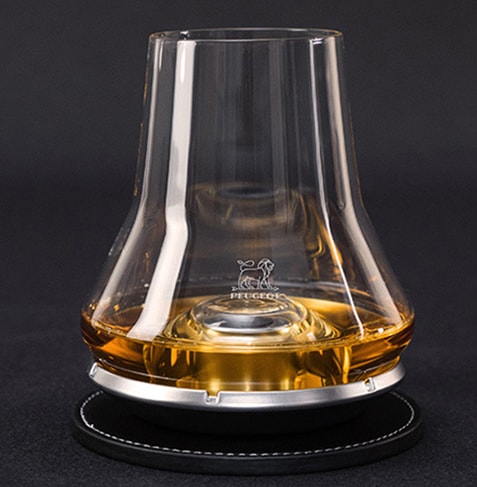
A pepper mill company selling glasses
The Peugeot family story starts in 1810, when the brothers Jean-Pierre and Jean-Frédéric Peugeot turned a mill in the Doubs, in eastern France, into a steel foundry. Steel bands and saw blades came first. Coffee grinders followed in 1840, the pepper mill in 1874. Cars came much later.
Peugeot Saveurs, the kitchenware side, shares the roots with the car company but runs as its own business. As you'd expect from a firm known for cutting grinder teeth, its move into wine has been mostly about tools: decanters, aerators, corkscrews.
A glass is a slightly odd thing for them to sell. And this glass didn't start with Peugeot.
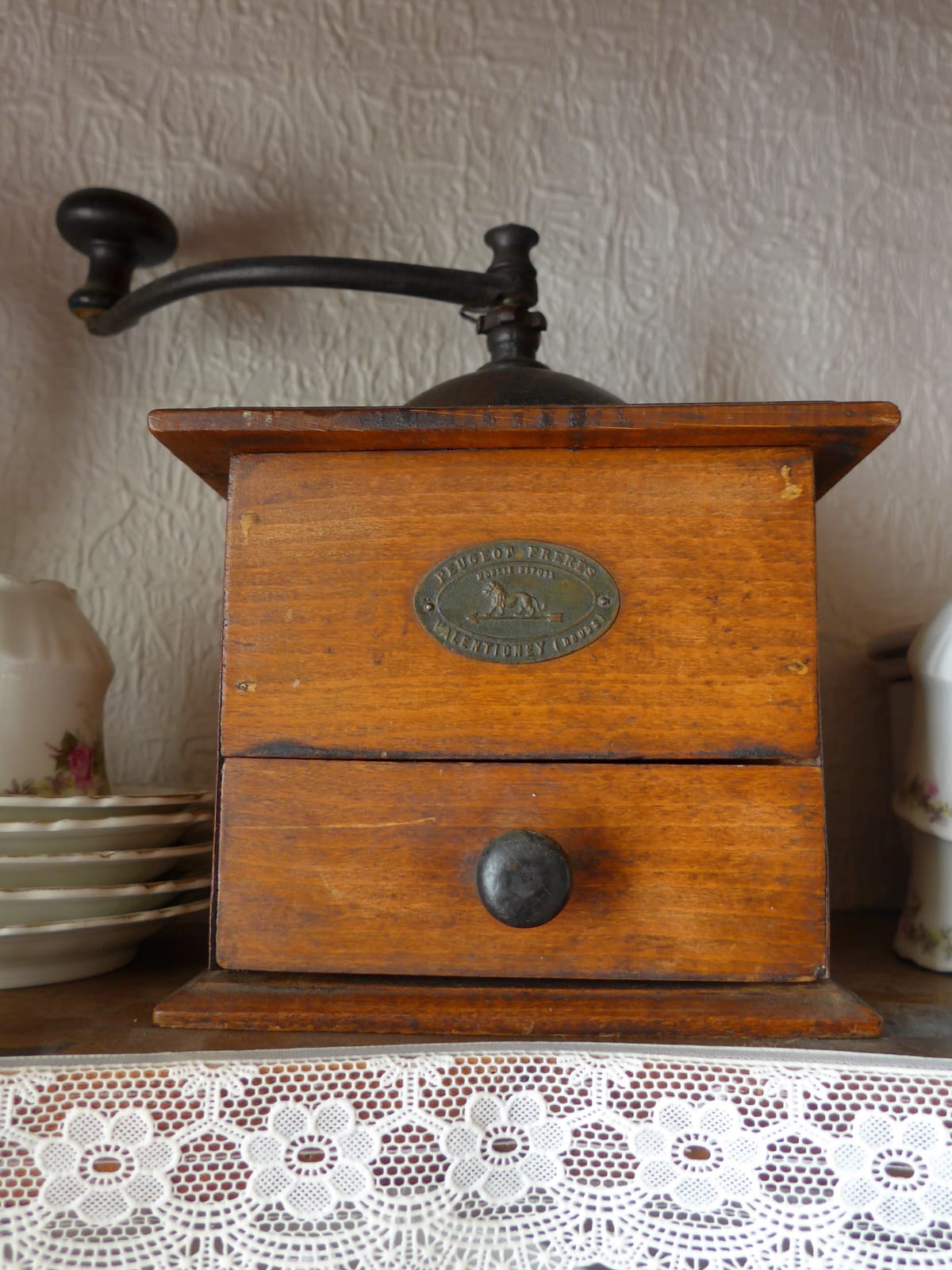
A Peugeot coffee grinder from the first half of the 20th century. The plate reads 'Peugeot Frères, Valentigney (Doubs)' (Photo: Celeda / Wikimedia Commons, CC BY-SA 4.0)
The merciless ones
Les Impitoyables is a series of wine tasting glasses designed by Jacques Pascot in 1984. The name means something like "the merciless ones". The idea was a glass that doesn't flatter a wine but shows its faults along with everything else. The originals were etched with Pascot's name and the year 1984, and you still see them turn up on the second-hand market.
The series later passed to Peugeot Saveurs, which added a whisky version. Peugeot doesn't say when it took the line over, or who designed the whisky glass. It is sold in 29cl and 38cl sizes, and the set with the base runs around fifty dollars on Peugeot's US store.
The habit of the series hasn't changed since the wine days. It doesn't leave the shape ordinary. Bowls kink at odd angles, bottoms are pushed in. In the whisky glass, that habit shows up as the dome.
The bump in the middle
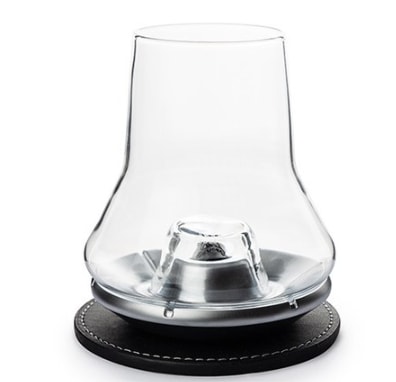
Empty, the dome in the bottom is easy to see. It is hollow underneath, and the centre of the metal base sits up inside it (Photo: Peugeot Saveurs product image)
Peugeot's explanation is short. Alcohol vapour gathers in the middle of the glass, and the dome pushes it out to the sides, so it doesn't catch your nose.
There's a condition. You have to pour below the tip of the dome. Cover the peak and you just have a glass with a slightly raised floor. That was the first thing the review site Bespoke Unit pointed out: pour to just below the top, and don't overfill.
So does alcohol actually gather in the middle?
The closest experiment I know of was published in Analyst in 2015 by a Japanese team led by Takahiro Arakawa. They called it a sniffer-camera: an enzyme mesh laid over the glass that lights up where it meets ethanol vapour, photographed to show how the ethanol spreads across the mouth of the glass. In a wine glass holding wine at 13°C, the ethanol formed a ring of high concentration around the rim, with comparatively less in the centre. It's often cited as an explanation of why a wine glass is good for nosing through the middle.
Taken at face value, that points the opposite way from Peugeot's claim. In a wine glass, at least, the alcohol didn't pile up in the middle. Then again, that was 13% wine in a different shape. I couldn't find anyone who has run the same measurement with 40%-plus whisky in this glass. So there's no evidence either way. What exists is the manufacturer's explanation.
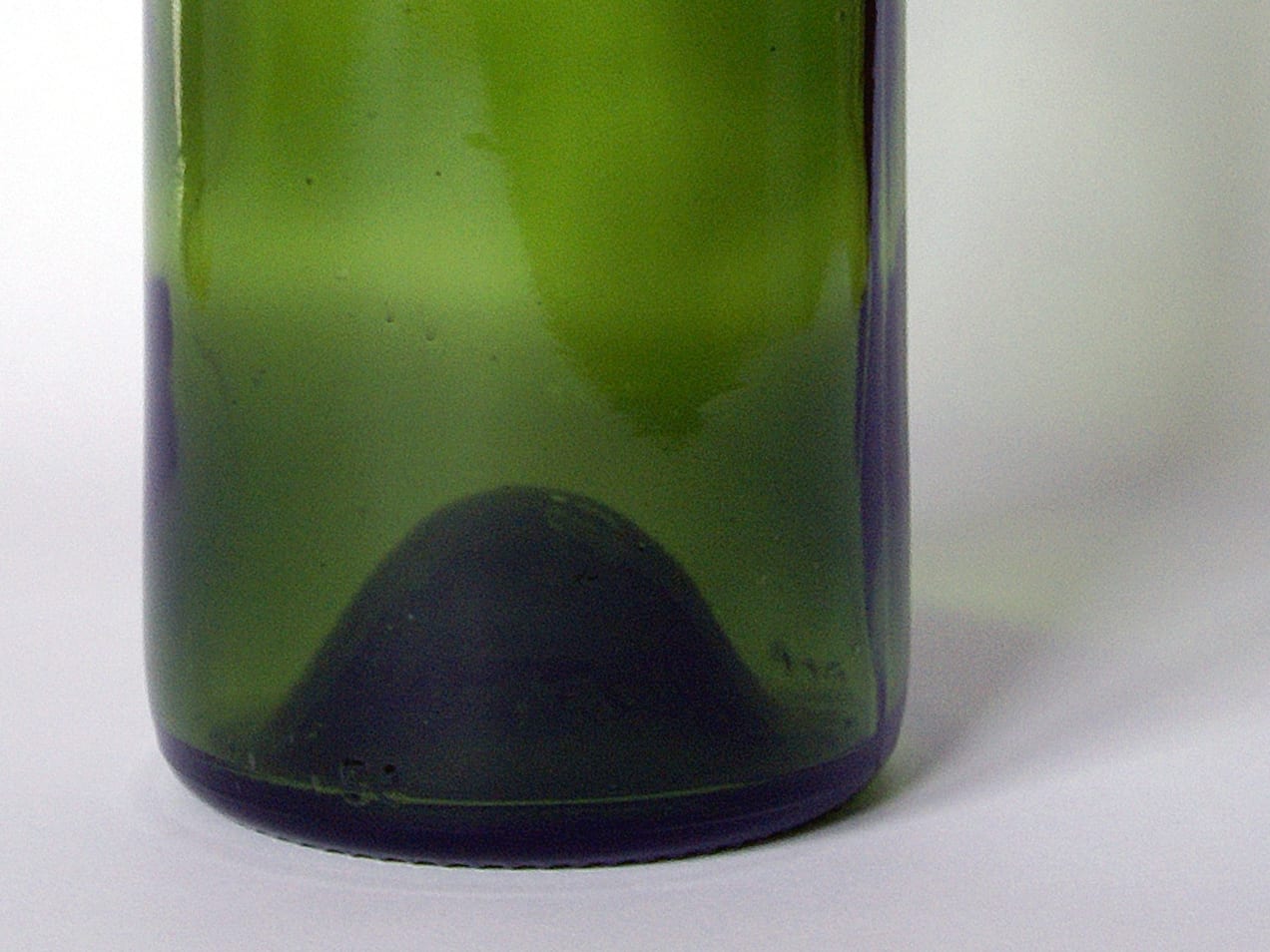
Here's my guess. The one thing the dome definitely does is set the size of your pour. Fill a 38cl bowl only up to the tip and you've poured a fairly small dram. A small pour in a big bowl leaves a lot of air above the liquid, and the vapour thins out before it reaches your nose. If the glass really does take the edge off the alcohol, that may account for more of it than the geometry of the dome. It's a guess, nothing more.
The NEAT glass goes after the same problem a different way. It flares the rim outward to let ethanol spill off to the sides. Peugeot changed the floor instead. One works from the top, the other from the bottom.
The frozen base
The other half of the set is the metal base. Put it in the freezer for about two hours, set the glass on it, and Peugeot says the whisky drops to 5–8°C in two or three minutes. It's not ice, so nothing melts into the drink, and you avoid the sudden temperature jump of pouring room-temperature spirit into a frozen glass.
Look at the product photos and you can see the underside of the dome is hollow, with the centre of the metal base sitting up inside it. So the dome is where the cold metal gets closest to the whisky. That suggests the dome does some work in chilling, not just in spreading the alcohol. Peugeot doesn't describe it that way, but that's what the shape says.
This is where it gets a little strange. 5–8°C is fridge temperature. As I wrote in the piece on chilling your glass, the colder whisky gets, the less aroma comes off it. So a glass built to expose aroma mercilessly comes boxed with a device that shuts aroma down.
It doesn't have to be a contradiction, though. Lower temperature also means less ethanol coming off the surface. If you want to calm a cask-strength whisky that stings your nose without adding ice or water, or you just can't stand lukewarm whisky in midsummer, the base has a use. Take the glass off the base partway through and you can watch the aroma slowly open as it warms. It makes more sense as a way to pick one more temperature than as a tool for drinking cold from start to finish.
Expect condensation. The colder the base, the more water beads on the outside of the glass. That's why the set includes a coaster.
What people who used it said
I haven't used this glass. So here is what people who have used it wrote.
In a 2021 review, Wine and Whiskey Globe poured Maker's Mark into this glass and into a standard rocks glass. From the Peugeot, secondary notes came through more clearly and the caramel was easier to pick out. In the same paragraph, they added that the difference was slight overall. Keep in mind that the comparison was against a rocks glass, not a nosing glass.
Bespoke Unit focused less on what the dome does and more on the conditions: that it only works if you pour below the tip, and that it's expensive for a glass that doesn't appear to be crystal.
Neither review called it a bad glass. Neither called it a decisive improvement either.
Is it worth buying?
If you already use a Glencairn and have no complaints, there isn't much yet to say this glass should replace it. The dome claim hasn't been backed by measurement, and the difference reviewers found was small.
It's worth a look for a few people, though. Anyone whose nose stings every time they pour a high-strength whisky. Anyone who hates ice but wants a cold dram in summer. And anyone who simply enjoys a glass with a strange idea built into it. Put a glass with a bump in its floor on the table and someone will ask about it.
Peugeot coffee grinder — Celeda / Wikimedia Commons (CC BY-SA 4.0) · Punt of a wine bottle — Patrick Heusser / Wikimedia Commons (CC BY 3.0) · Glass and chilling base — Peugeot Saveurs product images
Arakawa T. et al., "A sniffer-camera for imaging of ethanol vaporization from wine: the effect of wine glass shape", Analyst 140 (2015) · Peugeot Saveurs, Les Impitoyables Whisky Tasting Set product description · Wine and Whiskey Globe, "These New Tasting Glasses from Peugeot Really Work" (28 April 2021) · Bespoke Unit, "Les Impitoyables N°5 With Chilling Base"