Amrut
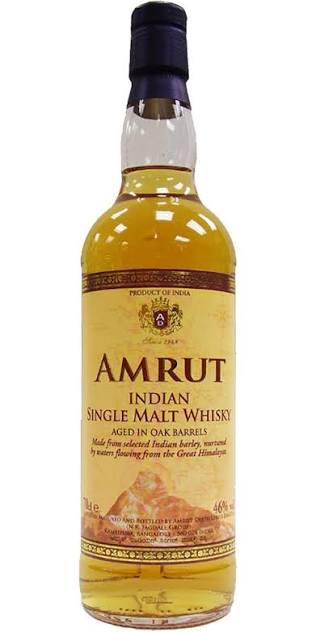
India's first single malt. The tropical heat ripens it fast — and the angels take a large share.
A lot of people still put on blinkers at the words "Indian whisky," assuming it must be cheap stuff. Amrut is the distillery that broke that prejudice head-on. In the early 2000s the critic Jim Murray gave Amrut Fusion a high score in his Whisky Bible, and the world started looking at Indian single malt differently.
The secret is the climate. In the heat of Bangalore, whisky matures several times faster than it does in Scotland. The exchange between cask and spirit is fierce — more is lost to the "angel's share" — but even a short maturation yields concentrated flavour. That's why you rarely see a 12 or an 18 on an Amrut label. Four years in India is said to rival ten or more in Scotland, and not without reason.
So fussing over age statements with Amrut misses the point. For a first bottle, Fusion — a blend of Indian barley and peated Scottish barley — is the safe bet. A gentle thread of peat under tropical, fruity sweetness, it settles the whole "Indian whisky" question in a single glass.
Personally, I think Amrut deserves credit for widening the map. It proved serious single malt exists beyond Scotland, Ireland and Japan — and Taiwan's Kavalan later took up the same path.
Most Indian 'whisky' is low-cost, molasses-based IMFL; Amrut put India on the world whisky map with a true barley single malt. Its Fusion scored 97 points in Jim Murray's 2010 Whisky Bible, named the third finest whisky in the world, which made its name overnight. The core range is fairly priced, but long-aged limited bottlings like Greedy Angels command high sums, since long maturation is itself rare in such a hot climate.
Rating — Jim Murray's Whisky Bible (2010) · Prices are approximate retail / duty-free · Not a personal tasting score
Amrut is made in Bengaluru, southern India, about 900m above sea level. In the hot, dry climate the spirit reacts with the cask fast, drawing out in four or five years what would take Scotland more than ten. The trade-off is an annual evaporation loss above 10%, a small yield accepted in exchange for concentrated aroma. It is distilled from barley grown in northern India, and Fusion adds Scottish peated malt to set the sweetness of Indian barley against light peat smoke.
The roots are a brewing and distilling company the Jagdale family founded in Bengaluru in 1948. After decades making spirits for the domestic market, it launched India's first single malt under the name 'Amrut' in Glasgow in 2004. 'Amrut' means amrita, the nectar of immortality the gods drink in Hindu mythology. It took an unusual path — born in India, yet first embraced by enthusiasts in Europe.
In Western markets Amrut won enthusiasts over with the surprise of Indian provenance and its bold malt and spice. It suits those who prefer something weighty and spicy over showy sherry, and Fusion is often recommended as an entry into peat. That the world's largest whisky market was a latecomer to single malt is half of this bottle's story.
To carry its bold malt, spice and Fusion's light smoke, a glass that gathers the nose — a Glencairn or copita — works well. The core sits around 46% and is fine neat, while cask-strength bottlings (in the 60s) settle their hot alcohol and open up sweetness with a few drops of water. With aromas this strong, let it sit at room temperature rather than pressing it down with a large ice cube.
Sources · Rating — Jim Murray's Whisky Bible (2010) · Production & range — amrutdistilleries.com · History — Wikipedia 'Amrut Distilleries' · Product image — Amrut