Blanton's
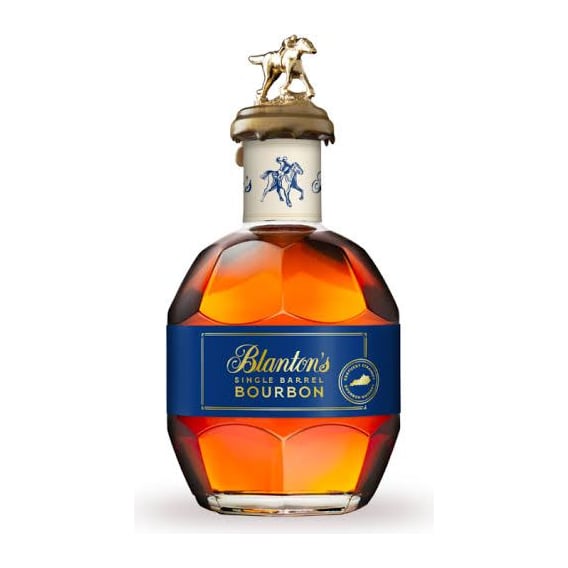
The world's first single barrel bourbon — a symbol of scarcity, famous for its horse-and-jockey stoppers.
You can't talk about Blanton's without the stopper. A little horse and jockey sit atop each cork, frozen in eight different moments of a race, and the letters set into the bases spell B-L-A-N-T-O-N-S when lined up in order. Quite apart from the whiskey, the urge to complete the set is one pillar of the brand's appeal. It's a rare case of a single bottle being both a drink and a collectible.
At the root of that appeal is the title "world's first single barrel bourbon." In 1984, master distiller Elmer T. Lee commercialised the idea of bottling from a single chosen cask and released Blanton's. At a time when blending many barrels for a consistent taste was the norm, this deliberately preserved the character of one. The now-common term "single barrel" started with this bottle.
A common misread is to expect that something this expensive must be overwhelmingly better. Blanton's market price is made by scarcity and collecting premium more than by any absolute grade of taste. Demand outruns supply enough to be allocated even in the US, and Japanese ownership built thick Asian demand early. It's plainly a good bourbon — but whether it's worth several times list is a separate judgement.
For a first taste the Original Single Barrel is the benchmark — it shows the Blanton's grain, clear rye spice over caramel and vanilla, in its most balanced form. Want it richer, step up to the cask-strength SFTB. Set beside Buffalo Trace from the same distillery, it helps you gauge how much is single barrel character and how much is scarcity premium.
Blanton's market price hinges on scarcity premium rather than list. Allocated even in the US, it's hard to buy at retail, and in Korea and Japan it trades at several times list. The culture of collecting all eight horse stoppers lifts demand further.
Prices are approximate retail / duty-free (volatile due to scarcity) — not a personal tasting score
Blanton's is a single barrel bourbon, bottled from one cask rather than blended from many for a uniform taste. It keeps the subtle character of each barrel intact. A higher-rye mashbill lays clear spice over caramel and vanilla sweetness, and maturation in a fast-heating metal-clad warehouse draws out concentrated flavour. So even under one label, the slight differences between barrel numbers become part of the fun of collecting.
The name comes from Albert B. Blanton, who rose from office boy to head of the distillery in the early 20th century. In 1984, master distiller Elmer T. Lee honoured him with the first commercial single barrel bourbon, chosen one cask at a time. Launched when bourbon was in the doldrums, it opened a new 'premium single barrel' category and stands today as a symbol of the bourbon revival and its collecting culture.
Blanton's has long been especially loved in Japan — its owner, Age International, is Japanese-held and brought it deep into the Japanese market early. With the stopper-collecting culture layered onto its scarcity, it draws heavy gift and keepsake demand in other markets too, and is hard to buy at list. Among bourbon lovers who like rich sweetness and spice, it's a name you're supposed to try at least once.
A sweet, clearly spiced bourbon, it takes neat or on the rocks well. A Glencairn or copita suits for nosing, and at 46.5% the aroma won't easily close over a single big cube. Higher-proof lines like the SFTB open with a few drops of water to release caramel and citrus. Given what you've paid, it's no waste to settle it into an aroma-gathering glass and study the barrel's character.
Sources · Production & range — blantonsbourbon.com · History — Buffalo Trace / Age International · Product image — Blanton's