Jura
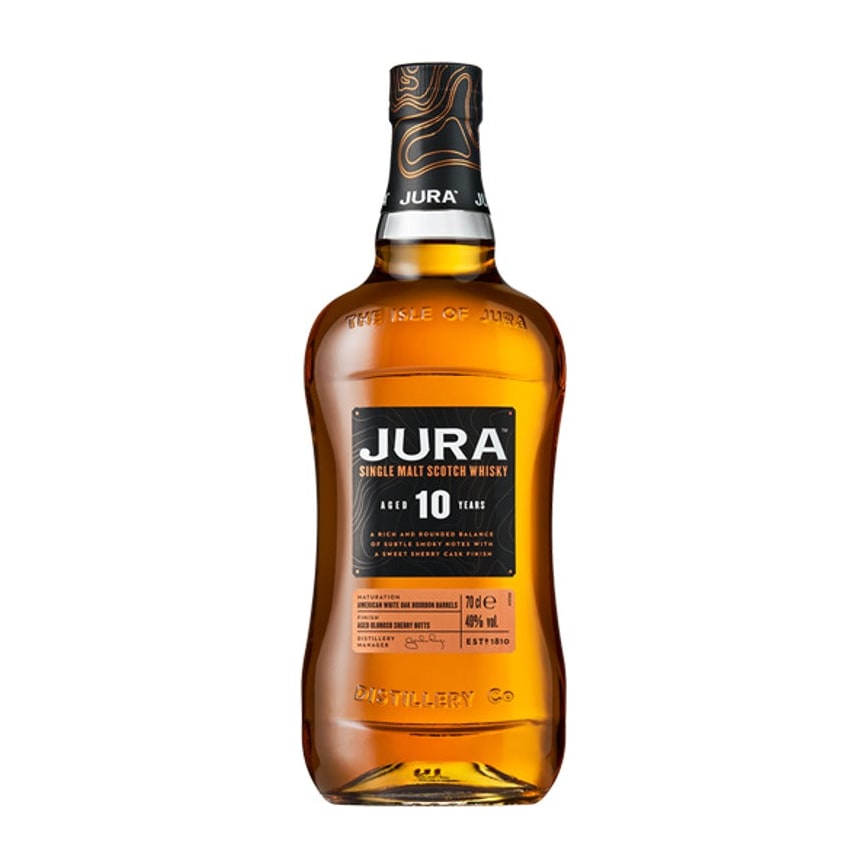
A different road from neighbouring Islay's peat. A smooth, faintly salty single malt reborn on an island of two hundred people.
You can't talk about Jura without its location. On a map it's the island right beside peat's spiritual home, Islay, yet its flavour heads almost the opposite way. Long-necked stills strip out the heavier compounds for a light, clean spirit, and most expressions use little or no peat. Come expecting Islay's big smoke and you meet a surprisingly gentle, malt-biscuit softness instead.
Today's Jura is a distillery that died and came back. It closed in the late 19th century — its equipment stripped out — and stayed silent for over half a century until, in 1963, local landowners brought in still designer Delme Evans to rebuild it and give the island work. So Jura's real history weighs less on the old licence date of 1810 than on that mid-20th-century revival to save an island community.
The island itself is the brand's identity. A population of some two hundred, more deer than people, and George Orwell writing 1984 at Barnhill in the north. What the bottle and the advertising sell is that isolation and story. It isn't a whisky that wins on bold character, but that backdrop is what makes Jura stick in the memory.
If you're buying, set expectations first. If you want smoky Islay, Jura isn't the answer. If peat feels like too much, or you want an easy first single malt, it's a good bridge. The sherry-finished 12yr generally gets the nod for balance, so start with the gentle 10yr or 12yr and gauge your taste from there.
Jura is priced less as an auction star than as a familiar island malt. It's an approachable entry-level bottle found easily in supermarkets and duty-free, with the 18- and 21-year expressions holding up the enthusiast end. Accessibility and story, not scarcity, are the value here.
Prices are rough duty-free / retail estimates — not a personal tasting.
By location Jura sits right beside peat's spiritual home, Islay, yet its flavour heads the opposite way. Long-necked stills strip out the heavier compounds for a light, clean spirit, and most expressions use little or no peat. Bourbon-cask maturation is the base, with sherry or wine finishes on the 12- and 18-year adding sweetness and fruit. Come expecting Islay's intensity and you meet, instead, a surprisingly gentle, malt-biscuit softness.
Distilling on Jura traces to an 1810 licence, but the distillery closed in the late 19th century — even its equipment stripped out — and stayed silent for over fifty years. Today's Jura is the result of a 1963 rebuild, when local landowners brought in still designer Delme Evans to give the island work. The backdrop of a remote island of some two hundred people, where deer outnumber humans, and George Orwell writing 1984 here, make up the brand's story.
Jura is remembered precisely for being next to Islay yet unlike it. It can read as tame to anyone expecting heavy peat, but its smooth, faintly salty character makes a good bridge for beginners who find smoky whisky too much. Its accessibility in Korea and duty-free makes it a common first single malt, while in the West opinion splits between 'lacks character' and 'easy to drink.' The sherry-finished 12yr draws the most praise for balance.
A light, clean character suits a tulip glass that gathers the aroma. Neat in a Glencairn, the malt biscuit, honey and light salinity come through. At around 40% ABV it needs little water, though the sherry- and wine-finished expressions open a touch more fruit with a single drop. Being gentle, it also survives a chilled highball without losing much aroma. Don't expect peat — approach it as an easy everyday dram.
Sources · Production & range — jurawhisky.com · History — Whyte & Mackay / trade sources · Product image — Jura