
One of the first questions serious whisky drinkers face is the glass. Should you buy a Glencairn? Is the ISO tasting glass better? What is a copita? Why does the Norlan cost so much?
All four were designed for the same purpose: delivering whisky's aroma efficiently to the nose. But their design philosophies differ, the whiskies they suit differ, and the situations they fit differ. There is no single right answer.
The Shared Principle
All four glasses share one structural logic: a bowl that is wide at the base and narrows toward the top. Whisky's aromatic compounds vaporise from the surface and accumulate in the headspace above. When the glass narrows upward, these vapours concentrate — arriving at the nose more intensely. A wide-mouthed rocks glass lets the aroma scatter in every direction.
The angle of the taper, the bowl's size, the presence of a stem, the thickness of the glass — alter any of these and the experience changes. That is where the four glasses diverge.
1. Glencairn — The Standard

Designed: 2001 | Capacity: ~180ml | Price: £8–12
William Davidson of Glencairn Crystal collaborated with master blenders from five major Scottish distilleries. The goal was a glass for drinking, not just professional evaluation. The result became the official glass of the Scotch Whisky Association — the de facto standard at whisky events and distillery tours worldwide.
The bowl opens wide from the base and narrows toward the top, converging slightly at the rim. No stem — held directly in the palm. A thick, heavy base provides stability.
Best for: Standard-strength whisky (40–46% ABV). Optimal balance of aroma delivery and everyday convenience.
Limitations: No stem means palm heat transfers into the whisky. The tapering rim concentrates aroma and alcohol vapour — at cask strength (55%+), the ethanol hit can be overwhelming.
2. ISO 3591 — Designed for Neutrality
Designed: 1970s | Origin: French INAO → ISO standard | Capacity: ~215ml | Price: £12–18
Formal name: ISO 3591:1977. Developed by France's INAO for official wine evaluation, adopted as an ISO specification. Used at the IWSC, San Francisco World Spirits Competition, and other major international competitions.
The long stem is the key feature. Holding the stem keeps palm temperature out of the equation entirely. Over the course of tasting multiple samples, the whisky stays at a stable temperature — allowing fair comparison across different expressions under identical conditions.
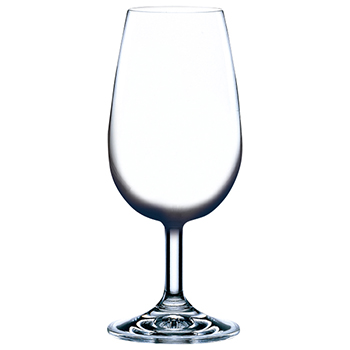
Best for: Systematic comparative tasting and blind evaluation of multiple whiskies.
Limitations: The stem makes it awkward for casual drinking. Thin walls break easily. The larger bowl allows some aroma dispersal.
3. Copita — From the Sherry Cellar

Origin: Jerez, Spain | Also known as: Dock Glass | Capacity: 120–150ml | Price: £8–18
Originated in the sherry-producing region of Jerez. Scottish distillery blenders adopted it early for professional evaluation. A significant proportion of tasting notes in Whisky Magazine and Whisky Advocate are written using a copita.
The bowl is narrower and more elongated than the Glencairn's. Aroma arrives in sequential layers — a first note, then a second, then a third. This layered unfolding is why tasting-note writers reach for the copita above all others.
Best for: Complex single malts — heavy sherry cask, peated, or finished expressions.
Limitations: The concentrated headspace makes cask-strength whisky overwhelming on the nose. Adding a small drop of water first is standard practice.
4. Norlan — The Modern Challenge
Designed: 2016 | Maker: Ragged Edge, UK | Capacity: ~170ml | Price: £28–40
Created by British design studio Ragged Edge, who identified structural flaws in the Glencairn and set out to solve them. The Kickstarter campaign hit 1,400% of its funding target.
The double-wall construction is the defining feature. An air gap between inner and outer walls acts as insulation — palm heat is blocked before reaching the whisky. A stemless glass that controls hand heat through structure. The inner surface carries a subtle ridged pattern to increase evaporating surface area, and the rim tapers more gently, reducing alcohol concentration.
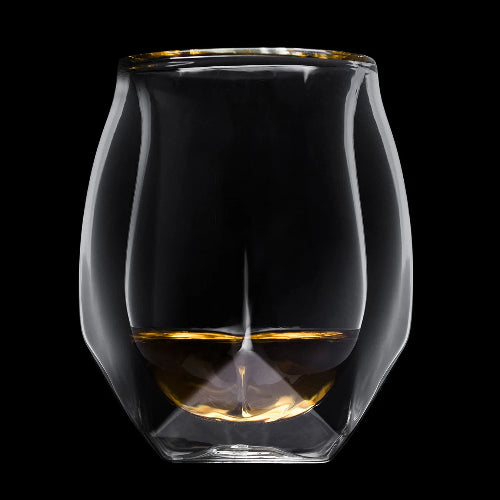
Best for: Cask-strength whisky (55%+ ABV). Most effective solution to alcohol harshness at high ABV.
Limitations: Water entering the double-wall gap does not drain naturally. No dishwasher use ever. Price is approximately three times the Glencairn.
Full Comparison
| Glencairn | ISO 3591 | Copita | Norlan | |
|---|---|---|---|---|
| Capacity | ~180ml | ~215ml | 120–150ml | ~170ml |
| Stem | No | Yes | Yes / No | No |
| Wall | Single | Single (thin) | Single | Double |
| Hand heat control | ✕ | ✓ | ✓ | ✓ |
| Aroma concentration | High | Medium | Very high | Medium–high |
| Alcohol harshness | Medium | Low | High | Low |
| Durability | High | Low | Medium | Medium |
| Dishwasher safe | ✓ | Caution | ✓ | ✕ |
| Official standard | SWA | ISO | Informal | Informal |
| Price (per glass) | £8–12 | £12–18 | £8–18 | £28–40 |
Which Glass Should You Choose
First nosing glass: Glencairn. Best-in-class for price, durability, and versatility.
Systematic comparison of multiple whiskies: ISO 3591. Most reliable when consistent conditions matter.
Deep aromatic analysis and tasting notes: Copita. Nothing separates aromatic layers better.
Frequent cask-strength drinking: Norlan. The most effective solution to alcohol harshness at high ABV.
The realistic recommendation: Glencairn for everyday drinking, copita for whiskies worth examining closely.
A good glass does not change the whisky. It lets you hear it more clearly.
Comments
Be the first to leave a comment.