
Hot coffee, whiskey poured in, and a collar of cream floated on top. Irish coffee is too warm to be a cocktail and too strong to be just coffee. And it's hard to talk about without talking about one glass: stemmed, footed, with a handle, clear all the way through. The drink and the glass were born in the same place — an airport bar in the west of Ireland, in the 1940s.
Foynes, where the flying boats came down
It's a quiet village now, but Foynes, in County Limerick, was once a gateway across the Atlantic. In the days of the flying boat — an aircraft that needed no runway, only water — passengers between Europe and North America came ashore here, landing on the river estuary. This is the late 1930s into the early '40s.
The trouble was the weather. The Atlantic route was often shut by storms, and a plane might fly for hours only to turn back. Wet, half-frozen passengers would find themselves returned to the terminal in the middle of the night.
As the story goes, in the winter of 1943 Joe Sheridan, who ran the kitchen there, tried to thaw them out by lacing their coffee with Irish whiskey. He melted in sugar and floated cream on top. When an American passenger asked whether it was Brazilian coffee, Sheridan is said to have answered, "No — it's Irish coffee." The name stuck.
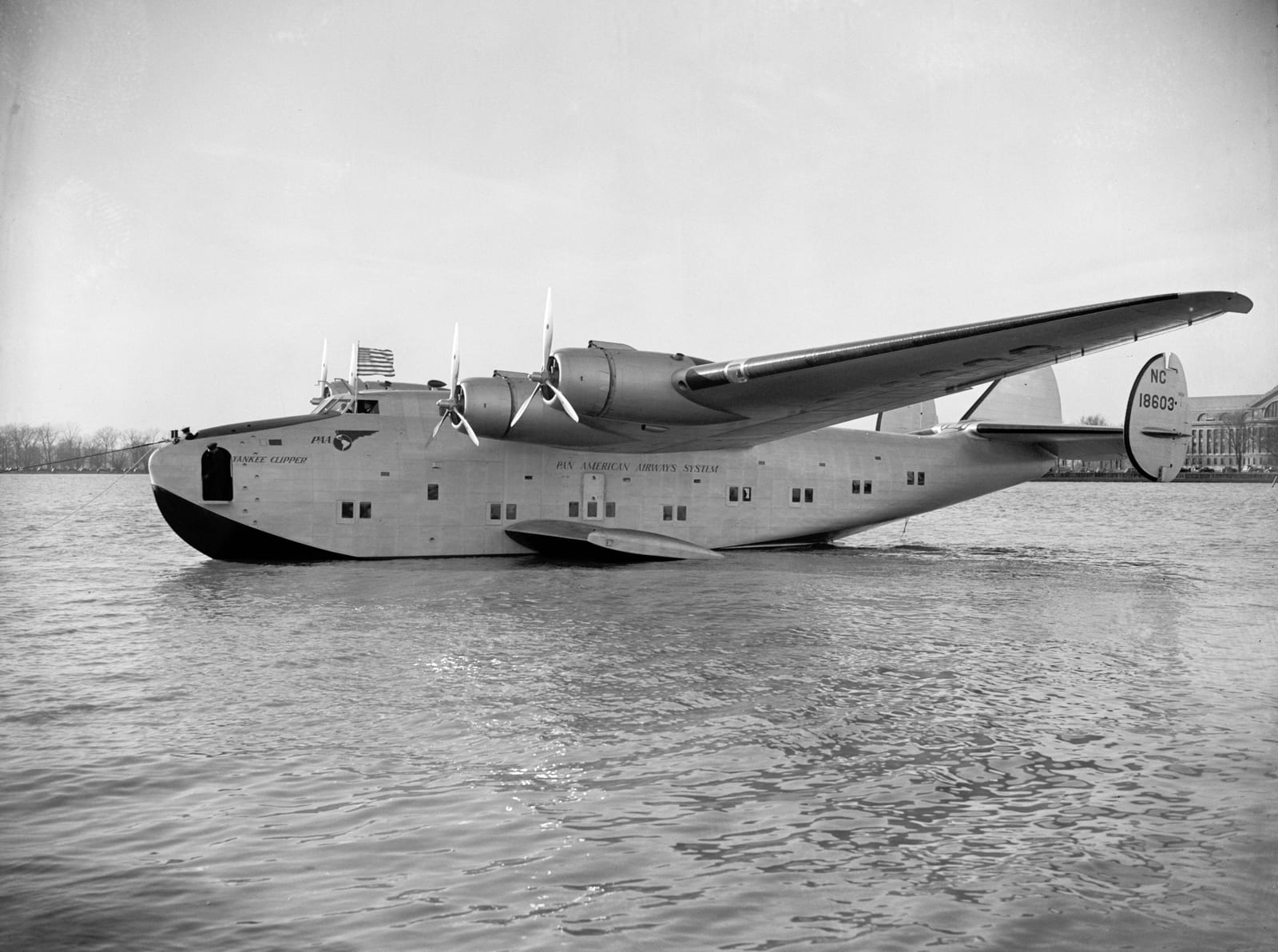
A Pan Am Boeing 314 "Yankee Clipper" flying boat, 1939 — the type that carried transatlantic passengers to Foynes, where they came down onto the water and stepped ashore.
Why the stem?
What sets Irish coffee apart from most cocktails is that it's a hot drink. And a glass full of hot liquid is hard to hold bare-handed for long.
So the glass got a stem, a foot, and a handle. Grip it low and it stays cool to the touch. A handleless mug burns your fingers; a ceramic cup hides what's inside. The Irish coffee glass took its present shape to avoid both.
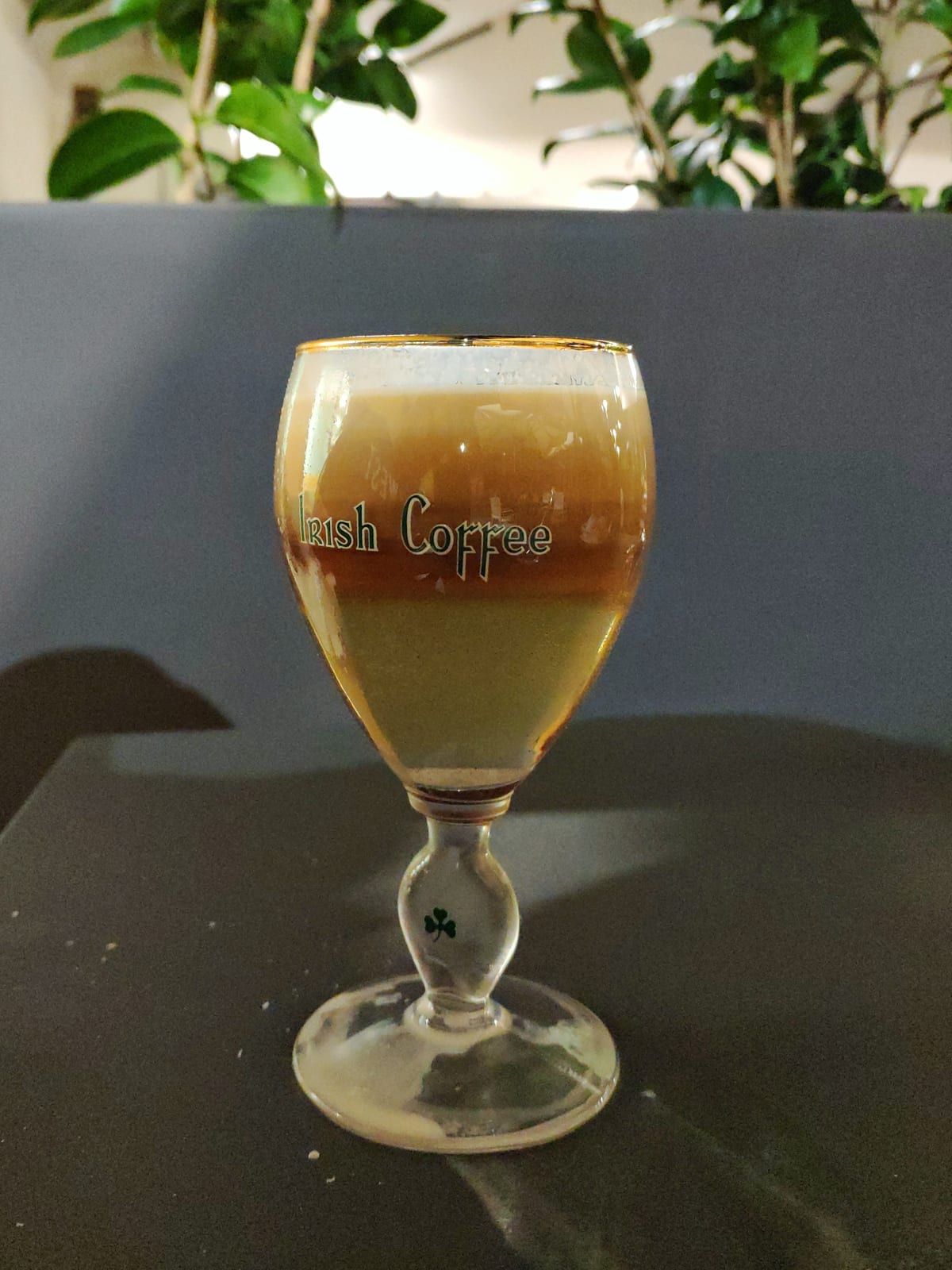
A clear glass with a stem, foot, and handle. You have to be able to see the white band of cream sitting on the dark coffee — that layering is what makes it Irish coffee.
The clear glass has a reason too. The white collar of cream over black coffee — those two layers need to read clearly, or the picture is gone. An opaque cup erases it.
Building the layer takes a knack. Dissolve enough sugar into the coffee to raise its density, then pour lightly whipped cream over the back of a spoon so it settles on top instead of sinking. When you drink, the hot coffee comes up through that cold cream — heat and cold, bitter and soft, folded into one sip. That's why the cream is left unstirred: it's the whole point.
The glass crosses the ocean
Foynes closed in 1945, handing over to Shannon Airport on dry land, but the glass survived and made the Atlantic crossing itself.
In 1952, Stanton Delaplane, a travel writer for the San Francisco Chronicle, brought the drink to America. He and Jack Koeppler, owner of the waterfront Buena Vista Cafe, set about recreating it — and the cream was the hardest part. It kept sinking; the layer wouldn't hold.
The break came, it's said, on the advice of George Christopher, then mayor of San Francisco and a dairyman by trade. Cream aged a couple of days, then lightly whipped, finally floated. The Buena Vista still pours thousands a day, and has become the name most people attach to Irish coffee.
The glass is the recipe
What makes Irish coffee special is that the glass isn't just a vessel — it's part of the method. Without the stem you can't hold it; opaque, you lose the layers; wrong in width or depth and the collar won't set. Every feature of the glass quietly dictates how the drink is meant to be had.
An airport-bar improvisation, meant to thaw out passengers who'd turned back, is used almost unchanged eighty years on. A warm drink on a cold night deserves a history like that.
Irish coffee — jules / stone soup, Wikimedia Commons (CC BY 2.0) · Boeing 314 "Yankee Clipper" flying boat (1939) — Harris & Ewing / Library of Congress (public domain) · Layered Irish coffee in a footed glass — Mannivu / Wikimedia Commons (CC BY-SA 4.0)