
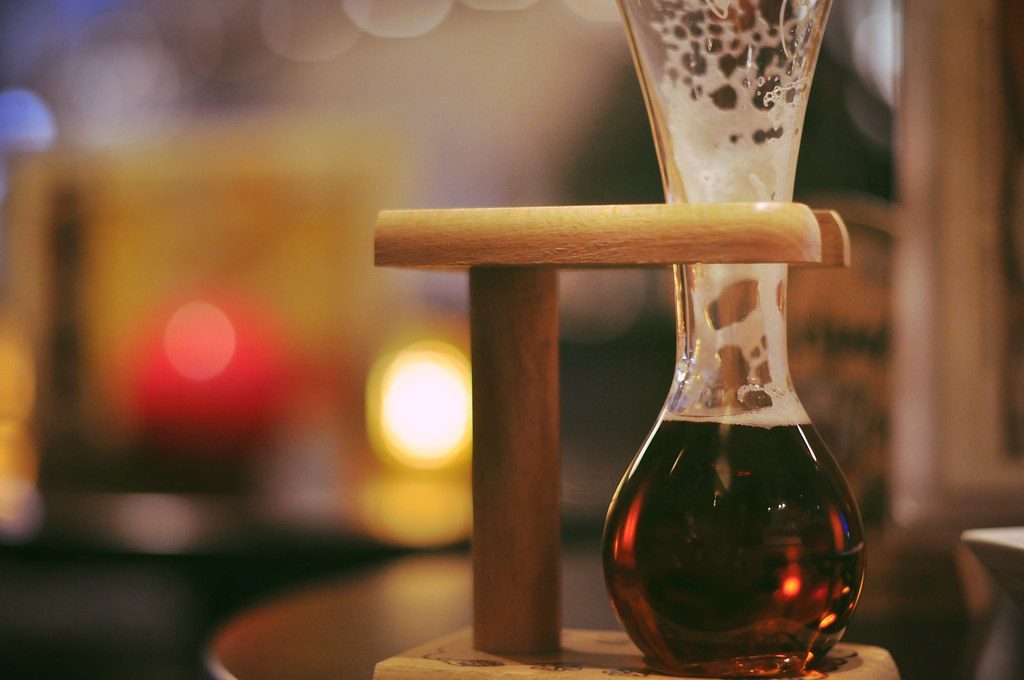
Anyone handed this glass at a bar is a little thrown. The bottom is a round bulb, the top narrows like an hourglass, and the whole thing comes in a wooden frame. Try setting the glass down on its own and it won't stand.
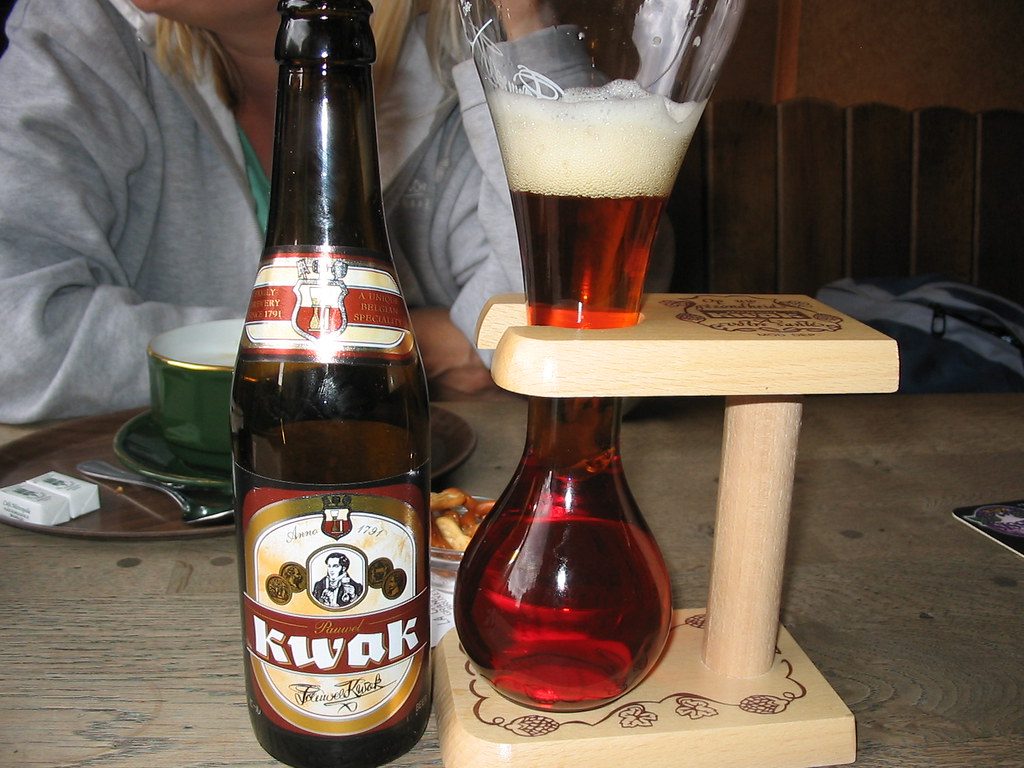
It's the glass for Kwak, a Belgian amber ale, and it comes with a famous story. Let's start with the brewery's own words.
The brewery's version
According to Bosteels Brewery's official page, Pauwel Kwak was a brewer and the owner of the De Hoorn inn in Dendermonde "at the time of Napoleon." Back then a coachman who stopped at an inn couldn't leave his coach and horses to get a drink, unlike his passengers, who went inside. The passengers drank, the coachman sat outside thirsty. So the inventive innkeeper had a special glass blown, one that could be hung safely on a coach, and the coachman could have a beer like everyone else.
Hence the "coachman's glass," koetsiersglas in Dutch. Plenty of write-ups describe the wooden frame as the part that hooks onto the coach. A beer magazine piece in English repeats the same account: hourglass shape, can't stand on its own, comes with a wooden support.
It sounds right. You can picture a driver reaching out and finding the glass right there.
The dates don't line up
Now put the sources side by side.
First, the Wikipedia entry on Bosteels Brewery. The brewery claims the innkeeper designed the glass "in the early 18th century" for coachmen. The same entry then notes that the beer and the glass were not launched until the 1980s.
The brewery's own page doesn't hide this either. In 1982, it says, Ivo Bosteels, inspired by the tale, created a special "Pauwel Kwak" amber beer and "recreated" the iconic glass design. Other sources say 1980, so the exact year varies. Either way it's over forty years ago.
Then there's a wobble inside the story itself. The official page says "the time of Napoleon." The brewery claim Wikipedia relays says "early 18th century." Napoleon was born in 1769 and became emperor in 1804. That's nearly a century apart. Each retelling seems to pick its own period.
Some write-ups go a step further and say the Napoleonic Code forbade coachmen from leaving their carriages. The Napoleonic Code is a civil code covering property, contracts and family law. I found nothing showing it contained a rule about coachmen and drinking, and the brewery's page doesn't say it. It looks like something added along the way.
So here's the summary. A beer launched in the 1980s was given the name of an 18th-century innkeeper and a story to match. I couldn't find an independent historical source confirming that a Pauwel Kwak or his inn existed. Wikipedia words it as the beer being "supposedly" named after him, and a US outlet went as far as calling the beer's history a piece of contemporary advertising.
Still a well-made glass
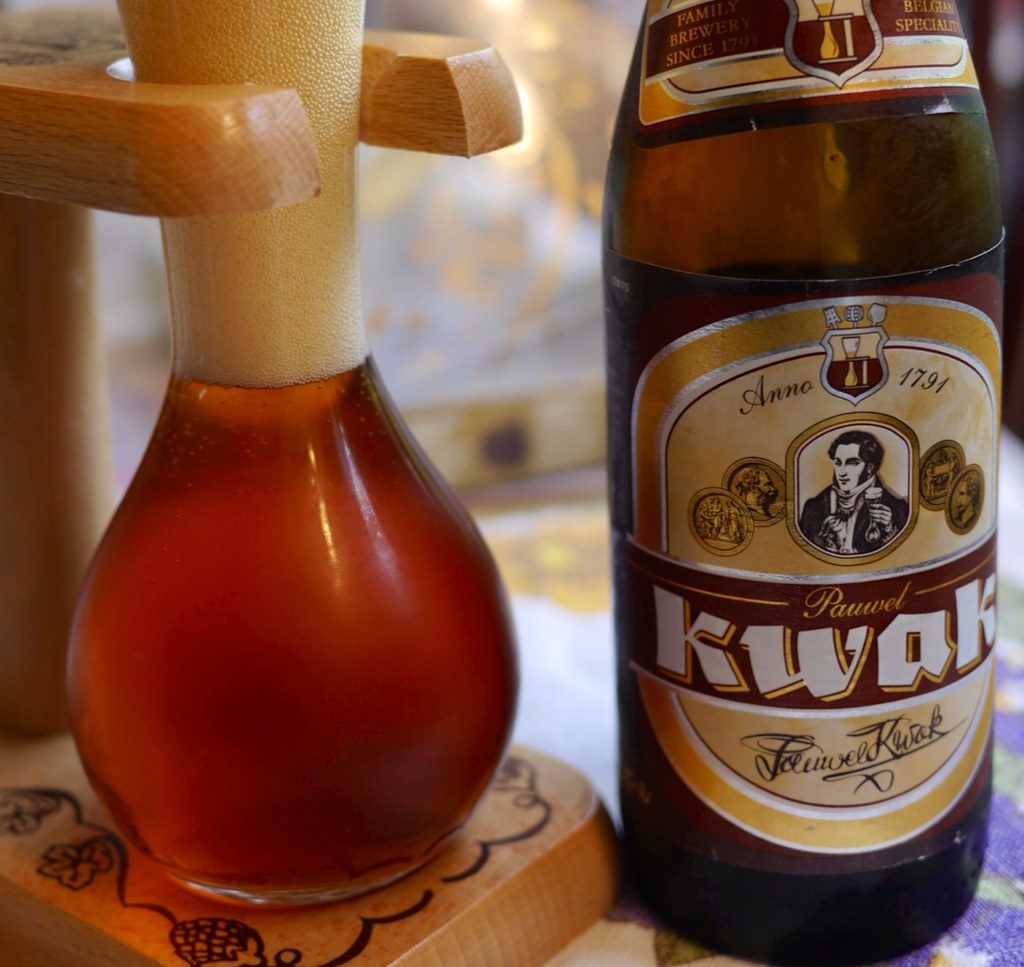
A marketing origin doesn't make it a bad glass.
Since the 1980s this glass has been the face of Kwak. It makes the beer recognizable across a bar. The flaw, that it can't stand, turned into a feature, the wooden frame. Down to the way people at the next table lean over to ask what that is, it's a successful piece of product design.
As for how the shape works in practice, the brewery's serving guide gives a hint. Tilt the glass to 45 degrees and fill the lower part first, then stand it up and keep pouring, then wait about 15 seconds until the head settles roughly 4 centimeters below the rim. Fill the round base first, then let the foam settle. That is the brewery's instruction; I haven't followed it myself.
Sizes are said to run from 0.3 to 1 litre. One beer site also mentions some Belgian bars taking your shoes as a deposit so the glass doesn't leave with you. That varies by bar, and I couldn't confirm anyone still does it.
How to look at it
As we saw in the history of the beer mug handle, a drinking vessel's shape usually has a practical reason behind it. The Kwak glass is the rare case where the shape came first and the reason was attached afterward.
That isn't a criticism. But if you read a piece saying it "was made for coachmen in the 18th century," it's worth a raised eyebrow. And if you're drinking one with a friend, "apparently this only dates from the 1980s" is the better line anyway.
If you've ever come across an old record or picture of coachmen actually drinking from a glass like this, I'd like to hear about it. Nothing I found shows one.
Bosteels Brewery official Kwak page (checked 2026.11.09) · Wikipedia, "Bosteels Brewery" · Beerology, "Vessels of Inspiration" (from TAPS Magazine, Winter 2010; posted 2011) · Shepherd Express, "Kwak Like a Duck" · 17.lambic.ru, "The legendary Kwak"