In Room 41 of the British Museum there is a glass cup about sixteen centimetres tall. With the case lights shining on it from the front, it's a dull olive colour, like old jade or set grease. Switch on a light inside the cup and the whole thing flushes red, as if someone had filled it to the brim with wine.
It's one cup. It isn't painted, and it isn't two layers of coloured glass stuck together. The same glass gives a different colour depending on which side the light comes from.
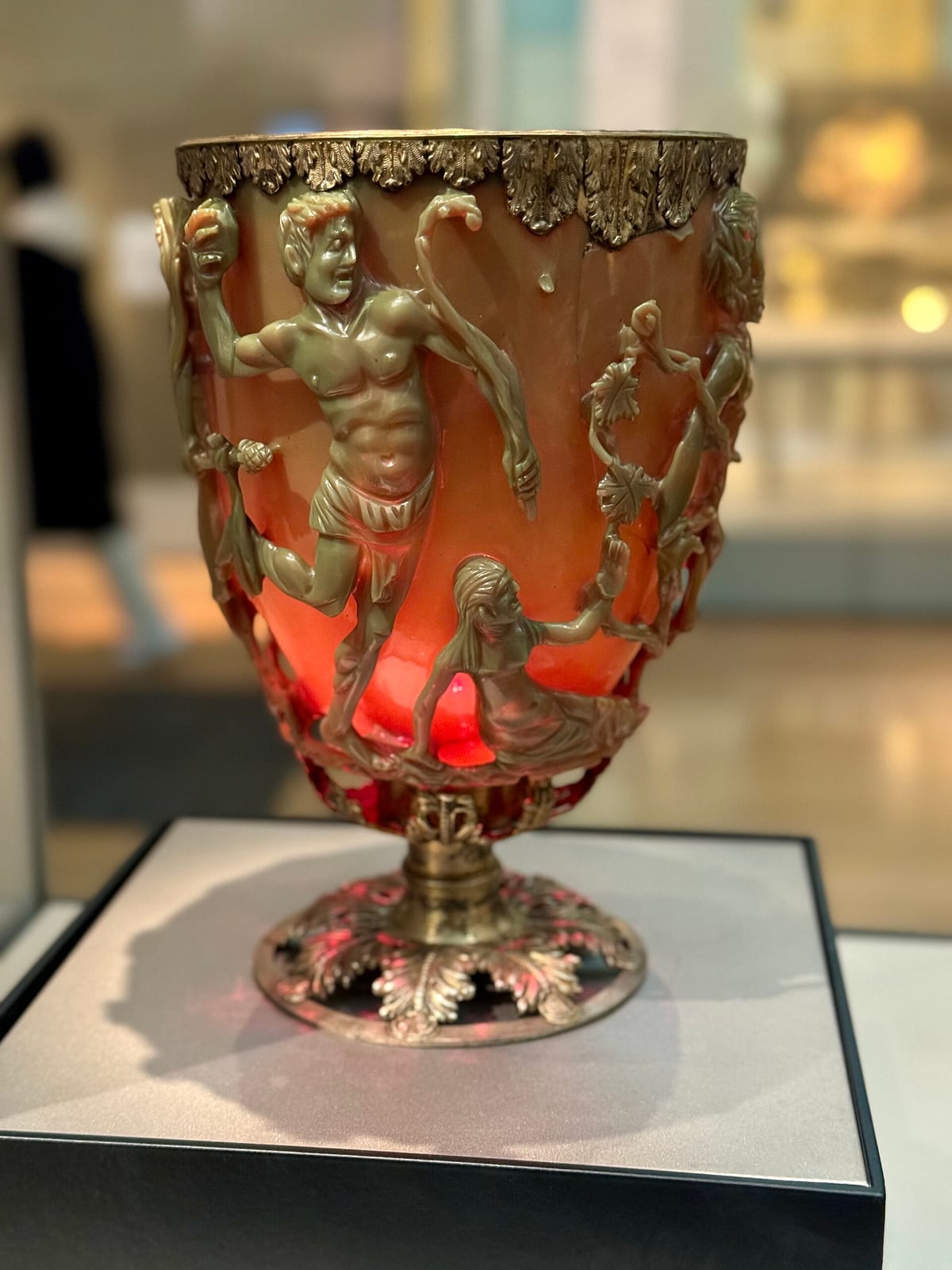
This is the Lycurgus Cup. It was made in Rome in the fourth century. Nobody properly explained the colour change until 1990.
At first nobody was sure it was glass
When the archaeologists Donald Harden and Jocelyn Toynbee began studying the cup in 1950, at Lord Rothschild's request, the first problem they hit was the material. Was it actually glass?
Nothing known about ancient glassmaking could produce that colour, so some suggested it might be carved jade or opal. G. F. Claringbull, Keeper of Mineralogy at the Natural History Museum, examined it and said glass, and X-ray diffraction confirmed it in 1959. Not stone, then. Which only moved the question along: if it's glass, what on earth is in it?
In reflected light it's an opaque greenish yellow; in transmitted light, a translucent ruby. A material that changes colour with the direction of the light is called dichroic. A handful of other Roman fragments behave this way, but the Lycurgus Cup is the only complete vessel.
What's carved on it is a man dying
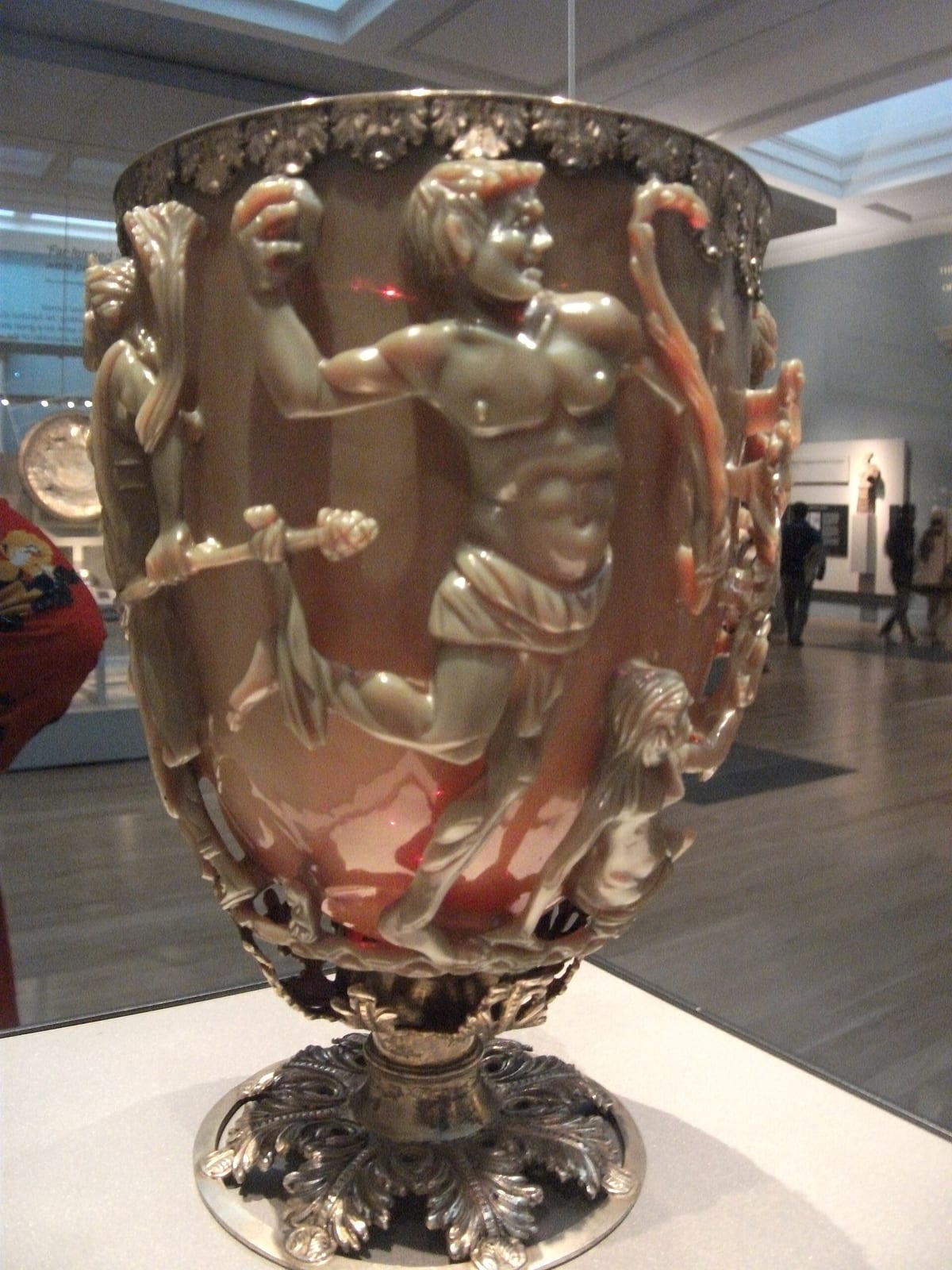
The colour gets all the attention, but the carving is just as unusual. The figures stand away from the body of the cup, floating in the air, attached to it only by a few small glass bridges.
The scene is the end of Lycurgus, king of the Edoni in Thrace. He first shows up in Book 6 of Homer's Iliad, as the king who drove off the women following Dionysus with an ox-goad and was punished by the gods for it. The cup shows a later, fuller version. The hot-tempered king attacks Ambrosia, one of Dionysus's maenads. She calls on Mother Earth and turns into a vine, and then, as a vine, wraps herself around him and holds him fast.
Turn the cup and the story runs on. Lycurgus struggling in the vines, Ambrosia crouching, a satyr with his arm raised to throw a rock, Pan, and Dionysus with one arm stretched out towards the king and a panther at his feet. Dionysus carries the thyrsus, the staff tipped with a pine cone.
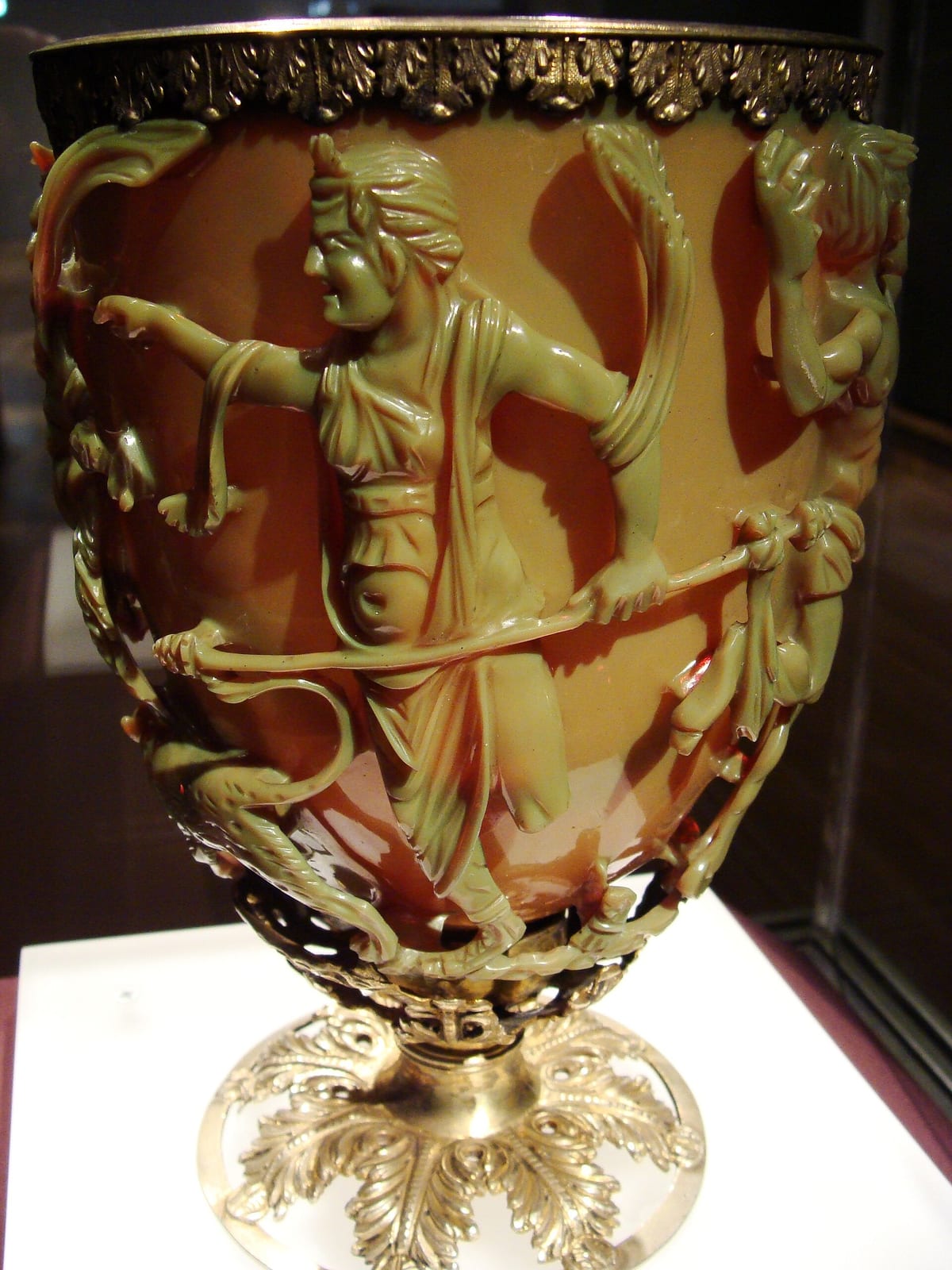
The god of wine binding the king who insulted him with a grapevine. It's hard to think of a better scene to put on a wine cup.
There's a political reading too. In 324 the emperor Constantine defeated Licinius, his co-emperor, who was executed the following year. On that reading Dionysus is Constantine and the punished king is Licinius. It's plausible. There's no proof.
Carved from a blank fifteen millimetres thick
Roman glass with openwork standing proud of the body like this is called a cage cup, or in Latin diatreta. Most date from the mid-third to the fourth century and have turned up all over the empire, but only something like fifty to a hundred survive, fragments included. Most carry a geometric lattice of linked circles. Very few have figures, and none as elaborate or as well preserved as the Lycurgus Cup.
How they were made has been argued over for a long time. The most widely accepted explanation goes like this: first make a thick glass blank in the shape of a cup, then grind and cut it away from the outside until only the design is left. In the 1960s Corning Glass Works made a replica blank with the same composition as the cup, and its walls had to be about fifteen millimetres thick. The cutter worked through that wall and then undercut behind the figures to open the gap between them and the cup. One slip and it was over.
When the cup's base was taken off in the 1950s, a few loose pieces of the original glass fell out. In 2007 a British Museum team put one of them, a piece of vine stem, under the microscope. Its sides carried crescent-shaped cut marks, the signature of a rotating wheel. The front and back showed the scratches of files and abrasives. Surfaces that had once been thought fire-polished turned out to be mechanically polished, with groups of fine parallel striations still visible. There is a rival theory, put forward by the German researcher Rosemarie Lierke, that cage cups were pressed into moulds while the glass was soft. This fragment, at least, pointed to cutting.
The Romans seem to have kept glassmakers (vitrearii) and glass cutters (diatretarii) separate. Whoever cut the Lycurgus Cup had skills closer to a gem engraver's.
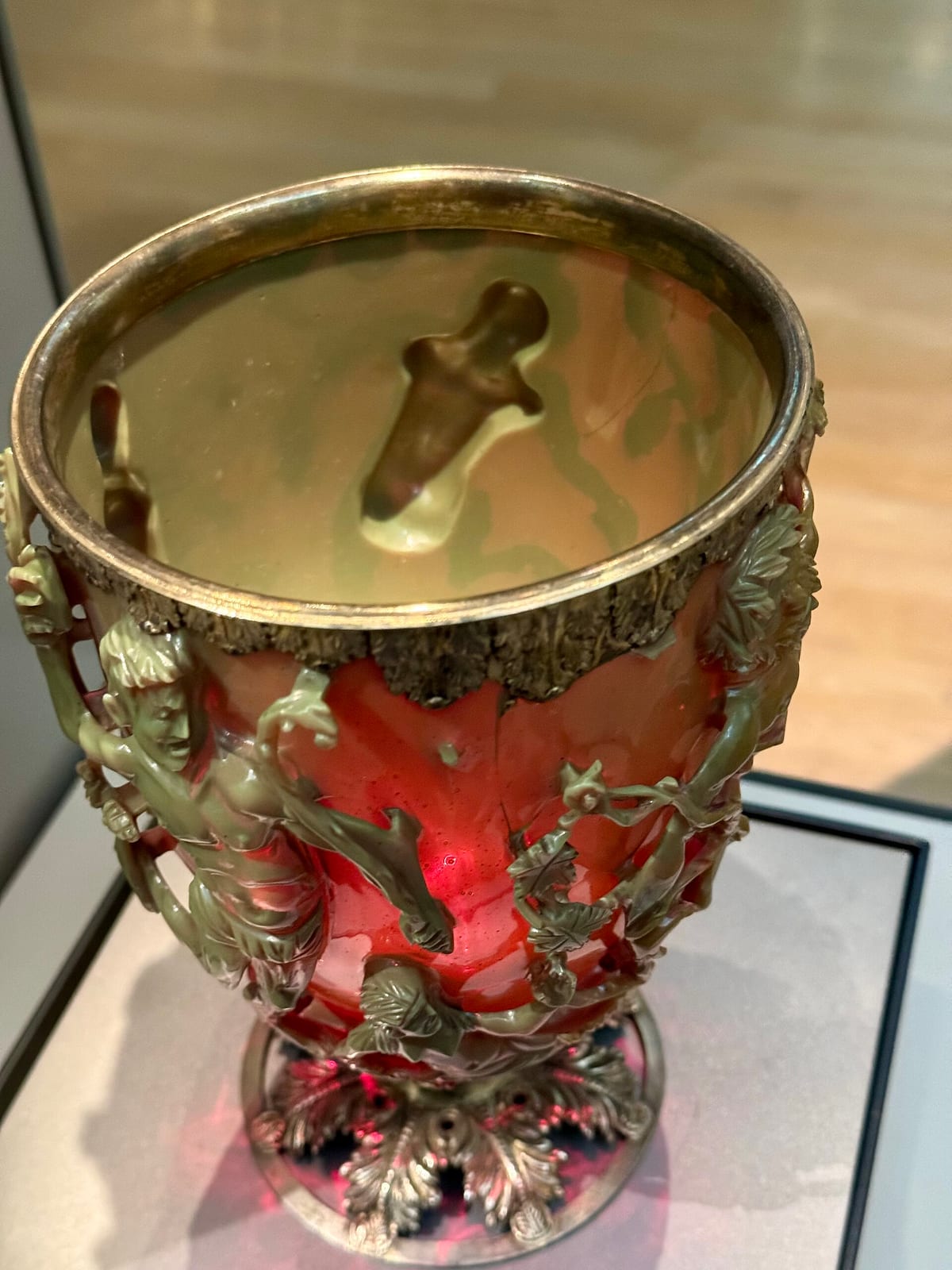
What's more remarkable is how they handled the colour. Behind the figures, the inside wall of the cup is hollowed out in the shape of each figure. Where a figure is attached, light has to pass through two thicknesses of glass, so they thinned the wall from inside to even it out. That way, when light shines through, the figures and the background redden together. And the body of Lycurgus was cut from a part of the blank that's a slightly different colour: more violet in transmitted light, more yellow in reflected light. They picked the spot so the main character would stand out.
There's almost no gold in it
In 1959 the British Museum sent a sample to the research labs of the General Electric Company (GEC) at Wembley. The glass turned out to be ordinary Roman stuff: soda-lime-silica, made from sand, soda and lime, the same family as modern window and bottle glass. But in the last one per cent or so of trace elements there was gold and silver.
From 1962 Robert Brill at the Corning Museum of Glass joined in. Melting his own experimental glasses, he confirmed that the dichroism was linked to about 40 parts per million of gold and about 300 of silver. Forty ppm is 0.04 grams of gold in a kilogram of glass. Melt down one ring and you could colour hundreds of cups like this.
What Brill couldn't do was show the decisive evidence, the metal particles themselves. The equipment of the day couldn't see them. It took until the late 1980s, when David Barber and Ian Freestone looked again with an analytical transmission electron microscope, for the particles to appear. The results came out in the journal Archaeometry in 1990.
- They were mostly 50 to 100 nanometres across, about a thousandth the width of a human hair.
- They were an alloy of silver and gold in a ratio of roughly 7 to 3, with about 10 per cent copper on top.
Size is the whole story. A lump of metal shines gold or silver. Break it into particles smaller than the wavelength of light and things change. The electrons at the particle surface slosh back and forth together in step with particular wavelengths, an effect called surface plasmon resonance. The gold–silver particles absorb or scatter the green part of the light and let the red through. From the front you see the murky green bounced back at you; shine light through from behind and you see red. Change the particle size or the gold–silver ratio a little and the colour shifts.
The microscope found something else too: crystals of sodium chloride, 15 to 100 nanometres across. The chlorine probably came from the mineral salts used as the alkali in the glass batch. Salt crystals are colourless, but halides are known to help gold develop colour in glass, so they may have played an indirect part. The antimony in the glass, about 0.3 per cent, probably helped turn the dissolved gold and silver back into metal particles.
Did the Romans know what they were doing?
Probably not. Not in the way we'd mean it, anyway.
As Freestone puts it, colouring glass with gold and silver in the Roman period was "something of a hit and miss affair". The concentrations of gold and silver, how evenly they were spread, the temperature and length of the heating, the atmosphere in the furnace: all of it had to line up. The other Roman dichroic glasses are all over the place in their gold and silver content. Another cage-cup fragment in the British Museum has 2,270 ppm of silver and only 13 ppm of gold, and it goes from an opalescent buff on the surface to a clear brown in transmitted light. Nothing like as dramatic. Even the blank for the Lycurgus Cup wasn't an even colour, as that differently tinted body of Lycurgus shows.
The glassmakers very likely didn't know gold was the key. Most of these glasses carry far more silver than gold. The gold may have gone in as electrum, the natural gold–silver alloy. As for how the effect was discovered, one guess is that metalworking waste was bought in as a glass colourant and the effect turned up by accident; another is an accident while making glass decorated with gold leaf. The high copper and lead in the glass fit the waste theory rather well.
What's certain is that the technique didn't last. There's no sign of it after the fourth century. People sometimes say the red of medieval stained glass came from gold, but every example analysed so far has been coloured with copper. Making red glass with gold on anything like a routine basis only arrived in seventeenth-century Europe, a discovery usually credited to the German glass chemist Johann Kunckel. Roughly thirteen hundred years passed between the Romans stumbling on it and Europe finding it again.
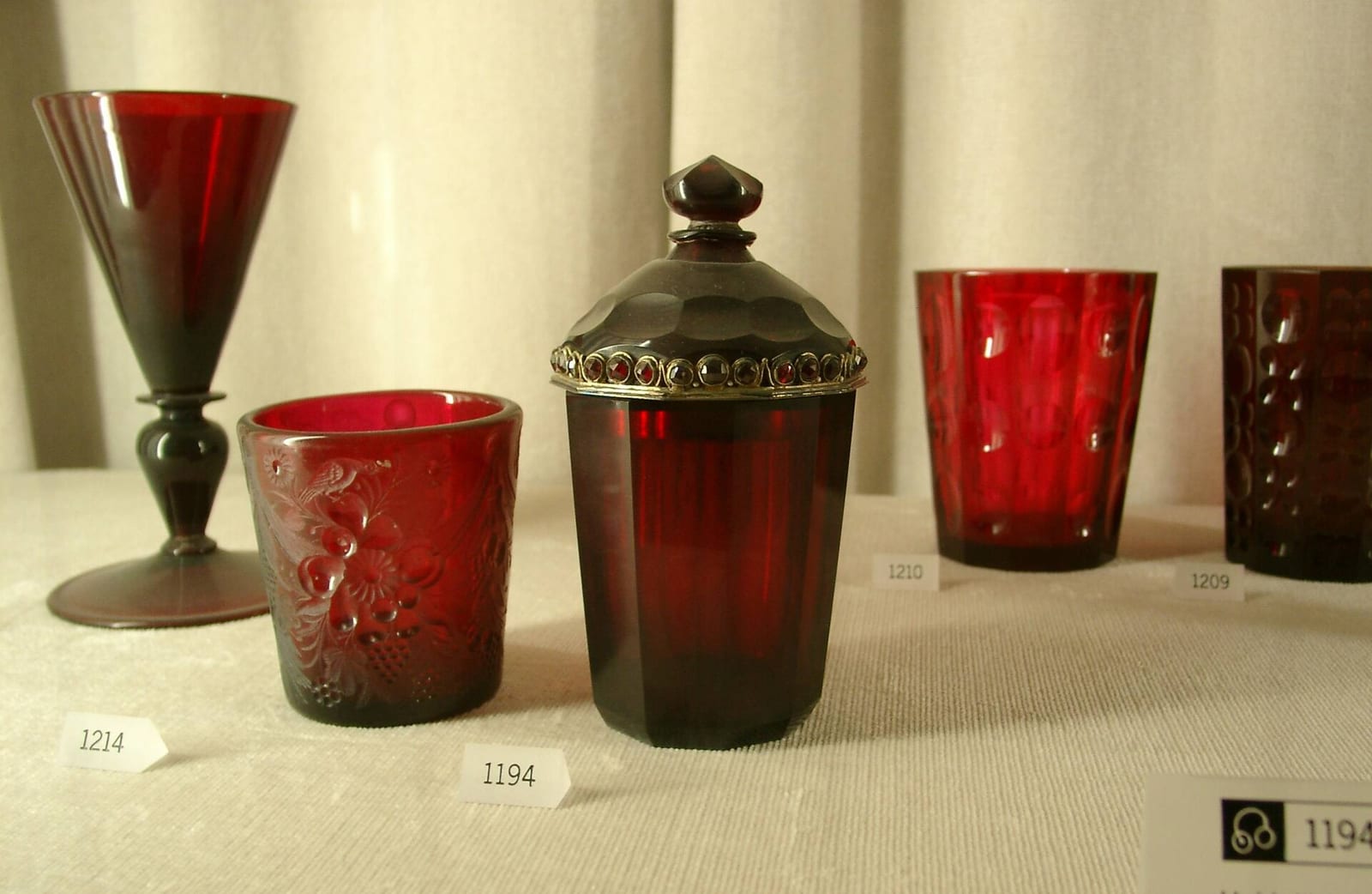
The first person to put his finger on why gold makes red was Michael Faraday, in 1857. He showed that gold broken down finely enough and dispersed in water makes a ruby-coloured liquid, and put the colour down to the tiny size of the gold particles. The answer the Lycurgus Cup had been holding for fifteen hundred years was right there. Confirming it inside the cup took another hundred and thirty-odd years.
An emperor's gift of cups that change colour
There's a text that hints at how the Romans saw these cups. The Historia Augusta, a collection of imperial biographies, includes a letter supposedly sent by the emperor Hadrian to his brother-in-law.
"I have sent you parti-coloured cups that change colour, presented to me by the priest of a temple. They are specially dedicated to you and my sister. I would like you to use them at banquets on feast days."
The Latin calls them calices allassontes, "allassontes" being a Greek word for changing, spelled out in Latin letters. Hadrian lived in the second century, and the letter is almost certainly made up. The Historia Augusta is notorious for forged documents and invented people. It's still useful. It shows that around the fourth century, when the book was written, its author knew about colour-changing cups, thought of them as precious enough to be an emperor's gift to family, and placed them on the table at feast-day banquets.
David Whitehouse, a former director of the Corning Museum of Glass, went a step further. Green turning to red, he suggested, is the grape ripening, and the cup was made for Dionysian celebrations. Vines, the god of wine, and a colour that ripens like fruit, all on one cup. That's a lot of coincidence.
The other cage cups carved a toast
Where the Lycurgus Cup carries a myth, other cage cups usually carry words. A band of glass letters floats around the top, above the lattice.
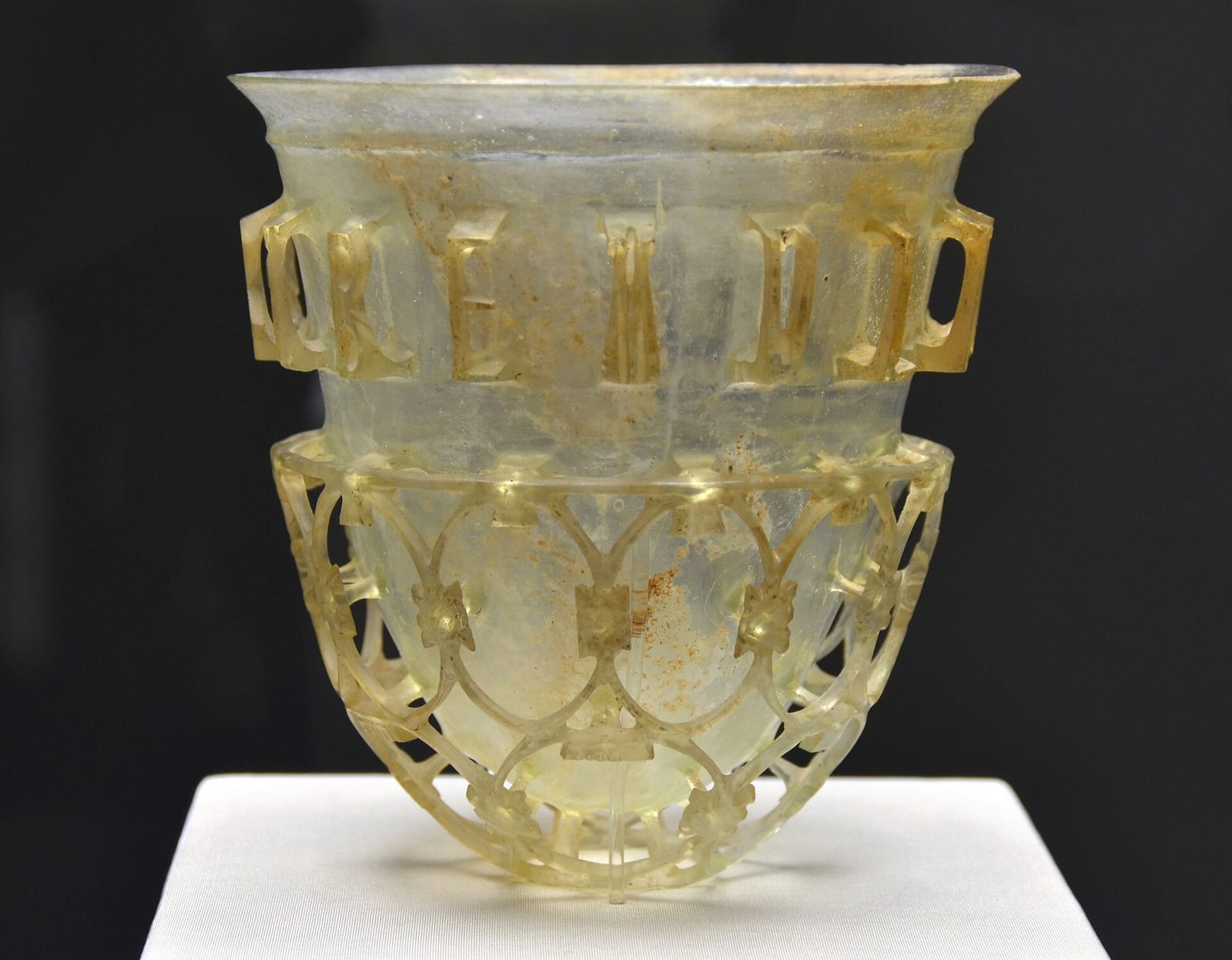
The Trivulzio cup in Milan says BIBE VIVAS MULTIS ANNIS, "drink, and live many years". The Cologne cup says, in Greek, "drink, live well forever". They are all invitations to drink. The kind of wish we now make when we clink glasses, the Romans carved straight into the glass.
Not every cage cup was a drinking cup, though. The wide bowl-shaped ones may have been hanging oil lamps; the one at Corning still had copper fittings for suspension. The beaker-shaped ones with inscriptions are taken to be cups passed around at feasts. Either way, these were never everyday tableware. In 2004 a bowl-shaped cage cup sold at auction for about £2.65 million.
Before 1845, nobody knows
Nobody knows where the Lycurgus Cup was found or who dug it up. It first appears in print in 1845, when a French writer mentioned having seen it "some years ago, in the hands of M. Dubois". By 1857 it belonged to Lionel de Rothschild in London, and in 1862 it was lent to an exhibition at the South Kensington Museum, today's V&A. For most of the next century it stayed with the Rothschilds.
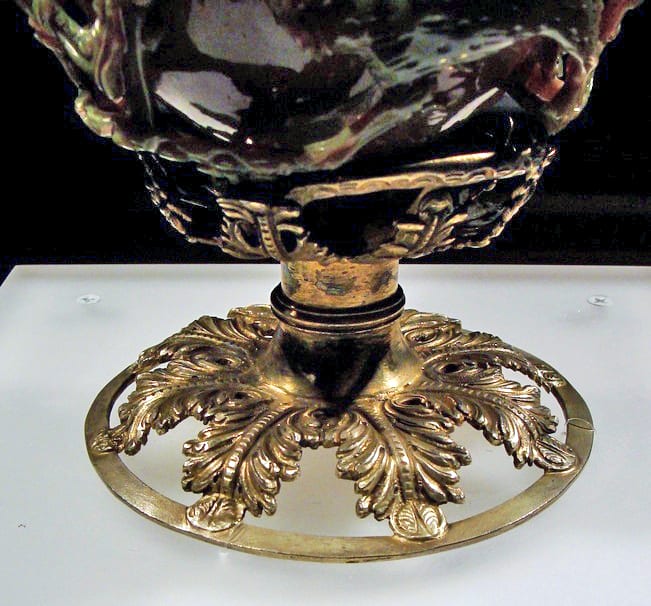
The silver-gilt mounts at top and bottom aren't original either. Someone added them in the eighteenth or nineteenth century. The cup would once have had an openwork base, and perhaps a taller rim. At some point it broke, and the damage was covered with metal. The fragments used in that tool-mark study are the ones that came out when the foot was removed. The foot went back on in 1973.
In 1958 Victor, Lord Rothschild sold the cup to the British Museum for £20,000, £2,000 of it put up by the National Art Collections Fund, now the Art Fund. Its museum number is 1958,1202.1.
And then into a sensor lab
In 2013 a team led by Logan Liu at the University of Illinois published a device named after the cup. They stamped a plastic sheet with huge numbers of tiny cup-shaped structures and coated them with gold and silver, a "nano Lycurgus cup array". Drop a liquid on it, whether water, oil or alcohol, and the sheet shows a different colour for each. You can read the difference with your eyes or an ordinary camera instead of a spectrometer. The team reported it to be about a hundred times more sensitive than other nanoplasmonic devices.
The team also guessed that the original cup would have changed colour depending on what was in it. What fills the cup changes how light bends at the glass, which changes what the particles respond to. So the cup may have looked different with water in it than with wine. There's no way to check. The British Museum is not about to let anyone pour anything into it.
D. B. Harden & J. M. C. Toynbee, The Rothschild Lycurgus Cup, Archaeologia 97, 1959 · R. H. Brill, The Chemistry of the Lycurgus Cup, Proc. 7th International Congress on Glass, 1965 · D. J. Barber & I. C. Freestone, An Investigation of the Origin of the Colour of the Lycurgus Cup by Analytical Transmission Electron Microscopy, Archaeometry 32, 1990 · I. Freestone, N. Meeks, M. Sax & C. Higgitt, The Lycurgus Cup — A Roman Nanotechnology, Gold Bulletin 40(4), 2007 · D. Whitehouse, Roman Dichroic Glass: Two Contemporary Descriptions?, Journal of Glass Studies 31, 1989 · M. R. Gartia, G. L. Liu et al., Colorimetric Plasmon Resonance Imaging Using Nano Lycurgus Cup Arrays, Advanced Optical Materials 1(1), 2013