
Glasses raised, eyes meeting, a clink. The gesture is universal — "Geonbae" in Korean, "Prost" in German, "Cheers" in English, "Santé" in French. But why strike the glasses together at all? A raised cup or a nod could mark the shared moment just as clearly. Why the collision?
The most common explanation: medieval nobles poisoned rivals so often that guests began clinking hard enough to slosh liquid between cups, proving nothing had been spiked. It sounds plausible. It is false.
Why the Poison Theory Fails
When glasses clink, liquid occasionally sloshes — mostly onto the table. The amount that reaches another person's cup is negligible; any poison already diluted in a full glass would be harmless in trace form. More fundamentally, the tradition of drinking to someone's health predates individual cups entirely. In ancient Greece and Rome, multiple people shared a single large vessel, the krater. The "cross-contaminate to test for poison" logic only functions after personal glassware became standard. Snopes, Ripley's, and most food historians have put this theory to rest.
The Greek Symposion — A Drinking Event With Rules
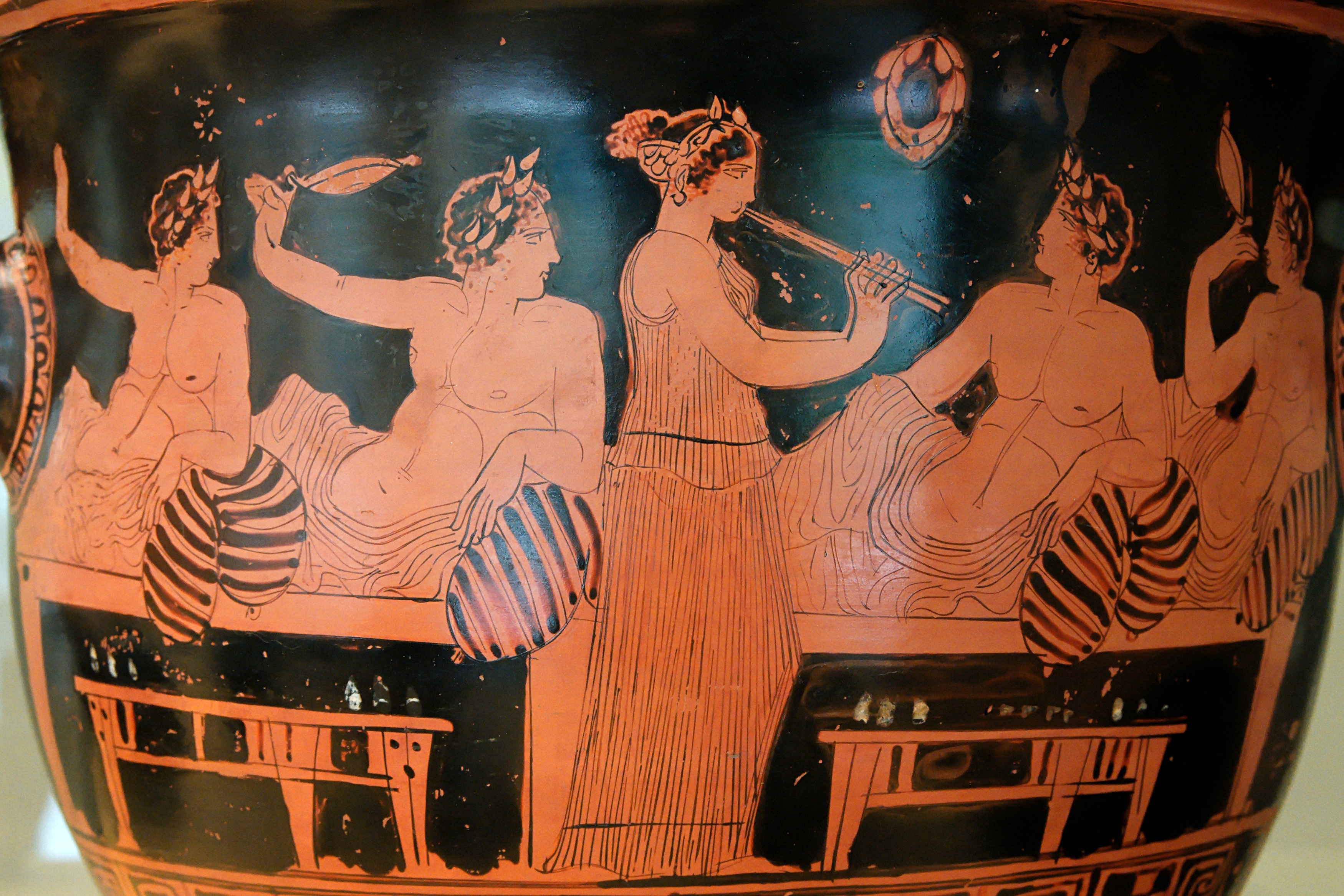
The oldest recorded form of the toast is the Greek libation (σπονδή, spondē), attested from at least the 6th century BC. Before drinking at a symposion, guests would raise a cup and pour a small amount of wine onto the floor or altar as an offering to the gods — Dionysus especially. The act of raising a cup to consecrate the occasion was as much a shared public declaration as a private act of piety.
The symposion itself was highly structured. Guests reclined on couches arranged around the room. Wine was diluted with water in a krater at the centre of the room — drinking undiluted wine was considered barbaric. Drinking proceeded from right to left (counter-solar direction), accompanied by designated singers, speakers, and those chosen to pronounce toasts. Plato's Symposion — where Socrates, Aristophanes, and Alcibiades debate the nature of Eros — takes place entirely within this format.
Roman Convivium — Drinking to the Emperor
Rome's equivalent was the convivium (literally "living together"), a formal dinner with ritual drinking. The leap from "drink to the gods" to "drink to this specific person's health" was complete in Rome's republican period; by the imperial era it had become politically mandatory.
In 27 BC, the Roman Senate passed a resolution requiring citizens to drink to the health of Augustus Caesar. Ovid's Ars Amatoria describes a custom of draining as many cups as there are letters in a lover's name — the longer the name, the more you drank.
Where "Toast" Comes From — A Piece of Bread
The English word "toast" has a literal culinary origin. 17th-century English wine was often acidic or off. A common fix was to float a piece of toasted bread in the wine: the char absorbed impurities and neutralised acidity. When honouring someone at a gathering, the toasted bread would be placed in the cup before drinking. The person being honoured became "the toast of the evening." By the 18th century, the bread had disappeared but the word remained.
Richard Steele's 1709 essay in The Tatler documents the word in transition, describing a Bath socialite declared "the toast of the assembly." Samuel Johnson's 1755 dictionary formally defines "toast" as both the act of drinking to someone's health and the person so honoured.
Two Medieval Theories — Spirits and Sound

Medieval European folk belief held that alcohol could harbour evil spirits. Clinking glasses produced a bell-like tone; church bells were thought to repel demons. The clink drove spirits away; spilling a little was an offering to appease them. Evidence is thin, but the belief reinforced the physical gesture.
The more historically grounded explanation comes from cultural historian Margaret Visser. When Venetian glassmakers developed lead crystal in the 17th century, glasses acquired a new acoustic property: a clear, resonant ring when struck. Earlier vessels — wood, clay, pewter, early glass — produced dull thuds or nothing. Lead crystal produced music.
Visser argues this added hearing to the sensory experience of drinking. Taste, smell, touch, sight — all already engaged. The deliberate production of that sound became a natural extension of the ritual. The clinking of glasses was no longer incidental; it was a small performance.
The 18th-Century Toastmaster
By the 18th century, English upper-class dinners had formalised toasting to the point of requiring a designated toastmaster — an official whose role was to manage the sequence of toasts and prevent excess. In an era when declining a toast proposed in your honour was considered an insult, meals could devolve into rounds of obligatory drinking. The toastmaster maintained order.
Victorian toasting etiquette was further codified: you must stand to propose a toast; the health of the sovereign is drunk with particular formality; you do not drink your own toast. "Ladies and gentlemen, please be upstanding" — heard at formal dinners today — is a survival of this tradition.
What the Words Mean
| Language | Expression | Literal meaning |
|---|---|---|
| Korean / Chinese | 건배 / 干杯 | Empty the cup |
| German | Prost | May it be good (Latin: prosit) |
| English | Cheers | Joy, encouragement |
| French | Santé | Health |
| Italian | Salute | Health |
| Japanese | 乾杯 (Kanpai) | Empty the cup |
| Russian | На здоровье | To your health |
| Hebrew | L'chaim (לְחַיִּים) | To life |
The East Asian "dry cup" imperative is a command to finish — in Korea and China, a toast often means a single shot. Most European traditions carry no such obligation. The gesture is the same; the social pressure varies enormously.
The Hungarian Eye-Contact Rule
In Germany, France, and especially Hungary, failing to make eye contact during a toast is considered bad luck — seven years of poor romantic fortune in some versions. Hungary's version has a specific origin story.
In 1849, Austrian forces executed thirteen Hungarian revolutionary leaders (the "Thirteen Martyrs of Arad") and reportedly clinked beer mugs in celebration. Hungarians are said to have vowed not to clink glasses for 150 years — a pledge that expired in 1999. The residue of that oath lives on as an insistence that eye contact be deliberately maintained: the clink is permitted, but only with full intention.
Why Drinking Together Builds Trust
Behavioural research suggests that communal drinking — consuming the same substance at the same time — triggers genuine trust signals. The act of producing a shared sound by clinking takes this further: the tone is not something either person hears alone. It exists only when both cups meet. It is, briefly, something made together.
That may be why the gesture persists across cultures that share none of the historical origin stories — and why negotiations, reconciliations, and celebrations still reach for a glass. The reason does not need to be known. The body already understands it.
Photo CreditsGreek symposion scene (Nicias Painter, c. 4th century BC) © Wikimedia Commons, Public Domain · Oktoberfest Prost © Wikimedia Commons (CC BY-SA)
Reader Notes
Be the first to leave a note.