
Everyone has a summer memory of pulling a frosted beer mug out of the freezer. That cold feels so good that, the next time the same hand reaches for a whisky glass, the thought surfaces — wouldn't this be better frozen too? The short answer is "usually not," but to understand the usually, you first have to see what cold actually does to a drink.
Why we freeze beer glasses doesn't carry over to whisky
We chill a beer glass for the temperature, not for the beer. Lager is meant to be drunk cold, and a warm glass heats it up fast. A frosted glass slows that warming and props up the very sensation of coldness; foam and carbonation also last longer when cold. Aroma is barely a factor here — the appeal of a lager is its crispness, not a complex bouquet.
Whisky sits at the opposite pole. More than half of a neat whisky is drunk through the nose. The vanilla, fruit, honey, and smoke that rise as you bury your nose in the glass — that aroma is what makes whisky whisky. And aroma is extraordinarily sensitive to temperature.
The instinct that colder is better is lager logic. For a drink where temperature matters more than aroma, it holds. But carry that logic straight over to whisky, where aroma is the very body of the drink, and you lose more than you gain. The moment you freeze the glass, what you are really doing is switching the aroma off.
So the question has to change. Not "is it better chilled?" but "what do I want from this glass right now?" — aroma, or refreshment?
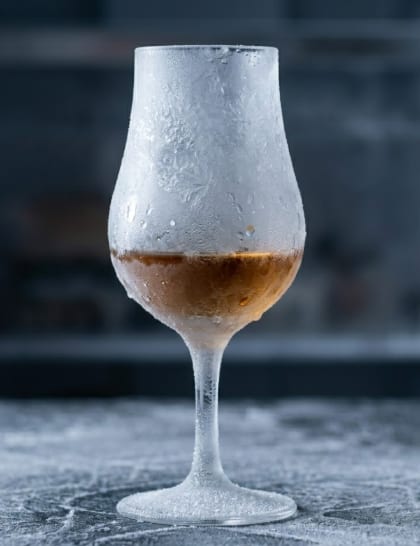
Frost on a glass just out of the freezer. For beer that cold is the appeal itself; for whisky it becomes a film that smothers the aroma. The same cold works in opposite directions depending on the drink.
What cold does to aroma
For aroma to reach your nose, it first has to evaporate out of the liquid into the air. The volatile molecules that make up whisky's aroma — esters, aldehydes, phenols — evaporate eagerly when warm and stay trapped in the glass when cold. As the temperature drops, the vapour pressure of these molecules falls and less aroma gathers in the headspace above the liquid. That is why cold whisky smells flat, as if the nose were shut. The aroma hasn't vanished; it just hasn't made it out of the liquid yet.
This is also why cradling the glass to warm it, or giving it a gentle swirl, brings the aroma back — both motions help evaporation. It's the same reason distillery tasting rooms serve whisky not chilled but at room temperature, sometimes a touch warmer. To draw out the most aroma you don't lower the temperature; if anything you raise it.
Here the shape of the glass and its temperature pull toward the same goal. A nosing glass that narrows at the rim, like a Glencairn or a copita, gathers the aroma as it rises, and a room-temperature glass lets enough of it rise in the first place. Freeze the glass and you shrink the very aroma the shape was meant to collect.
So why do we want it cold at all
If cold only muted aroma, the story would be simple — but it isn't. Cold makes one thing distinctly better: it tames the sting of the alcohol.
That nose-prickling sharpness, the hot rasp on the tongue, comes largely from ethanol. Ethanol is volatile too, so when cold it evaporates less, just like the aroma molecules, and its bite softens. The higher the proof, the more this matters. Sip a near-60% cask-strength whisky neat at room temperature and the aroma can be walled off behind alcohol; chill it slightly and that wall comes down.
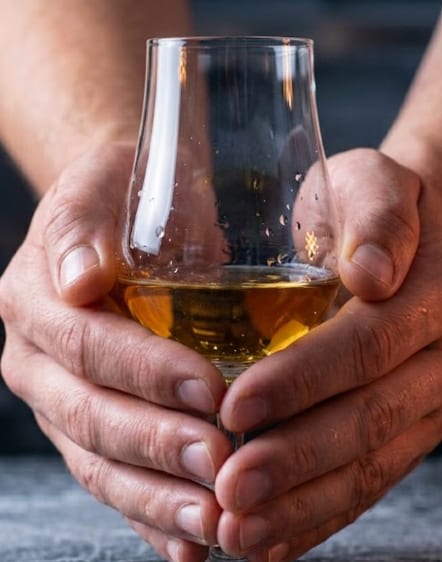
Cradle the glass in your hands and the warmth of your palms warms the whisky, coaxing the trapped aroma upward — if cold suppresses the sting of alcohol, warmth lifts the aroma. The temperature of whisky is always a trade between the two.
So the real nature of cold is a trade. It relieves the sting of the alcohol, but it relieves the complexity of the aroma by exactly as much. Press down one side and the other goes down with it — both lean on the same property, volatility.
That's why the answer depends on the drink and the purpose. For a matured single malt whose delicate aroma you mean to savour, the trade is a loss. For a setting where ease of drinking matters more than aroma, or a high-proof whisky where the alcohol dominates, a little cold can help.
There's an important distinction here, too. Chilling the glass and chilling the whisky are not the same thing. What governs aroma and bite is, in the end, the temperature of the liquid, not the temperature of the glass. A frozen glass does cool the whisky as it's poured in, but the effect is neither even nor predictable. If you want to soften the proof, adding a few drops of water or a single small cube is far easier to control than freezing the glass.
Condensation, the hidden catch
A frozen glass brings a second problem, separate from aroma — condensation. Cold glass pulls moisture out of the air and forms frost and beads of water on its surface. When the water gathered inside the glass melts into the whisky, you get a dilution you never intended. A few drops of water to open the aroma is deliberate dilution; condensation is random dilution you can control neither the amount nor the timing of. With beer it's nothing to worry about, but in a whisky where you weigh the strength of every sip, it's not trivial.
The other trouble with a frosted glass is that the cold doesn't last. Over the course of slowly emptying one dram, the glass drifts back to the temperature of your hand and the air. You'd be accepting condensation and lost aroma for the sake of the chill in the first few sips — which fits poorly with the way whisky is meant to be savoured.
So when to chill, and when to leave it
To sum up, the choice comes down to the character of the occasion.
Neat and nosing — leave it at room temperature. If you've poured a dram to savour its aroma, there's no reason to freeze the glass. A room-temperature glass, with the whisky at room temperature too — that's the condition in which aroma opens widest. If anything, cradle the glass to warm it slightly.
Highballs and on the rocks — a cold glass is fine. When refreshment is the lead rather than aromatic complexity — a highball or a drink on the rocks — a cold glass keeps it cool longer. Lager logic works here. But the ice is already doing that job, so it isn't essential.
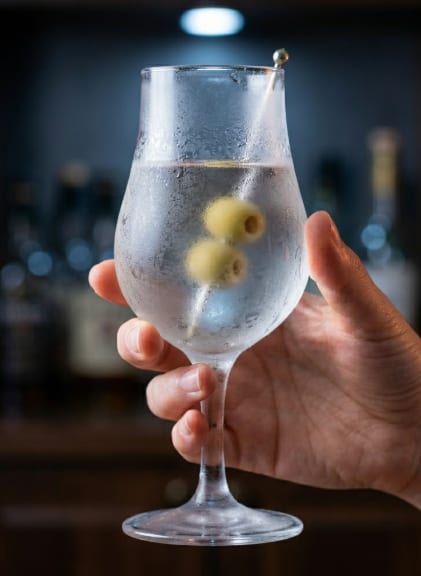
Where refreshment leads, a cold glass earns its keep. In a straight-up cocktail served without ice, a pre-chilled glass is the only way to hold temperature without dilution.
Cocktails served without ice — chill the glass. Whisky cocktails served cold without ice, like a Manhattan or a Sazerac, are the exception. If the glass itself isn't cold the drink turns tepid fast, and since you can't add ice, a pre-chilled glass is the only way to hold the temperature. It's why cocktail bars keep coupes and Nick & Nora glasses in the fridge.
High-proof whisky — to taste, just a little. If the alcohol stands out too much, a touch of cold can lower that wall. But rather than freezing the glass, a manageable splash of water or one small cube is usually the better answer.
Whether to chill or not comes down, in the end, to what you want from the glass. Want aroma, keep it warm; want refreshment, make it cold — just as the glass sets the way you drink that day, so does the temperature. Before you open the freezer door, just decide first whether tonight's dram is one you'll drink through the nose or down the throat.