
Pick it up and the surface isn't smooth. Vertical ridges run down it, like a lump of half-melted ice or the runs left by a dripping icicle. This is the Ultima Thule by the Finnish glassmaker Iittala — a piece from 1968 that is at once a chunky tumbler, just right for whisky over ice, and one of the defining objects of Finnish design. And that rugged surface is not a pattern carved on for looks.
A surface cast from melting ice
Ultima Thule was designed by Tapio Wirkkala (1915–1985), the Finn who introduced twentieth-century Finnish design to the world. He spent much of his life in a log cabin in Lapland, in the far north, and the ice and snow there — and the surface of ice as it begins to melt in spring — return again and again in his work.
The ridges of Ultima Thule carry over exactly that melting ice. Rather than engraving a pattern into smooth glass, Wirkkala tried to transfer the rough surface of thawing ice straight onto the glass itself. So the glass scatters the light differently across each facet, and in the hand it feels nothing like ordinary smooth glassware.
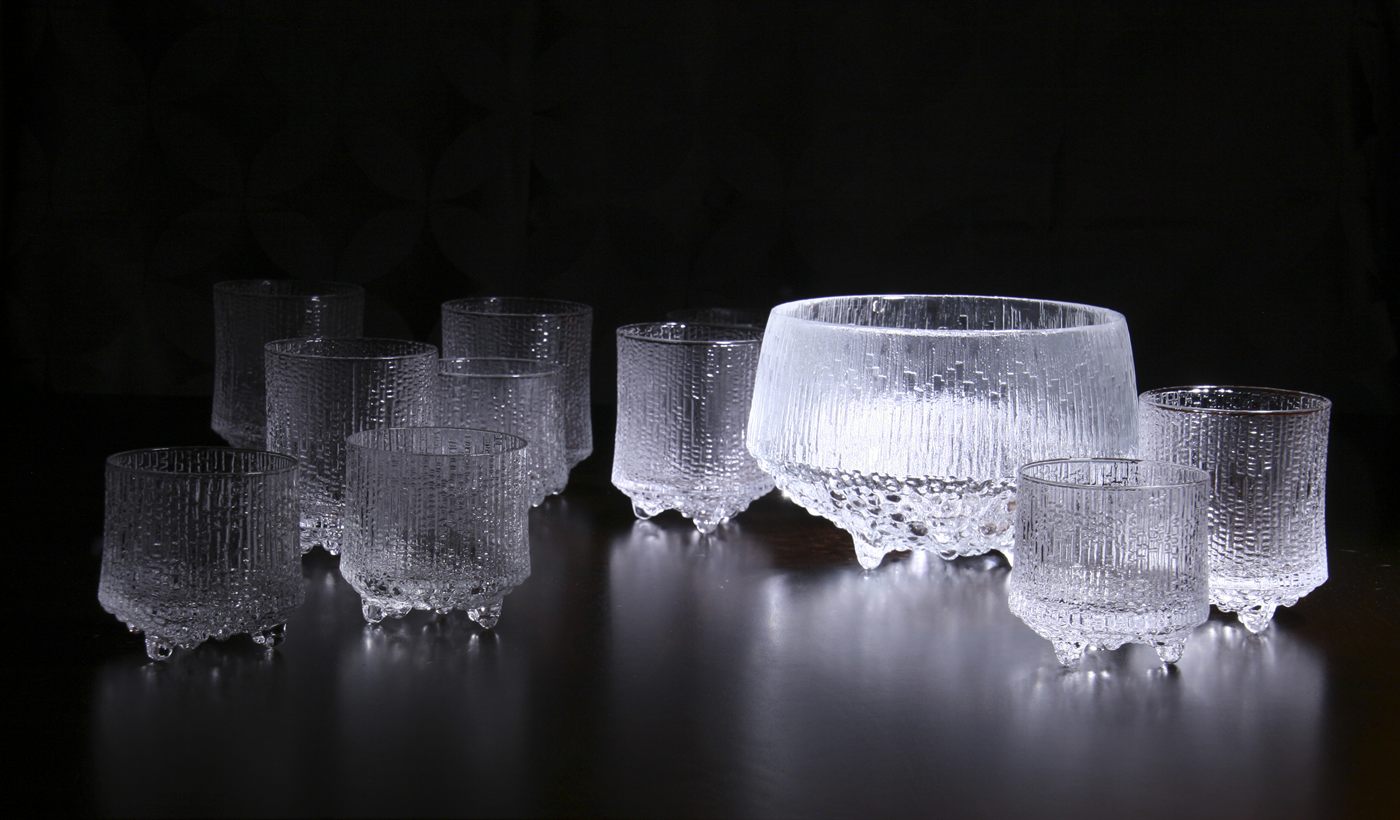
Iittala Ultima Thule. The downward-running ridges are not an engraved pattern but the trace left by blowing glass into a charring wooden mould.
A pattern made as the wooden mould burns
How that surface is made is the heart of Ultima Thule. Wirkkala carved a mould out of wood. When molten glass at over 1,000°C is blown into it, the heat of the glass sets the wood charring, raising soot and steam. That burning leaves the rough, icicle-like ridges on the surface of the glass.
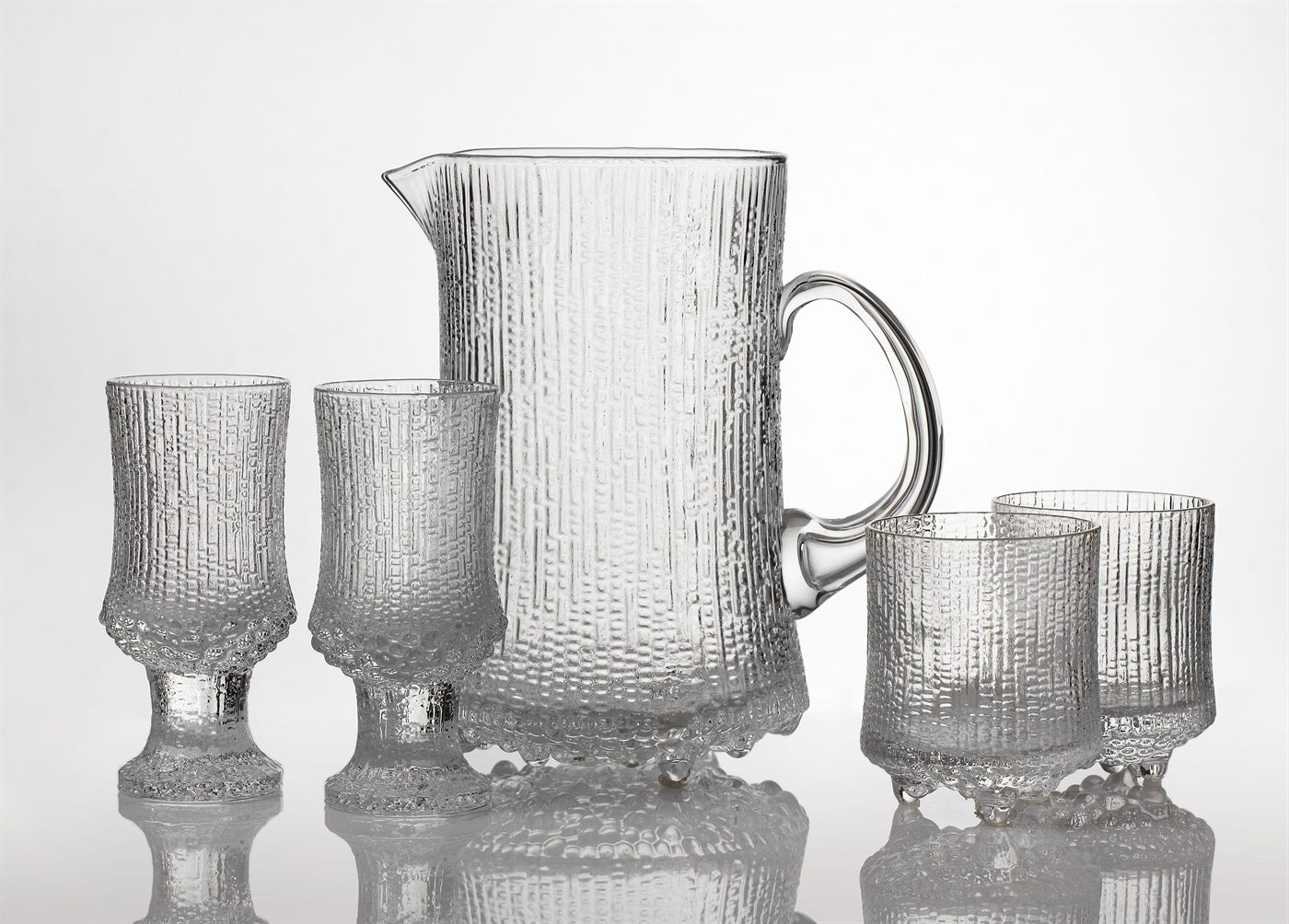
Designed by Tapio Wirkkala, made by Iittala. No two pieces share the exact same ridges, because the mould chars a little with every blow and the same pattern never comes out twice.
That the mould burns means it deforms a little with every piece blown. So no two glasses have identical ridges, and after a set number of uses the mould has to be carved anew. It is the opposite of ordinary glassware, stamped out endlessly in the same shape from a factory mould. Iittala called this the "ice glass" technique, and Wirkkala spent years refining it. It is labour-intensive and the moulds keep having to be remade — which is part of why the pieces cost what they do.
Wirkkala and Finnish glass
Iittala is a Finnish glassworks founded in 1881. In the mid-twentieth century the glassware that Wirkkala and other designers produced with Iittala made up a golden age of Finnish design, and much of it is still a common sight on Finnish tables today.
The widest reach of Wirkkala's ice aesthetic was, of all places, a liquor bottle. In 1970 he designed the bottle for Finlandia vodka. With its surface worked like glacial ice, it stayed in production for nearly thirty years, until 1999, and became the face of the brand. Same hand, same idea as Ultima Thule. Bottle or glass, the glass Wirkkala touched looked like the ice of the north.
As a whisky glass
Ultima Thule comes in many forms — glasses, bowls, a pitcher — but where drink is concerned, the one most often reached for is the thick-based tumbler, the on-the-rocks (old fashioned) glass. It is sized and weighted for a cube or two of ice with whisky poured over.
This is not a nosing glass. Its purpose is different from a Glencairn or a copita, which narrow at the mouth to lift the aroma up. Ultima Thule is a wide-open rocks glass; rather than trapping the aroma, it leans toward enjoying a cold mouthful with the ice. Instead, the rough ridges meet the ice and break up the light, and they give the hand a cold, uneven grip. The glass itself is made to feel like a piece of ice while you drink. It answers not "how do you better smell the whisky" but "how do you better hold it, cold, and look at it."
From 1969, soon after its launch, Ultima Thule was used aboard Finnair, and it often turned up as a gift handed to guests visiting Finland — the glass the country reaches for when it wants to show itself off.
The glass of the farthest north
"Ultima Thule" was the old European name for the northernmost edge of the known world, and the unknown land beyond it. No name could fit better on a glass that began with the ice of Lapland. A glass is usually remembered by the drink it holds; this one is remembered by the landscape it copies. Put ice in a measure of whisky and take it in your hand, and you are holding a small piece of Lapland's melting ice.
Ultima Thule glasses — Grigur / Wikimedia Commons (CC BY-SA 4.0) · Ultima Thule range — Nasjonalmuseet / Wikimedia Commons (CC BY-SA 4.0)