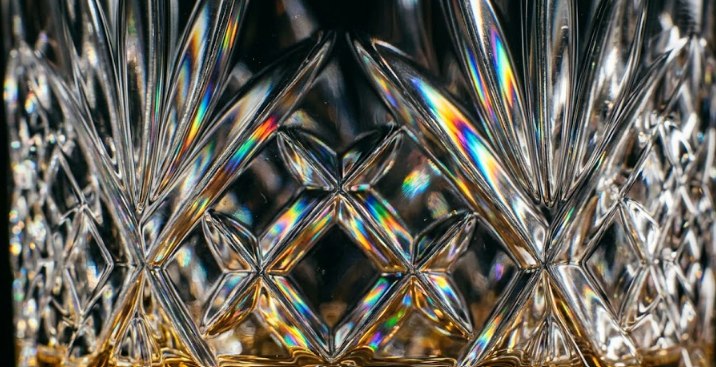
You have probably been handed a heavy cut-crystal tumbler in a bar. It sits weighty in the hand, every cut facet splits the light into a rainbow, and a flick of the fingernail against the rim sets it ringing — a long, clear ting. It is plainly something other than the thin, light glass beside it. That something is "crystal," and half the history of crystal is, in fact, the history of lead. And anyone who drinks whisky asks it sooner or later — the lead in this glass, does it leach into my whisky?
Not all glass is the same glass
Most drinking glasses are soda-lime glass. Sand (silica) is melted with soda ash and lime. It is cheap, tough and everywhere. But it has to be made thick to be stable, and a thick base seen edge-on carries a faint green or grey tint. It presses well by machine, so it suits mass production. Most of our water glasses and beer glasses are this.
Crystal is that same glass with metal oxides added. Traditionally the oxide was lead, and that one ingredient changes the character of the glass entirely.
Why crystal is different
The word "crystal" has, in truth, nothing to do with mineral crystals. Glass is an amorphous solid, with no crystalline structure at all. In the glass trade, "crystal" is simply a commercial and legal name for glass given a high refractive index and density by adding metal oxides above a certain proportion. The EU grades it by the type and amount of oxide — "full lead crystal" at 30% or more lead, a 24%-plus tier, and "crystal glass" with at least 10% of lead, barium, potassium or zinc oxides. The key point: legally, becoming "crystal" does not require lead at all.
But for centuries, that metal was almost always lead.
What the lead does
After George Ravenscroft in England worked out how to add lead oxide to glass in the 1670s, lead crystal became the byword for fine glass. The lead does four things, broadly.
- It bends light more. A higher refractive index splits the light at every cut facet into that brilliant sparkle. The rainbow of cut crystal comes from here.
- It grows heavier. Greater density makes it sit weighty in the hand at the same size — and that weight reads as luxury.
- It softens. The glass becomes more workable, so a craftsman can blow it thinner and cut it deeper. Fine cutting and thin rims are owed to the lead.
- It rings. Flicked, it sounds a long, clear ting — unlike the short tunk of soda-lime glass.
As a whisky glass the advantages are obvious. A thin, smooth rim does not catch the lip; the brilliance shows the amber within more sharply; the weight lends a pour a sense of ceremony. There is a reason cut-crystal old-fashioned tumblers, and names like Waterford and Baccarat, have long been bound up with whisky — and a reason the most expensive whisky glasses are, almost to a one, cut crystal.
So does the lead leach into the whisky?
Here everyone hesitates. Lead is a neurotoxin. Surely it cannot be fine to drink from a glass made with it.
The honest answer is "it depends." A 1991 study from Columbia University in The Lancet is the one usually cited. The crux is time.
- Stored long, a lot leaches. In experiments, port wine kept in a lead crystal decanter for four months saw its lead level climb many times over, and a decanter that held brandy for several years reached tens of thousands of micrograms per litre. The alcohol and acids in the drink draw the lead out slowly.
- Drunk briefly, little leaches. Lead does leach while you drink from that same crystal glass, but the amount over a few minutes to an hour is incomparably smaller.
In short, the hazard is not the glass but the storage. Keeping whisky in a lead crystal decanter for show, for weeks or months — that is the thing to avoid. Pouring a single dram into a cut-crystal glass and finishing it there is very low risk. Still, it is not recommended for daily use, nor for children and pregnant women, since health authorities hold that there is no lower threshold of lead that counts as safe.
The rise of lead-free crystal
After these studies, the trade found ways to get crystal's virtues without the lead. Barium, zinc, titanium and potassium oxides went in instead, reaching a similar refractive index and clarity while leaving the lead out — "lead-free crystal." Schott Zwiesel's Tritan, and a good many modern fine glasses such as Riedel and Zalto, took this road. Many are also tougher against chipping and scratching, and survive the dishwasher.
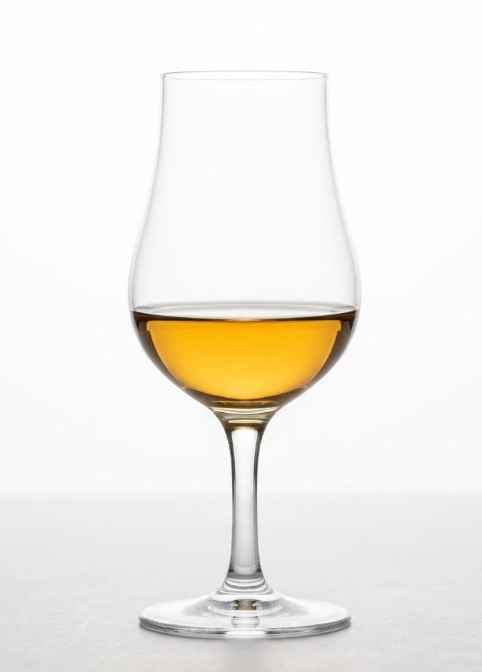
The same is true of whisky nosing glasses. The Glencairn and most nosing glasses in common use today are lead-free crystal or crystalline glass — thin and clear, with no lead to worry about. "Crystal" stamped on a glass does not, then, mean it contains lead.
In practice — telling them apart, and choosing
There are rough ways to judge whether your glass is lead crystal.
- Weight — unusually heavy for its size is worth a second look.
- Light — facets that split light into strong rainbows mean a high refractive index.
- Sound — a long ting when you flick the rim leans crystal; a short tunk leans soda-lime.
- Provenance — old cut crystal, vintage decanters and older Waterford- or Baccarat-type pieces are likely leaded. Recent ones marked "lead-free" are not.
Home lead-test kits exist if you want certainty. But the choice itself is simple. For a nosing or tasting glass you finish on the spot, leaded or lead-free makes virtually no practical difference, and lead-free crystal is the easier conscience. For a decanter that holds whisky for days or more, go lead-free — or honestly, leave it in the original bottle. If you have an old cut-crystal glass handed down to you, there is no need to bin it — just don't use it for storage.
What a glass is made of is usually the last question to come to mind. Caught up in shape and brand, "what is it made of" is easy to forget. Yet the brilliance, the weight, and even that moment of hesitation all come from what the glass was made from. The nature of the clarity that lights up your whisky is worth knowing, at least once, before you raise it.