
Whisky glasses — especially crystal — are not ordinary drinkware. Thin walls, precise geometry, and high-quality glass require care appropriate to the material. The common mistakes that shorten a glass's life are almost always in the washing and drying.
Why Hand-Washing Only
Crystal whisky glasses should not go in the dishwasher. Three reasons.
High-temperature damage. Dishwashers reach temperatures that can warp or fracture crystal. The thermal shock of hot water followed by a cooling cycle stresses the glass repeatedly.
Chemical etching. Dishwasher detergent contains alkaline compounds that etch glass surfaces over time. The result is "cloudiness" — microscopic surface scratches that scatter light and make the glass appear dull. This damage is irreversible.
Physical impact. Glasses move during wash cycles and knock against each other. Thin crystal rims are extremely vulnerable. Even one chip diminishes both the aesthetics and, practically, the drinking experience.
Standard soda-lime glass is more resistant to these effects. But even for standard rocks glasses or tumblers, the safest approach is still hand-washing.
The Correct Hand-Washing Method
The ideal water temperature is lukewarm — not hot, not cold. Sudden temperature changes stress glass.
Do not use regular dish soap. It can leave a film that affects the aroma of the whisky. Use a small amount of unscented washing liquid, or simply rinse with warm water. For crystal glasses, warm water rinsing alone is usually sufficient.
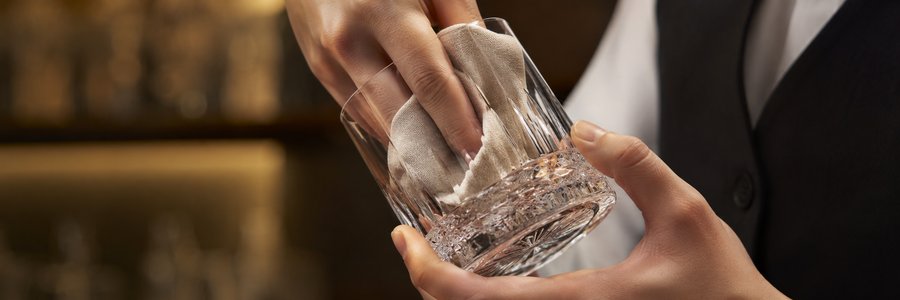
Do not scrub the interior with a brush. Use a lint-free cloth — linen or microfibre — reaching inside and rotating gently. Do not grip the glass tightly with one hand while doing this; crystal may crack.
Drying Methods
Method 1 — Air drying. Set the glass inverted on a clean cotton towel or silicone mat. Water runs off as it drains, and once fully dry, water marks are minimised. Letting the water flow before wiping is also effective.
Method 2 — Linen cloth drying. Use a lint-free linen or microfibre glass cloth. Cotton towels leave fibres inside the glass. Hold the base securely with one hand, insert the cloth with the other, and rotate to dry. Do not grip the glass firmly; crystal may crack.
When Mineral Deposits Form
Hard water leaves white mineral deposits (calcium and magnesium) on glass surfaces. These are mainly cosmetic but worsen with time.
Two removal methods:
White vinegar. Fill the glass halfway with a solution of one part white vinegar to three parts warm water. Leave for 10–15 minutes, then rinse thoroughly. Effective at dissolving calcium carbonate.
Lemon juice. Same principle as vinegar. Wipe the interior with half a lemon, then rinse with warm water. Less pungent than vinegar and easy to use.
Both methods are safe for crystal glasses. Do not scrub hard. The acidic compounds need contact time to dissolve the minerals — 30 seconds to 1 minute of contact is effective.
Storage Principles
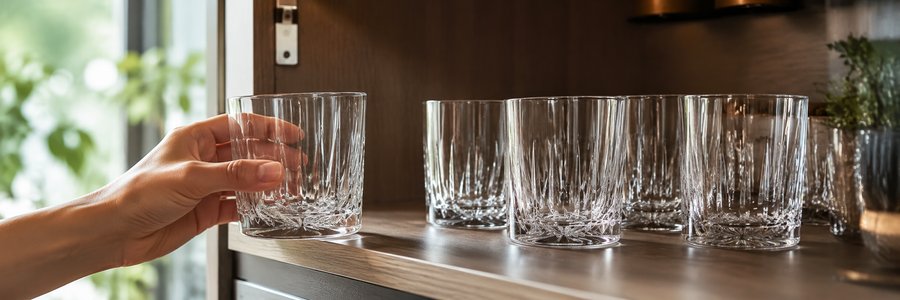
Store upright. Storing glasses inverted keeps rims in contact with the shelf surface. Over time this wears down the rim — the thinnest and most important part of the glass. Store upright whenever possible.
Avoid enclosed spaces. Wooden cabinets and closed shelves allow odours from the wood or surrounding materials to absorb into the glass. Glass is porous enough to pick up ambient smells. An open shelf or glass-fronted cabinet with ventilation is ideal.
Avoid stacking. Stacking glasses concentrates stress on the rims and lower bowls. The base of one glass bearing down on the rim of another is one of the most common causes of rim damage.
Separate from other kitchenware. Glasses stored alongside heavy plates or mugs are at risk of contact damage. Store whisky glasses in a dedicated space.
Quick Reference: Care Principles
| Action | Correct | Avoid |
|---|---|---|
| Washing | Warm water, lint-free cloth | Dishwasher, brush |
| Drying | Air dry or linen cloth | Hot air, paper towel |
| Mineral deposits | Vinegar, lemon juice | Abrasive cleaners |
| Storage | Upright, open shelf | Inverted, enclosed cabinet |
A whisky glass is not just a container. The rim angle, bowl curvature, and glass thickness all affect how the whisky smells and tastes. Taking care of the glass is part of taking care of the whisky.