
The Glencairn was born in Scotland in 2001. William Davidson designed it, and six major Scottish whisky distilleries adopted it from the start. After the SWA (Scotch Whisky Association) approved it as the official nosing glass, it earned the reputation of "the standard for nosing glasses" — and today it sits on the desks of whisky lovers around the world.
Yet within the global whisky community, the Glencairn's limitations have been a longstanding topic of debate. A question keeps surfacing on Reddit r/Scotch and Whisky Advocate forums: Is the Glencairn always the best choice?
Why the Glencairn Became the "Standard"
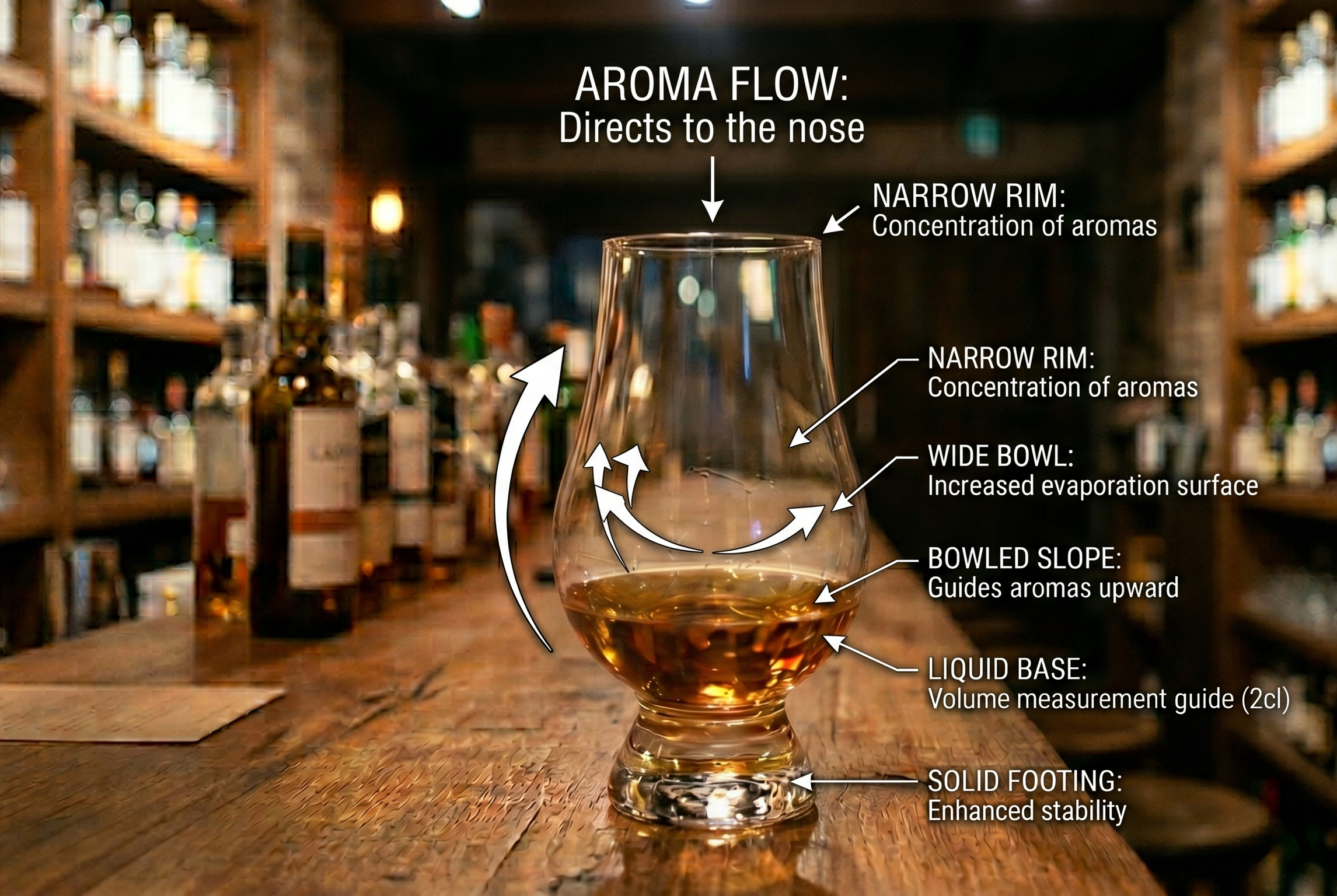
The Glencairn's design is optimised for nosing. The wide bowl concentrates the whisky's aroma compounds, then the narrowing rim channels them towards the nose. The glass walls are uniformly thin for rapid temperature response. The base is heavy and stable.
Every element of this design is optimised for nosing — the act of evaluating a product used by distillery blenders and master distillers.
The Glencairn was designed to concentrate aroma. But when aroma concentrates too much, alcohol vapour concentrates with it.
British whisky media such as Whisky Magazine and Malt Whisky Yearbook consistently recommend the Glencairn as an entry-level nosing glass. Yet the same publications note that professional blenders often prefer the Copita in practice — a glass that evolved from Spanish sherry culture centuries before the Glencairn existed, and which became standard in Scottish distilleries long before the Glencairn arrived.
Comparing Five Nosing Glasses
Here are the key specifications of five glasses commonly compared in the whisky community.
| Glass | Bowl Width | Rim | Weight | Use |
|---|---|---|---|---|
| Glencairn | Medium | Narrow | Light | Nosing-focused, alcohol-intensive |
| Copita | Wide | Narrow | Light | Aroma-rich, professional preference |
| Norlan | Wide | Medium | Medium | Nosing + drinking balance |
| Rocks | Wide | Wide | Heavy | On the rocks, drinking ease |
| Tulip | Narrow | Medium | Light | Delicate aromas, small pours |

The Physical Limitations of the Glencairn
Hand Size and Temperature
The Glencairn holds about 180ml. If your hand is large, the palm wraps around the entire bowl, rapidly warming the whisky with body heat. Aroma compounds vaporise quickly, and before you can capture the delicate notes, alcohol vapour rises first. This is why organisations including the Scotch Malt Whisky Society regularly address this issue.
Rim Angle and Drinking Position
While optimised for nosing, the rim angle is awkward when you actually drink. You have to tilt the glass steeply, which tends to direct the whisky only to the front of the tongue. This is one reason professional blenders often switch to a Copita or tulip-style glass after evaluating.
Alcohol Concentration in High-ABV Whisky
What concentrates the aroma also concentrates the alcohol vapour. Pour cask-strength whisky (55%+ ABV) and the alcohol hit often arrives before the aroma. In such cases, some professionals reach for a large Copita or a Bordeaux wine glass.
The SNS and Whisky Glass Culture
The #whiskyglass and #whiskynosing tags on Instagram hold hundreds of thousands of posts, with the Glencairn appearing most frequently by far. But in recent years, #copita and #norlan tags have grown rapidly. Within the global whisky community, interest in glass diversity is clearly on the rise.
The same shift is observable in Korea. Discussions about nosing glasses beyond the Glencairn have grown noticeably in Korean whisky circles since 2022 — a trend that tracks the maturing of Korean whisky culture.
Conclusion: There Is No Single Right Answer
The Glencairn suits people who want aroma concentration and enjoy standard-ABV (40–46%) single malts, primarily through nosing. But for high-ABV whisky or those who want both nosing and drinking ease, Norlan or Copita-style glasses may serve better.
This debate has played out in the global whisky community for years, always arriving at the same conclusion: there is no single right glass for whisky. The right choice depends on your drinking style and the character of the whisky in front of you.
Next in this series: The Norlan Glass — designed against the Glencairn's weaknesses
Reader Notes
Be the first to leave a note.