
The glass you use to drink Hungary's fruit brandy, pálinka, properly is almost the same shape as the one you reach for to nose whisky seriously. A foot, a stem, and a bowl shaped like a tulip — rounding out at the belly, then narrowing toward the mouth. Anyone who has seen a Glencairn or a copita will know the silhouette. The drink is different and so is the country, yet the resemblance of the glasses is no accident. They solve the same problem: how to gather the aroma so it doesn't scatter, and send it up to the nose.
A tulip that gathers the aroma
A good pálinka glass stands on a foot, is held by a stem, and has a bowl like a tulip. Narrow at the bottom, widest in the middle, then narrowing again toward the top, with a slight outward flare at the lip.
That curve has a clear job. The wide belly gives the spirit a large surface against the air, so the fruit aroma can rise fully. The aroma that lifts off then passes through the narrowing upper section, gathering to a single point and going straight to the nose. The little flare at the rim is there to soften the touch against the lips. Spread the aroma wide to gather it, then funnel it up in one stream — exactly what a whisky nosing glass does.
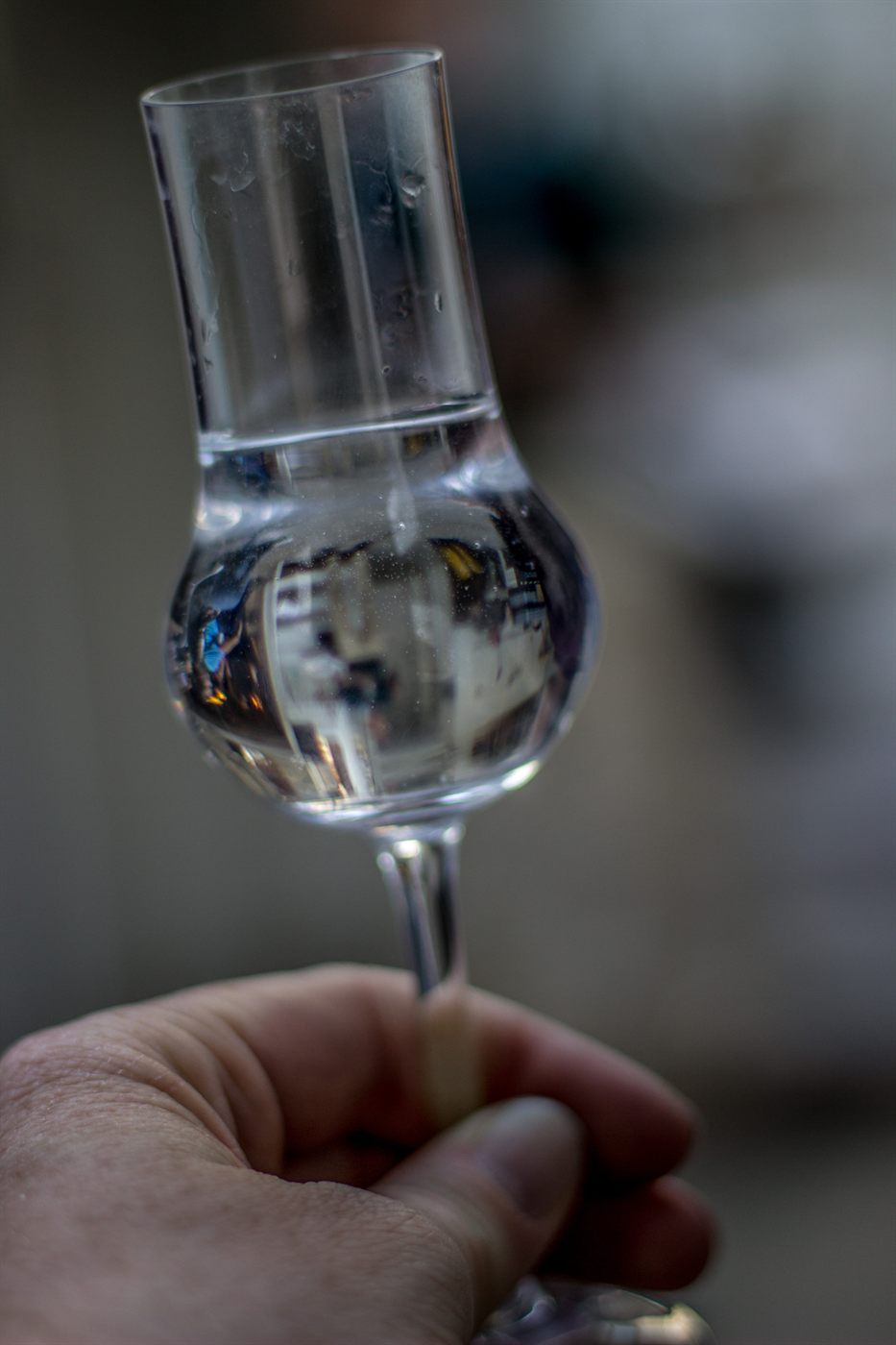
A tulip glass that gathers the aroma. The wide belly lets the scent rise fully, and the narrowing mouth funnels it to one point and up to the nose — the same principle as a whisky nosing glass.
So the way you drink it resembles savouring whisky, too. Pálinka is not a spirit to be served frozen. Too cold and the fruit aroma shuts down, so it is kept close to room temperature, smelled first, then sipped slowly. Two to four centilitres — a sip or two — is plenty in a glass.
The glass you tossed back
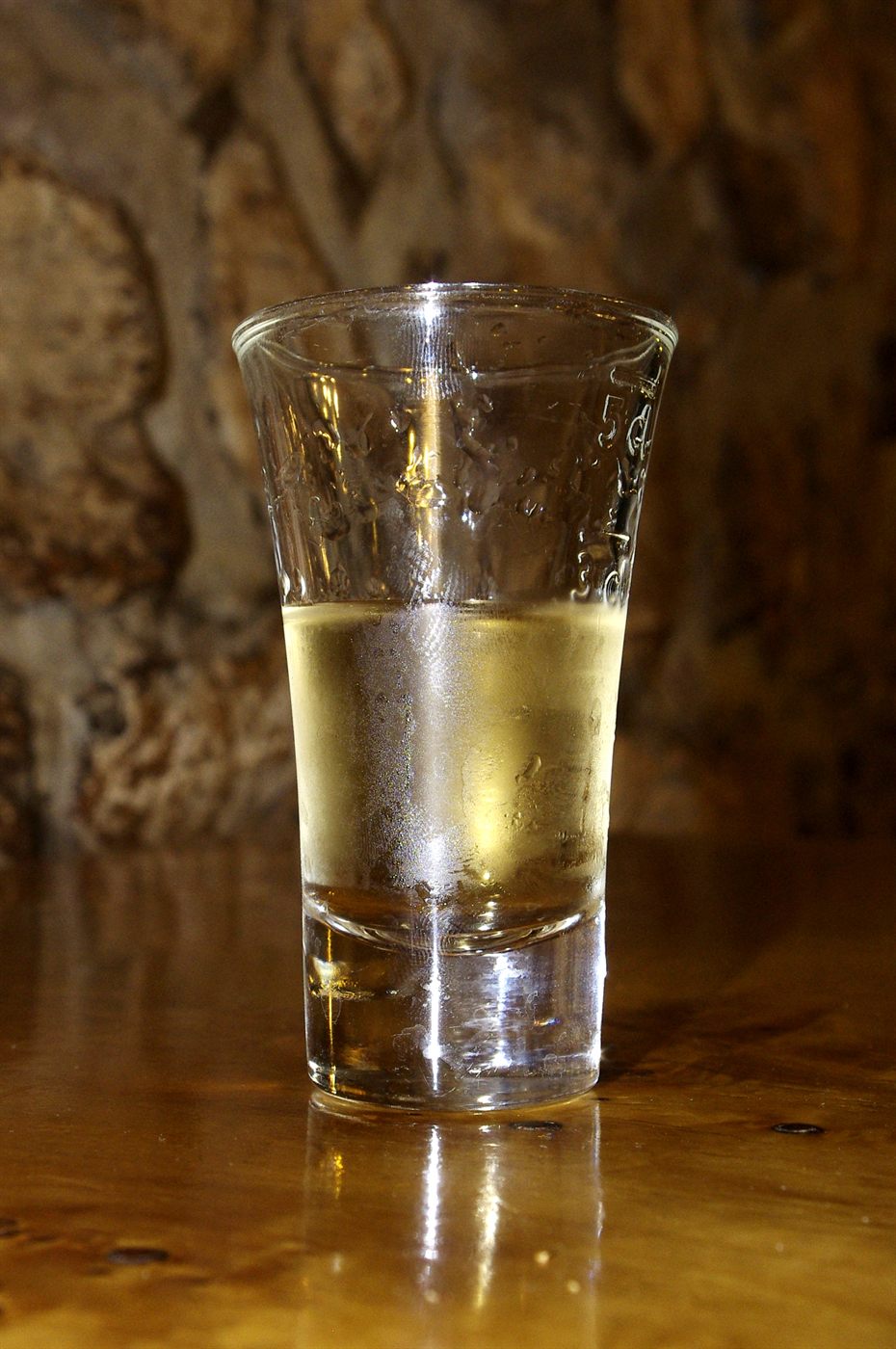
The small glass pálinka was traditionally drunk from. Its shape suits tossing the spirit back in one go rather than savouring the aroma. The tulip glass took hold only fairly recently.
But pálinka was not always served in a tulip. In the old Hungarian countryside it was less a spirit to savour than a mouthful to open the day. It was poured into a small, plain glass — known by names like feles in Hungarian, or stampedli from the German — and tossed back in one go, often from the morning on. Rough home-distilled pálinka needed no glass to gather the aroma. It was a drink to be swallowed fast, warm, all at once.
Even now, in the countryside and in casual settings, that small glass is common. The tulip is a fairly recent arrival, taking hold only as pálinka began to be treated as a spirit to be smelled.
What pálinka is
Pálinka is a spirit distilled from fruit alone. Plum (szilva), apricot, pear, cherry and the like are fermented and distilled, and into real pálinka nothing — no sugar, no flavouring — is added. Only the fruit and its scent. That is why a fine pálinka is clear and colourless, yet bring it to the nose and the fruit it was made from declares itself in the aroma. Because that aroma is the whole point, a glass that gathers it actually means something.
The name pálinka is protected by law. The European Union reserves the term "pálinka" for spirits made in Hungary (and, for apricot brandy only, in parts of Austria) from that country's own fruit, distilled and bottled there. Hungary has designated pálinka a hungarikum — a piece of national heritage — and in 2008 a so-called "Pálinka Act" raised the standard for quality.
Why the glass changed
The shift from the small glass to the tulip runs alongside a change in pálinka's own standing. There was a time when it carried the strong image of a rough country liquor, distilled roughly in every house. Then more distilleries took quality seriously, the law set standards, and pálinka began to be treated as a refined spirit judged on its aroma and craft.
As the drink rose in rank, the glass followed. You cannot savour carefully preserved fruit aroma out of a glass meant to be tossed back. The tulip — which gathers the scent for a slow nose — took its place. The very process by which whisky shed its cheap reputation and moved to the nosing glass played out again in Hungary's fruit brandy.
What the glass tells you
The shape of a glass is also a set of instructions for how to treat the drink. A small glass to throw back says "swallow it fast"; a tulip that gathers the aroma says "smell it first, then sip slowly." That pálinka has earned the latter glass means the spirit has earned that kind of treatment. The drink is not whisky, but the curve of that aroma-trapping tulip is one answer the two spirits arrived at alike.
Tulip nosing glass — Stefan Giesbert / Wikimedia Commons (CC BY-SA 4.0) · Traditional pálinka glass (apricot pálinka) — Traumrune / Wikimedia Commons (CC BY-SA 3.0)