
When you read about an award-winning whisky, have you ever wondered which glass the judges used? A Glencairn? A Copita? In many cases, it was neither.
There is an official tasting instrument that has been widely adopted across international beverage judging panels. It is called ISO 3591. Published in 1977 by the International Organization for Standardization, this sensory analysis glass specification predates the Glencairn by 24 years — yet most whisky enthusiasts have never heard of it. The reason is simple: this glass spread quietly among professionals, without marketing.
ISO 3591:1977 — Why It Was Created
The full title of the standard is Sensory analysis — Apparatus — Wine-tasting glass. As the name indicates, it was originally developed for wine evaluation. By the 1970s, the internationalisation of the wine trade had made standardised quality assessment urgent. If judges in different countries used different glasses, the same wine could receive different evaluations — an obviously unacceptable situation.
ISO assembled sensory scientists and blenders from France, Germany, Italy, Spain and other major wine-producing nations, and after years of collaborative work published the standard in 1977. The core principle was singular: minimise variables in the tasting environment, while optimising for aroma capture and analysis. The glass geometry that resulted — a tulip-shaped bowl, narrow rim, thin walls, stem — proved equally suited to evaluating spirits including whisky and brandy. Over the following decades, this adoption became widespread.
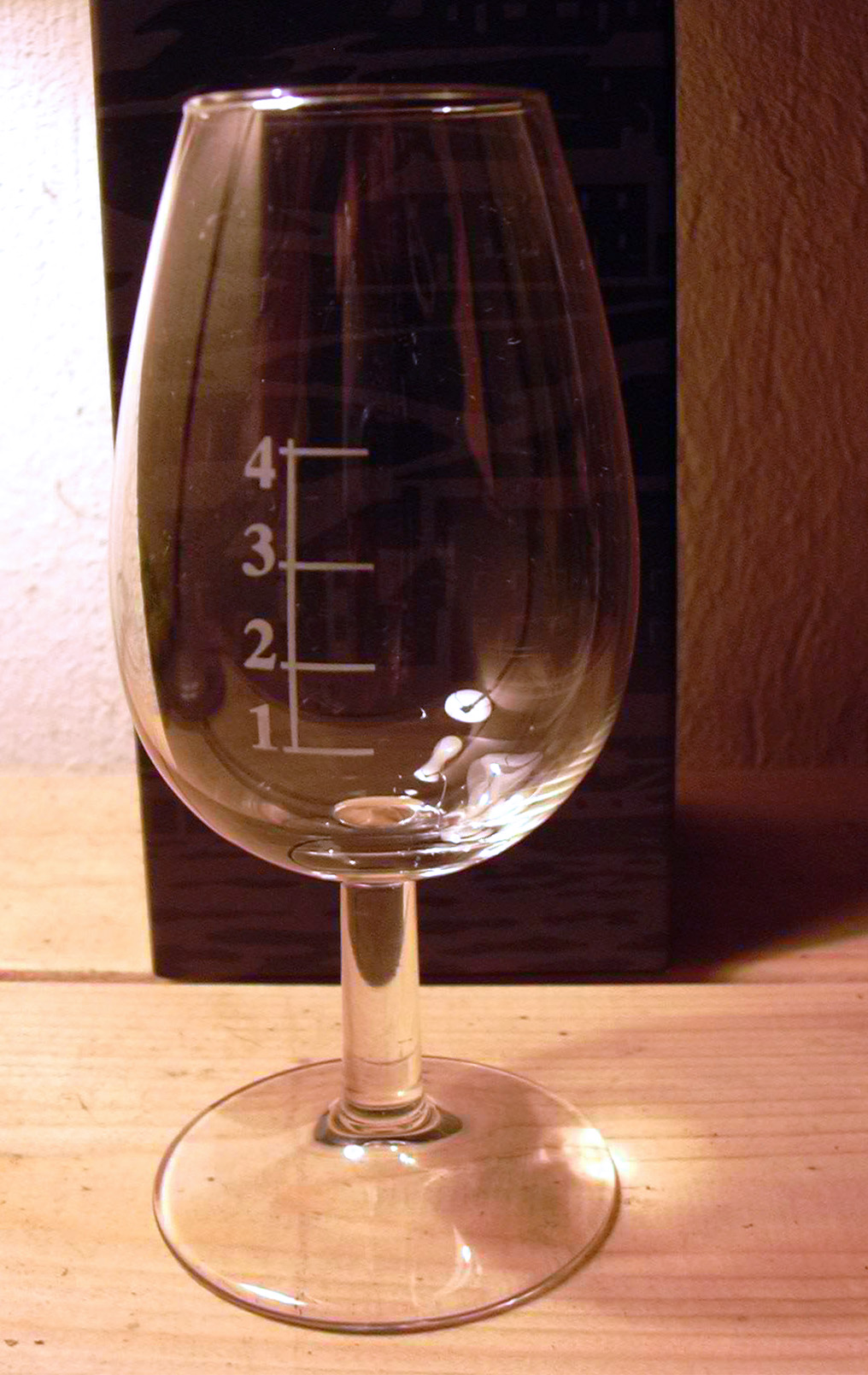
The Four Design Principles
ISO 3591 mandates four key characteristics, each with a scientific rationale.
Colourless, clear glass. No tint, etchings or pattern. The glass must allow accurate visual assessment of the liquid's appearance — colour depth, clarity and viscosity. These are meaningful evaluation criteria for both wine and whisky.
Thin walls. The specification restricts wall thickness to approximately 0.8–1.0 mm. Where a thick-walled glass might seem to protect the liquid from external temperature, the ISO logic goes the other way: if the stem prevents hand warmth from reaching the bowl (which it does), insulation is unnecessary. Thin walls reduce the weight of the glass and the tactile intrusion at the rim.
Tulip-shaped bowl. The bowl widens downward to a maximum diameter of approximately 65 mm, then tapers inward toward a rim of approximately 46 mm. This convergent geometry does two things simultaneously: the wide bowl provides surface area for volatile aromatic compounds to evaporate; the narrowing rim concentrates those vapours upward toward the nose.
Stem. The structural separation between hand and bowl prevents body temperature — typically 33–36°C at the palm — from warming the liquid and altering its evaporation profile. Consistent temperature is a prerequisite for meaningful comparison across multiple samples.
ISO 3591:1977, Sensory analysis — Apparatus — Wine-tasting glass, International Organization for Standardization
Exact Dimensions of the ISO 3591 Glass
The standard specifies: total height approximately 100 mm; total capacity 210–225 ml; recommended serving volume 50 ml; maximum bowl diameter approximately 65 mm; rim diameter approximately 46 mm; wall thickness approximately 0.8 mm.
The 50 ml serving specification is significant. It means the remaining volume inside the glass — far more than the liquid itself — functions as a headspace reservoir for aromatic vapours. This is the same principle the Glencairn uses, though in a smaller, more concentrated form.
Why Competitions Use This Glass
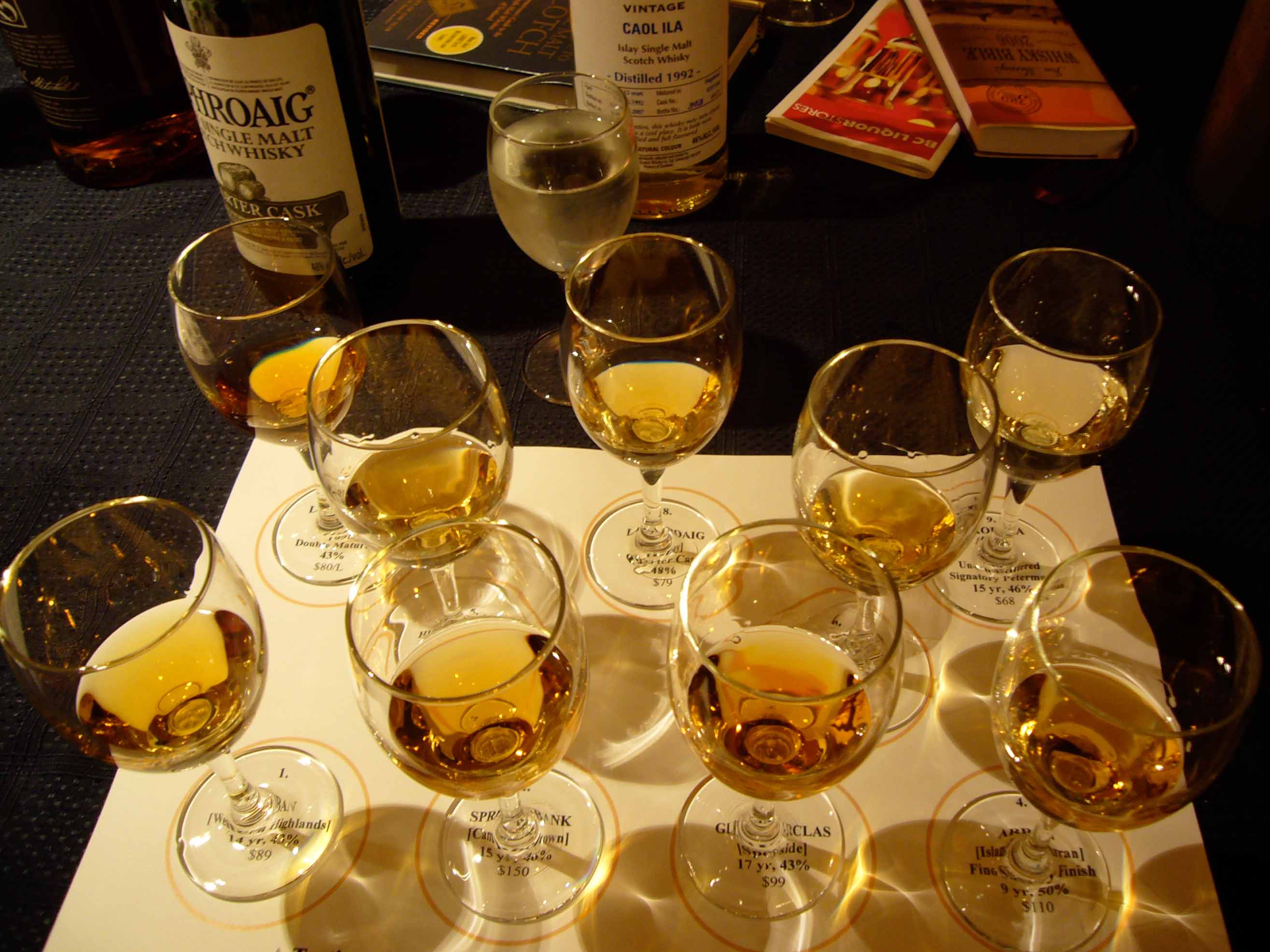
The reason international tasting competitions and professional evaluation panels adopt ISO 3591 or compatible glasses comes down to one principle: standardisation. When dozens of judges evaluate the same whisky, they must do so under identical conditions using identical vessels.
This matters more than it might seem. Research has established that the same wine or spirit can be evaluated differently depending on the glass it is served in. Glass form affects aroma concentration, the perceived intensity of alcohol sting, and the structure of the first impression. If judges use different glasses, differences in their scores may reflect the glass rather than the liquid.
The WSET (Wine & Spirit Education Trust) uses ISO-specification or equivalent tulip-shaped glasses for tasting exercises in its advanced qualification programmes. The WSET states that standardised tasting tools provide the foundation for learners to analyse aroma and flavour under consistent conditions and develop precise descriptive vocabulary.
WSET (Wine & Spirit Education Trust), WSET Level 3 Award in Spirits Specification, 2023
France's Institut national de l'origine et de la qualité (INAO) — the body governing AOP (protected designation of origin) classifications — formally adopted the ISO 3591 specification for its official evaluations. This is why the glass is sold commercially under the name INAO tasting glass as often as it is sold under the ISO designation.
ISO vs INAO Glass — Are They the Same?
A common source of confusion: are ISO 3591 glasses and INAO glasses the same thing? Largely yes, but with a distinction.
INAO adopted the ISO 3591 specification and added its own quality-control requirements. Only glasses produced by INAO-approved manufacturers may carry the INAO designation. In other words, all INAO glasses conform to ISO 3591, but not all ISO 3591-conforming glasses carry INAO approval.
In practice, the difference is minor. INAO-approved glasses from French manufacturers (notably Arcoroc and Paris Gobelet) are the most widely used in official evaluation settings. They are available at low cost — typically €3–8 per glass — and suitable for bulk purchase, which is why professional tasting panels typically use them by the dozen.
Structural Comparison: ISO 3591, Copita, Glencairn
All three are tulip-form nosing glasses designed to concentrate aroma, but their structural differences produce meaningfully different tasting experiences.
| Feature | ISO 3591 | Copita | Glencairn |
|---|---|---|---|
| Stem | Yes | Yes | No |
| Max bowl diameter | ~65 mm | ~55 mm | ~50 mm |
| Rim diameter | ~46 mm | ~38 mm | ~35 mm |
| Wall thickness | Very thin | Thin | Relatively thicker |
| Serving volume | 50 ml | 30–40 ml | 30–40 ml |
| Primary context | Standardised comparison | Professional nosing | Personal drinking |
The most consequential difference is the rim diameter. The ISO glass's wider rim (~46 mm) disperses ethanol vapour more broadly, reducing the alcohol sting that reaches the nose relative to aromatic compounds. For back-to-back nosing of many samples, this delays olfactory fatigue. The Glencairn's narrow rim (~35 mm) concentrates aroma more intensely — an advantage for exploring a single whisky in depth, but potentially overwhelming for extended comparative sessions.
Why the ISO Glass Suits Whisky Particularly Well
The ISO 3591's wider rim has an advantage that is especially relevant for whisky: it moderates the alcohol sting that comes with higher ABV.
Whisky at 40–46% ABV contains roughly three times the ethanol concentration of typical wine at 12–15%. Ethanol vapour concentrates strongly under a narrow rim. The ISO glass's wider aperture allows ethanol vapour to disperse more before it reaches the nose, giving secondary aromatic notes — floral, herbal, woody — a better chance to register before the alcohol sensation dominates.
For cask-strength whisky (55–65% ABV), this effect becomes critical. Many professionals who regularly nose high-ABV expressions reach for wider-rimmed glasses precisely for this reason.
The Glencairn's Connection to This Glass
According to Glencairn Crystal's published materials, founder Raymond Davidson drew on traditional nosing glasses already in use at Scottish distilleries when designing the Glencairn. Many of those glasses were structurally close to the ISO 3591 tulip form. The Glencairn retained the aroma-concentrating geometry of professional tasting glasses, then removed the stem and thickened the base to suit everyday use.
Glencairn Crystal Studio, The Story of the Glencairn Glass, glencairnglass.com
The ISO 3591 glass and the Glencairn are, in a real sense, related: one is the professional benchmark that preceded and informed the other.
Where to Find an ISO 3591 Glass
ISO 3591-specification glasses are available from specialist kitchenware retailers and wine and spirits equipment suppliers online. Searching INAO tasting glass or ISO tasting glass will return results from several manufacturers. Entry-level INAO-compliant glasses are available for under £5 per piece.
For comparative tasting sessions, buying six or twelve identical glasses is the standard professional approach. Uniform vessels are the simplest way to ensure that perceived differences between whiskies reflect the liquid, not the container.
Reader Notes
Be the first to leave a note.