Is it possible to spend the equivalent of a million won — or considerably more — on a whisky glass? Yes. And the glasses that carry such prices have reasons to justify them. Or not. This article examines the structure of those prices.
Three Axes of Glass Pricing
The price of a whisky glass is governed by three factors. When all three are present in combination, prices rise exponentially.
Axis 1: Material Quality
Ordinary soda-lime glass and crystal are chemically different substances. Soda-lime glass is a mixture of silica (SiO₂), soda (Na₂O) and lime (CaO). Adding specific metal oxides changes refractive index, clarity and workability.
Traditional lead crystal incorporates lead oxide (PbO) at 24% or more. The refractive index of lead crystal (n ≈ 1.56–1.62) is higher than soda-lime glass (n ≈ 1.52), which means it bends light more strongly and produces more intense brilliance and sparkle. Lead crystal is also more workable — it can be blown thinner and hand-cut more readily.
The concerns about lead leaching from glassware changed this picture. In 2001, a European Parliament resolution tightened lead content standards for crystal glassware used with food and drink. Most premium crystal manufacturers subsequently transitioned to lead-free crystal, in which barium oxide (BaO), titanium oxide (TiO₂) or zinc oxide (ZnO) replace lead as the modifying oxide.
European Parliament, Resolution on crystal glass, Official Journal of the European Communities, 2001/C 196/01
The best modern lead-free crystal achieves refractive index and clarity approaching lead crystal. A buyer purchasing a new piece from a major crystal house today is almost certainly buying lead-free crystal, regardless of the brand's historical reputation for lead crystal.
Axis 2: Manufacturing Technique
The gap between machine production and handcraft is the most direct contributor to price.
Machine-pressed glass is uniform and scalable. Most glassware at every price level up to the lower tier of the premium market is produced this way.
Mouth-blown glass is formed by an artisan who blows air through a blowpipe to shape molten glass. It can be made with thinner walls than machine pressing allows and permits more freedom of form. Production speed is low and the technique requires years of training.
Hand-cutting is the carving of decorative patterns into the glass surface using rotating grinding wheels and diamond tools. Machine cutting achieves reasonable results at speed; hand-cutting achieves superior precision and brilliance. Complex hand-cut patterns on a single glass may represent dozens of hours of skilled labour.
Axis 3: Scarcity and Heritage
Work from a named artisan or historic studio carries value beyond the object itself. The provenance, the signature, the story of production — these are the components of a collectible. A piece from a recognised Edo Kiriko master or a limited Baccarat edition commands a premium that reflects its standing in a collector market, not purely its material or manufacturing cost.
Edo Kiriko — Tokyo's Cut Glass Tradition
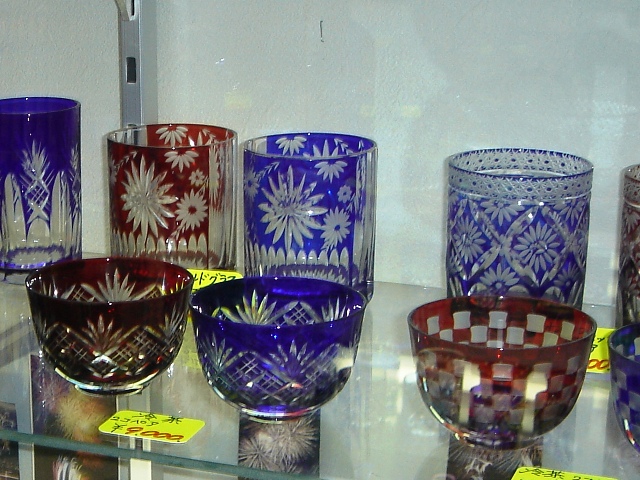
Edo Kiriko (江戸切子) is a cut glass tradition practiced in the Sumida and Koto districts of Tokyo, with roots in the Edo period. It was designated a Traditional Craft of Tokyo in 1985 and a National Traditional Craft in 2014 by the Japanese government.
The historical record places the origin of Edo Kiriko in 1834, when a glassworker in Edo named Kagaya Kyūbei applied European cut-glass techniques — imported via trade — to Japanese glass. During the Meiji era (1868–1912), British glassworkers were brought to Japan to formalise and develop the technique, producing the distinctive aesthetic vocabulary that characterises Edo Kiriko today.
Tokyo Metropolitan Government Bureau of Industrial and Labor Affairs, Edo Kiriko — Traditional Crafts of Tokyo, 2023
Pattern Complexity and Pricing
Edo Kiriko patterns vary substantially in technical difficulty, and the pricing reflects this directly.
Yarai (矢来): Diagonal crossing lines forming a lattice. One of the foundational Edo Kiriko patterns; relatively accessible in difficulty and price.
Rokkaku kagome (六角籠目): A hexagonal basket-weave pattern requiring precise angular control. More technically demanding than yarai.
Kiku tsunagi (菊繋ぎ): A chrysanthemum-linked design. Multiple motif elements must be connected uniformly, requiring advanced skill.
Nanako (魚子, literally "fish roe"): Hundreds of small, uniform circular elements arranged in dense grids. Maintaining consistent size and spacing across the entire surface is considered one of the most demanding Edo Kiriko techniques.
Price Ranges for Edo Kiriko Whisky Glasses
Entry-level production pieces: ¥10,000–30,000 per glass (₩90,000–270,000)
Mid-tier skilled artisan work: ¥50,000–100,000 (₩450,000–900,000)
Named master artisan signed work: ¥200,000+ (~₩1,800,000+)
Special commission pieces: no ceiling
The intersection with Japanese whisky culture is natural. Japan's well-developed tradition of drinking whisky as mizuwari (水割り — whisky diluted with water) or highball makes old-fashioned-style Edo Kiriko rocks glasses the most commonly sought form.
The European Crystal Houses
Baccarat — France, est. 1764
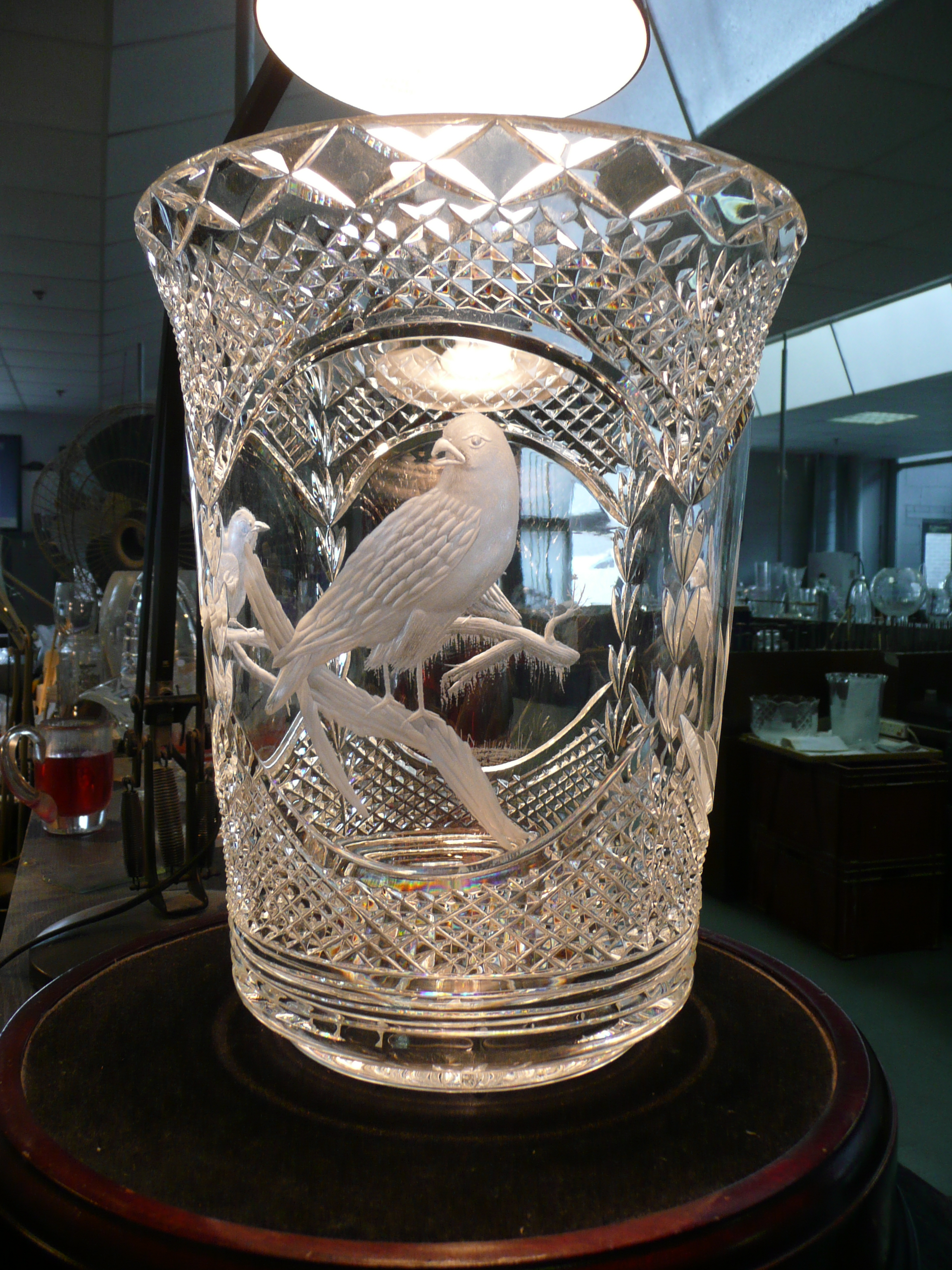
Baccarat was established in the Lorraine region of France in 1764 at the instigation of the Bishop of Metz, with permission from King Louis XV. It became a royal supplier under Louis XVI and subsequently built its international reputation through exhibition medals, most notably gold at the 1867 Paris Exposition Universelle. More than two centuries of lead crystal manufacturing formed the technical foundation of the brand.
The company has since transitioned to lead-free crystal. Its whisky glass range includes the 'Harcourt' series, first designed in 1841, which continues in its original form. Whisky glasses from the standard range run approximately $150–500 per piece; special and limited editions exceed this substantially.
Waterford Crystal — Ireland, est. 1783
Waterford was founded in 1783 by George and William Penrose in Waterford, Ireland, and built on Irish lead crystal traditions until the firm's closure in 1851. The crystal industry in Waterford was re-established in 1947, growing into the international brand. The company now produces lead-free crystal.
The 'Lismore' pattern — combining diamond and wedge cuts — was designed in 1952 and is claimed to be one of the most widely sold crystal patterns in the world. Waterford's whisky line, including the 'Lismore Whisky Tumbler', is designed for on-the-rocks drinking. Prices range approximately $50–150 per piece.
Riedel — Austria/Bohemia, est. 1756
Riedel began in Bohemia in 1756 and relocated operations to Austria in the 1920s. The brand's most significant innovation was not a manufacturing technique but a marketing argument: that the shape of the glass measurably affects the taste and aroma of the wine or spirit it contains.
From the 1950s, Claus Riedel designed varietal-specific glasses — different forms for different grape varieties. His son Georg Riedel developed this into systematic tasting demonstrations with sommelier panels in the 1990s, attracting wide media attention. The argument that glass shape affects perception is now widely accepted; whether the specific differences Riedel claims can be reliably detected remains a subject of discussion among sensory scientists.
Riedel's whisky-related range includes the 'Vinum Single Malt Whisky' glass and the 'Sommeliers Cognac Hennessy' glass — the latter a Copita-adjacent stemmed tulip that many whisky professionals prefer for nosing. The 'Sommeliers' range is mouth-blown and hand-cut; prices range approximately $60–200 per piece.
Price Reference Table
| Category | Brand / Product | Price per glass |
|---|---|---|
| Entry premium | Riedel Vinum, Waterford Lismore | $40–100 |
| Mid premium | Baccarat entry, Riedel Sommeliers | $100–200 |
| Edo Kiriko entry | Standard production | $90–270 |
| High premium | Baccarat Harcourt, skilled Edo Kiriko | $270–900 |
| Collector tier | Baccarat limited, Edo Kiriko master-signed | $900+ |
Does Price Improve the Whisky Experience? An Honest Assessment
The direct answer: the scientific case that expensive crystal makes whisky taste better than well-designed inexpensive glass has not been established.
What affects a whisky's aroma and flavour from the glass is primarily form: the bowl size, rim diameter and overall height. These structural properties determine ethanol vapour concentration, aroma delivery and the dynamics of the first impression. A correctly formed glass costing £10 can express a whisky more accurately than an incorrectly formed glass costing £300. This is an empirically testable and testable claim.
But the drinking experience is not a laboratory measurement. The weight of the glass in the hand, the tactile quality of the rim against the lip, the way hand-cut facets return light, and — not least — the awareness that this is a beautiful and costly object: these elements construct the context in which the whisky is perceived. Psychology research on expectation effects suggests that drinking from a valued vessel genuinely influences the evaluation of the contents.
The appropriate way to think about expensive whisky glasses is probably this: they do not improve the chemistry of the experience, but they alter its meaning. Whether that alteration is worth the cost is a personal decision — and an honest one, as long as the buyer understands what they are purchasing.
Reader Notes
Be the first to leave a note.