

Sometimes you drop ice into a whisky, or add a little water, and the glass goes cloudy. A clear amber drink looks as if fog has rolled in. The first time, you wonder if it has gone off.
It hasn't. Look at the label again and there is a good chance it says "Non-Chill-Filtered" or "Un-Chillfiltered", and says it proudly. NCF for short.
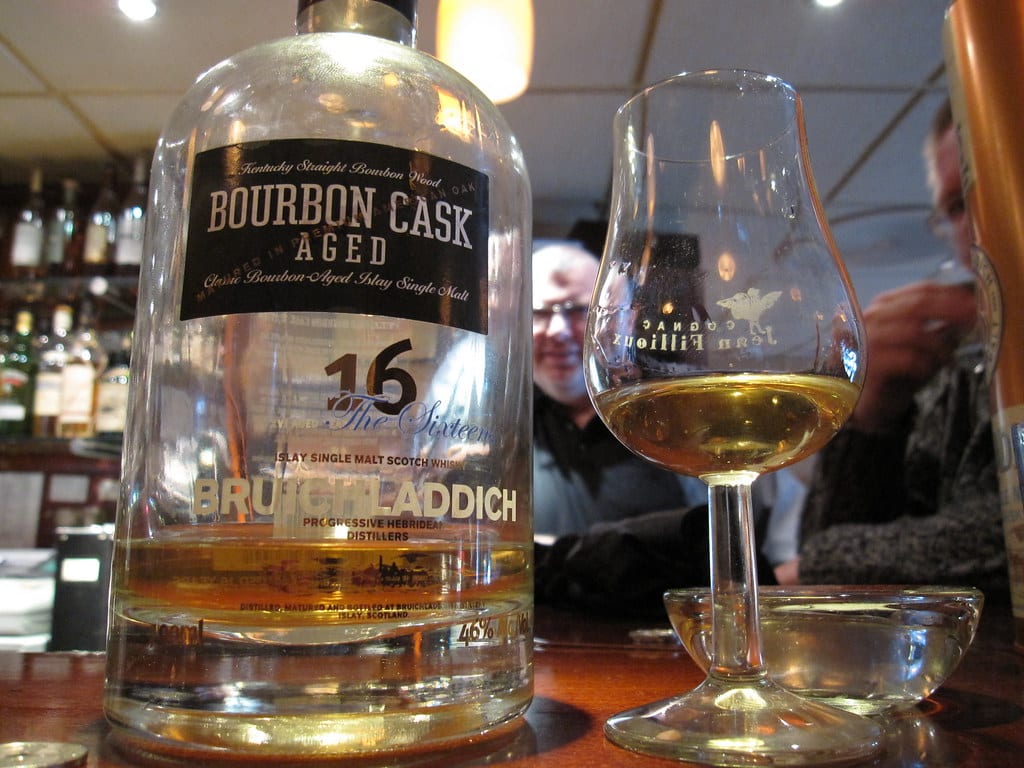
What goes cloudy
Besides water and alcohol, whisky contains hundreds of compounds in tiny amounts. Among them are long-chain fatty acids and esters, which are fatty acids bonded to alcohol. The technical notes published by Annandale Distillery in Scotland name esters such as ethyl laurate and ethyl palmitate as the main cause of haze. They form during fermentation and distillation, and some come from the cask.
These compounds dissolve well in alcohol and badly in water. At high strength and room temperature they stay dissolved and you can't see them. When the strength drops or the temperature falls they can no longer stay in solution and gather into very small clumps. The clumps scatter light, and the whisky looks hazy.
So adding water lowers the strength and brings on haze, and adding ice lowers strength and temperature together and brings it on faster. A bottle left somewhere cold can be cloudy when you fetch it. Warm it up and it clears.
It is the same principle as aniseed spirits turning white with water. With rakı and absinthe people enjoy the change on purpose. The whisky industry went the other way and decided to get rid of it.
What chill filtration does
The method is what the name says. Before bottling, the whisky is chilled until the haze forms and then passed through a filter. The temperature varies by distillery. The blog Whisky & Wisdom says it is typically between about −4°C and 4°C; Annandale gives a range from ambient down to −10°C. Whisky is strong enough not to freeze at those temperatures.
The filter is a stack of alternating plates and frames. Sheets made of cellulose or kieselguhr sit between the plates and the whisky is pushed through under pressure. By Annandale's account this removes about 80 to 90 per cent of the haze-forming clumps.

Why go to the trouble? Appearance. Whisky Advocate writes that most distilleries that chill filter do it primarily for aesthetic reasons. It stops bottles going cloudy in a cold warehouse and ending up on the shelf like that, and stops customers returning a whisky as faulty because it turned hazy over ice. There is a story about Scotch shipped to America in the 1950s that clouded and was sent back. Whisky & Wisdom thinks it is more likely a well-spun tale than a real event.
Why 46%
Almost every whisky that skips chill filtration is 46% or stronger. That is not a coincidence.
Above about 46%, the compounds in question stay dissolved at room temperature. Annandale writes that the critical point "seems to be about 46% alcohol by volume", and Whisky Magazine explains that above 46% the whisky does not flocculate even below 3°C. If you are not going to filter, you set the strength above 46% so the bottle doesn't cloud in the shop.
It is not an exact line. Whisky & Wisdom points out that some in the industry consider 50% the more appropriate threshold. And a 46% whisky still drops below that once you add water, so it will haze in the glass. Think of it as the line at which the whisky holds up in the bottle.
On a label, this is what you can use. At 46% or above the whisky has probably not been chill filtered; at 40% or 43% it almost certainly has. There are exceptions. Whisky Advocate gives Glen Grant and BenRiach as single malts that are unfiltered at 43%, and notes in the other direction that large American distilleries such as Jim Beam and Wild Turkey chill filter most of what they make even at higher proofs.
Does it taste different?
This is where opinion divides.
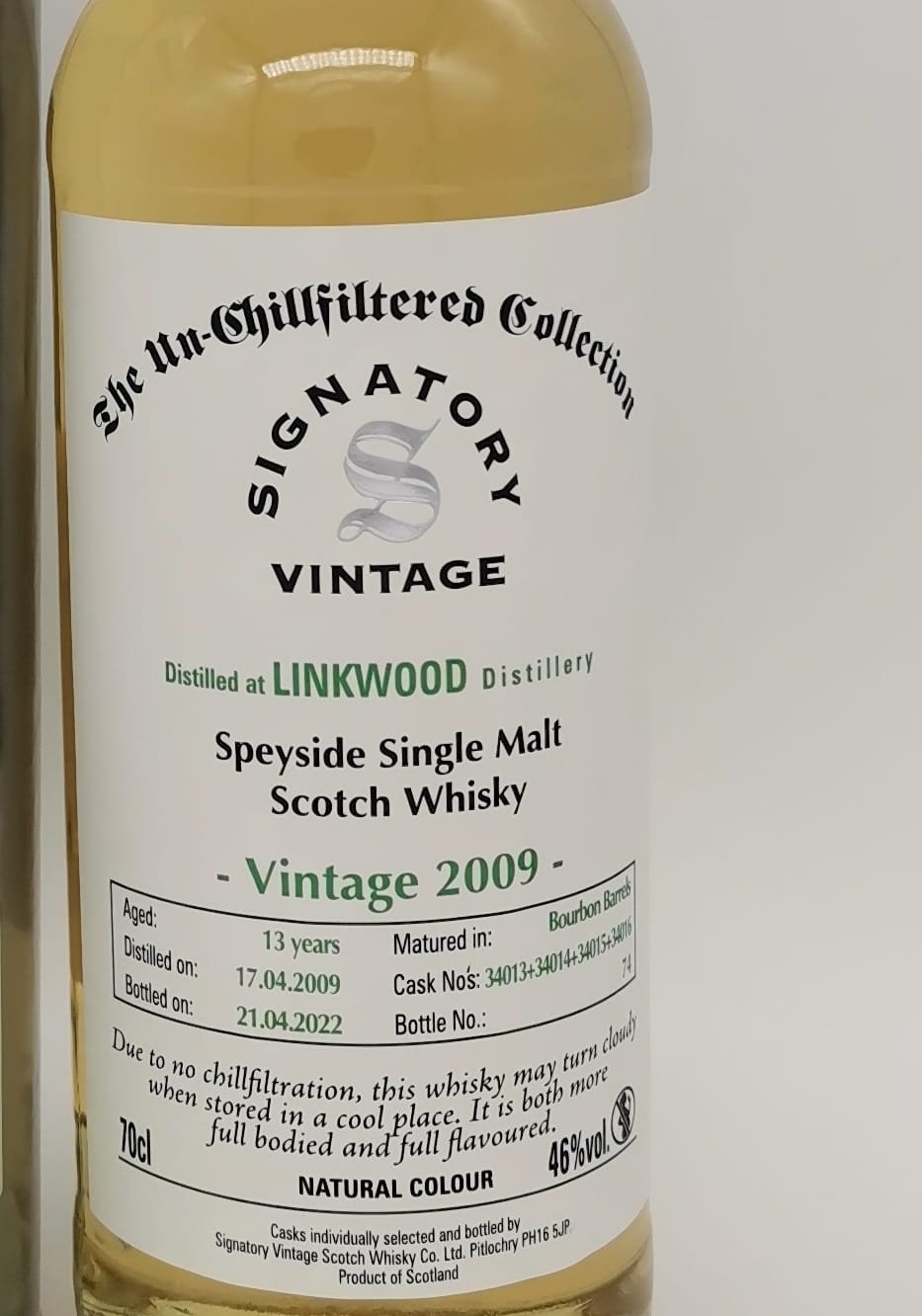
The case against filtering goes like this. The fatty acids and esters being removed are part of the whisky. Take them out and some of the oily texture in the mouth and some of the aroma go with them. The Signatory label in the photo above says the whisky is "both more full bodied and full flavoured" for being left alone. Whisky & Wisdom reports that in 1997 the critic Jim Murray argued Laphroaig in particular was a whisky whose character suffered from chill filtration.
There is evidence on the other side. Annandale's technical note says chill filtering could diminish flavour, but only "to a very modest extent". The compounds removed are large, heavy molecules that don't rise easily to the nose in the first place.
People have also tested whether the difference can be tasted. According to a reader's comment under the Whisky & Wisdom article, the German retailer whisky.de ran a trial in 2013 with more than 100 participants and over 1,000 samples, and most found it very difficult to tell chill-filtered malt from unfiltered. Another comment describes a blind tasting held by a British retailer in which even well-known palates could not pick them apart. This comes from comments, so weigh it accordingly.
There is one more reason comparison is hard. Almost no brand sells the same whisky both filtered and unfiltered. Non-chill-filtered bottlings are usually stronger as well, and uncoloured. If one tastes different, you can't easily say whether that is the filtering or the strength.
My own reading is that the term is less a guarantee of quality than a statement of attitude. A distillery that prints 46%, natural colour and non-chill-filtered together is telling you it wants to do less to the whisky.
Who doesn't filter
Among single malts the number has grown noticeably since the 2000s. Whisky & Wisdom lists Ardbeg, Bunnahabhain, Tobermory, Deanston, Bruichladdich, Craigellachie and GlenDronach as distilleries whose flagship bottlings are 46% or above and not chill filtered. Springbank and GlenAllachie, Teeling in Ireland and Kim Chang Soo in Korea are on the same side. Most independent bottlings are unfiltered.
Cask strength whisky is strong enough that there is no real need to filter it. Even so, some producers, Michter's in the United States for one, filter everything including their cask strength releases.
Silence on the label does not mean the whisky was filtered. "Non-chill-filtered" is not a legally defined term, so whether to print it is the distillery's choice. There is a separate guide to reading a whisky label.
When your glass goes cloudy
Drink it. As Whisky Advocate puts it, the haze poses no hazard to the person drinking it. The flavour hasn't changed either. Something that was dissolved has simply become visible.
If a whole bottle has clouded, leave it at room temperature and it will clear. Occasionally a haze won't go away. According to Whisky & Wisdom, if the water used to reduce the whisky still held calcium or magnesium, a deposit can form that has nothing to do with temperature. That is harmless too.
If a few drops of water cloud your glass, it means that bottle was handled less before it was filled. You will see it most clearly on the rocks.
Annandale Distillery, "Technical Notes: Chill Filtration" · Whisky Advocate, "Everything You Need to Know About Chill-Filtered Whisky" · Whisky & Wisdom, "The complete guide to non chill-filtered whisky" · Whisky Magazine, "Strength in Numbers"; Ian Wisniewski, "Does the ABV Really Matter?", 2018