
The Norlan Glass was designed in 2016 by British design studio Ragged Edge. The starting point is interesting — it was designers, not whisky specialists, who identified structural problems with the Glencairn and set out to solve them. It launched via Kickstarter crowdfunding, achieving 1,400% of its funding goal and immediately attracting attention from the whisky community.
Unlike the Glencairn, the Norlan declared from the outset that it was solving two specific problems: heat transfer from the palm, and the concentration of alcohol irritation in high-ABV whisky. Both issues are longstanding criticisms of the Glencairn.
Why Did Designers Make a Whisky Glass?
Ragged Edge is not a specialist glassware manufacturer — it's a brand identity and product design studio. Their interest in whisky glasses came from the functional problems they identified in the Glencairn.
The Glencairn was designed in 2001 and has been the standard whisky glass ever since. But from Ragged Edge's perspective, the Glencairn had been optimised for the single act of nosing while neglecting the full experience of actually holding and drinking from the glass.
Norlan co-founder Craigie Mackintosh put it this way in an interview: "The Glencairn is a glass for distillery blenders. Blenders don't walk around holding the glass — they set it on a table and bring their nose to it. But we drink from glasses we hold in our hands."
This perspective became the starting point for the Norlan's design.
The Double-Wall Structure — Principle and Effect
The Norlan's most distinctive feature is its double-wall construction. There is a second layer of glass inside the glass, with an air gap between the inner and outer walls acting as insulation.
Double-wall construction was not invented by Norlan — it has been used in coffee cups and tea glasses for a long time. But applying it to a whisky nosing glass was a first.
The insulation principle is physically simple. Air conducts heat far less efficiently than glass. Heat from the palm may pass through the outer wall, but it is blocked at the air gap and reaches the inner wall and the whisky much more slowly. This is why the whisky temperature rises more slowly in a Norlan than in a Glencairn.
One misconception is that double-wall glasses are only for cold drinks. Norlan's insulation effect is actually more meaningful for spirits drunk at room temperature — it prevents the palm's warmth from rapidly heating the whisky.
Bowl Shape and Internal Structure
The Norlan's bowl is wider and taller than the Glencairn's. The inner surface features a subtle pattern of fine grooves that are nearly invisible to the naked eye. These guide the whisky to spread across a wider surface area as it flows down the glass — the intent being to increase the surface area from which aroma compounds can evaporate.
The rim narrows inward like the Glencairn, but at a more gradual angle. Aromas concentrate, but the co-concentration of alcohol vapour is comparatively reduced.
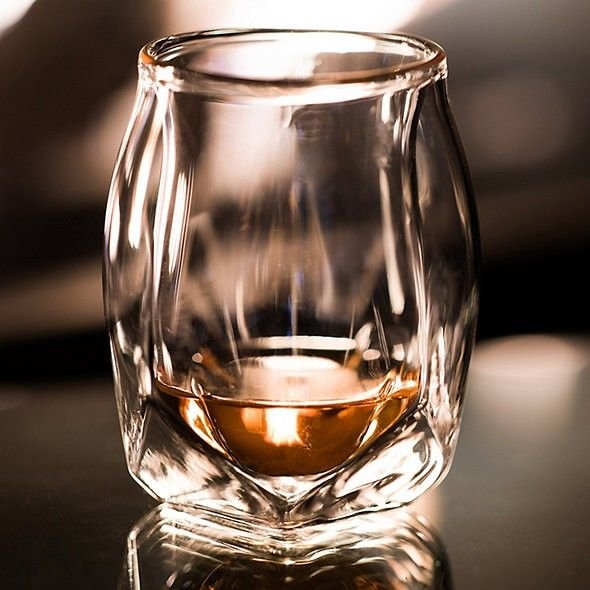
Specifications Compared
| Feature | Glencairn | Norlan |
|---|---|---|
| Capacity | ~180ml | ~170ml |
| Bowl diameter | Medium | Wide |
| Wall construction | Single | Double |
| Rim angle | Sharply narrowing | Gradually narrowing |
| Inner surface | Smooth | Micro-groove pattern |
| Weight | ~85g | ~120g |
| Price (per glass) | £10–15 | £30–45 |
| Dishwasher | Possible (not recommended) | No |
Performance with High-ABV Whisky
Reports consistently emerge from the Reddit r/Scotch community that cask-strength whisky enthusiasts prefer the Norlan over the Glencairn. The common reason is that the Glencairn's narrow rim concentrates alcohol irritation, while the Norlan's wider bowl and more gradual rim disperses it.
Whether this is due to the double-wall construction or the bowl shape is debated within the community. Structurally, both elements likely play a role. But the consistency of reports from users experiencing a different sensation with high-ABV whisky is notable.
Whisky Advocate reviewers evaluate the Norlan as "an improvement on the Glencairn's drinking experience" while maintaining that the Copita-style glass remains more suitable for professional tasting when aroma concentration alone is the priority.
The Cleaning Reality
The double-wall structure's greatest downside is cleaning. If washed like a regular glass, water enters the gap between inner and outer walls — and doesn't drain naturally.
The official Norlan care method is to invert and air-dry. Moisture trapped in the gap takes time to evaporate, and if the glass is used before it fully dries, water marks form inside the gap.
Dishwashers are absolutely out. High-temperature steam damages the double-wall structure, and Norlan's warranty does not cover dishwasher use.
Conclusion: Who Should Choose the Norlan?
The Norlan is likely the better choice over the Glencairn in these circumstances:
- You frequently drink cask-strength whisky (55%+ ABV)
- Your nosing sessions are long and you hold the glass throughout
- You're sensitive to alcohol irritation and struggle to focus on aroma
- You don't mind a contemporary design aesthetic
Conversely, the Glencairn may serve better if:
- You primarily drink standard-ABV (40–46%) whisky
- Ease of cleaning is important to you
- You prefer traditional whisky aesthetics
- You value the official SWA-recognised nosing glass status
The Norlan is not a replacement for the Glencairn. It is a next-step glass for those who genuinely experience the Glencairn's limitations as a problem.
Next: Copita vs Glencairn — why stemmed glasses appear more often at professional tastings
Reader Notes
Be the first to leave a note.