
Put two glasses side by side. One is pale as straw, the other dark as soy sauce. You haven't brought your nose anywhere near them, and a sentence is already forming in your head. The one on the right must be older. Sherry cask, surely. That one will be richer.
And that sentence usually survives all the way to the first sip, because it has already decided what you'll look for in the aroma and what you'll ignore.
There's an object that tries to cut this off with nothing more than a glass. A black glass you can't see into at all.
Same glass, colour removed
Glencairn Crystal sells opaque versions of its own glass. They come in five colours — black, blue, green, gold and red — and also as a six-piece "blind tasting set" alongside the clear original. The company's pitch is a single sentence: hide the colour of the spirit so you can taste blind.
What matters is that the shape is identical. The same tulip bowl out of the same mould, the same height, the same rim. Aroma gathers the same way and the rim meets your lip the same way. Exactly one thing changes: what you can see.
Why that matters: when you compare glasses, several variables usually move at once. Put a copita against a Glencairn and shape, capacity and stem all change together. The black Glencairn doesn't do that. It holds every other condition still and takes away colour alone — a controlled experiment in the form of a glass.
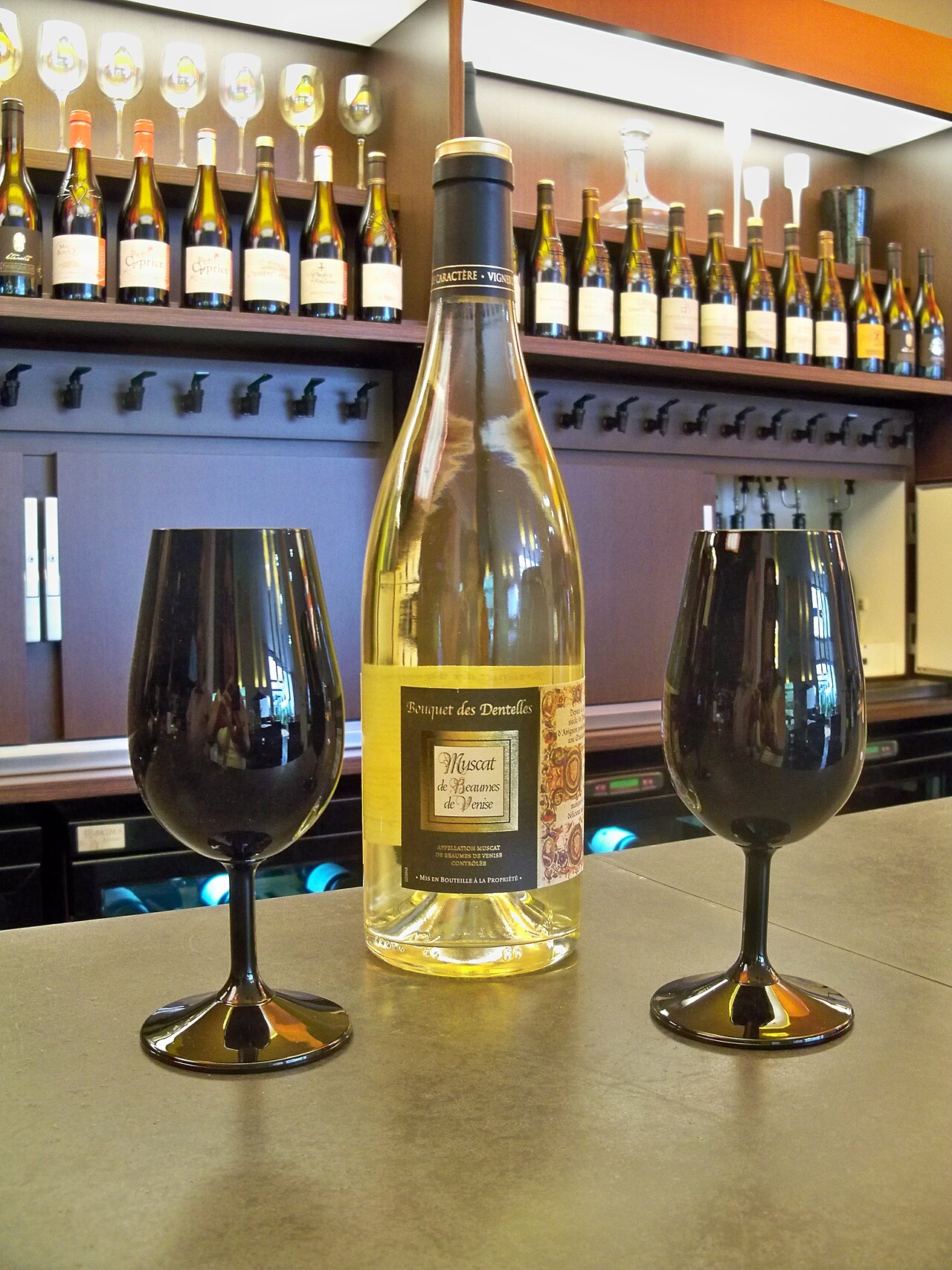
A tasting counter at a winery in Vacqueyras, France. These are black INAO glasses, made to hide the colour of the wine — whisky wasn't the first to have the idea (photo: Véronique Pagnier / Wikimedia Commons, Public Domain)
There's a reason for six colours, too. Line up a row of black glasses and you lose track of which is which. Colour tells the glasses apart, while only the host knows what's in each one. The identity of the spirit is hidden; the identity of the glass is kept.
To be clear, whisky didn't invent this. Wine has had the black INAO glass, derived from the same specification as ISO 3591, for far longer, and you still see it on French winery counters today. Whisky is closer to a late follower — why wine got there first comes up again below.
So what is whisky colour a function of?
Before the black glass makes sense, there's a question to answer. Why is erasing colour an advantage? If colour were honest information, there'd be no reason to hide it.
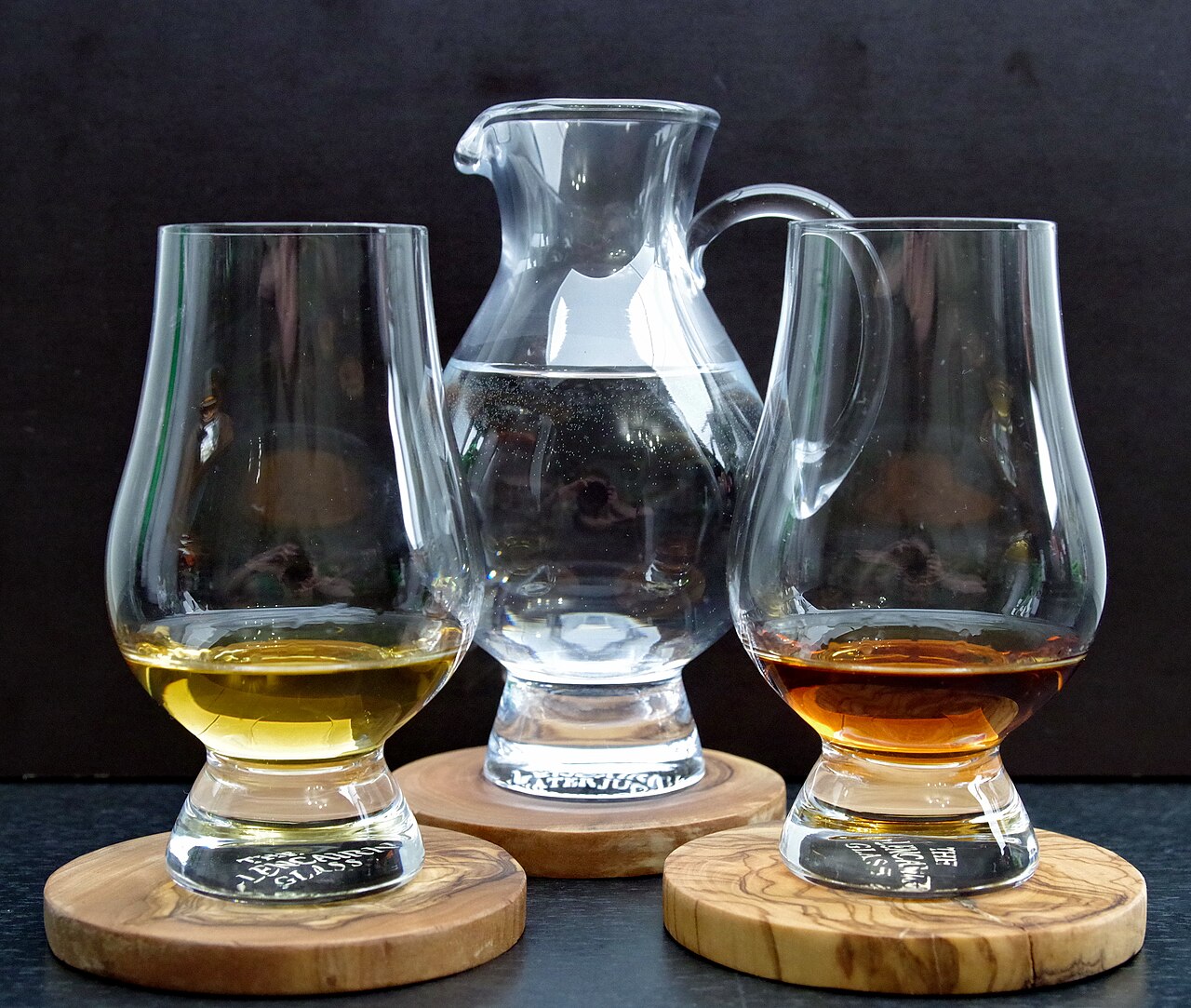
Left, Laphroaig Quarter Cask; right, Laphroaig Triple Wood. Same distillery, same peat, and this much difference in colour (photo: Lord van Tasm / Wikimedia Commons, CC BY-SA 3.0)
The two glasses above come from the same distillery. Same island, same peat, same stills. Yet one is pale gold and the other a reddish amber.
What made the difference isn't age but wood. The left one spent time in small quarter casks; the right one finished in oloroso sherry casks. First-fill or third-fill, bourbon barrel or sherry butt, big cask or small, which floor of the warehouse it sat on — colour is the sum of these variables.
Years in cask is just one of them, and the weakest. A whisky that spent 25 years in a refill bourbon cask coming out far paler than one that spent eight in a first-fill sherry cask is entirely ordinary.
There's one more thing on top. Scotch is legally allowed to contain spirit caramel (E150a). The stated purpose is to even out colour from batch to batch, and plenty of mainstream Scotch uses it. The full story is in our piece on no added colour and caramel.
Put together, it looks like this.
| What you read from colour | What colour actually reflects |
|---|---|
| Age | Cask type, number of fills, cask size |
| Intensity of flavour | How active the cask is, warehouse position, strength |
| Quality and price | All of the above, plus E150a where added |
That doesn't mean colour lies. It's fairly honest about the wood. The problem is that we translate it into age and quality as we listen. Few signals are as awkward to handle as one that gives an accurate answer to the wrong question.
Wine has been through this already
In 2001, Morrot, Brochet and Dubourdieu at the University of Bordeaux published "The Color of Odors" in Brain and Language. The experiment was almost cruelly simple.
They gave 54 oenology students a white wine and a red wine and asked them to describe the aromas. A few days later the same people got two glasses again. This time, though, the "red" wasn't red wine. It was the same white wine with an odourless red dye added.
The result is well known. The students described the reddened white in the language of red wine. The point isn't that they were fooled into thinking "this is red". What the researchers analysed was vocabulary. When the colour changed, the words themselves switched over to red things — plum, cherry, liquorice.
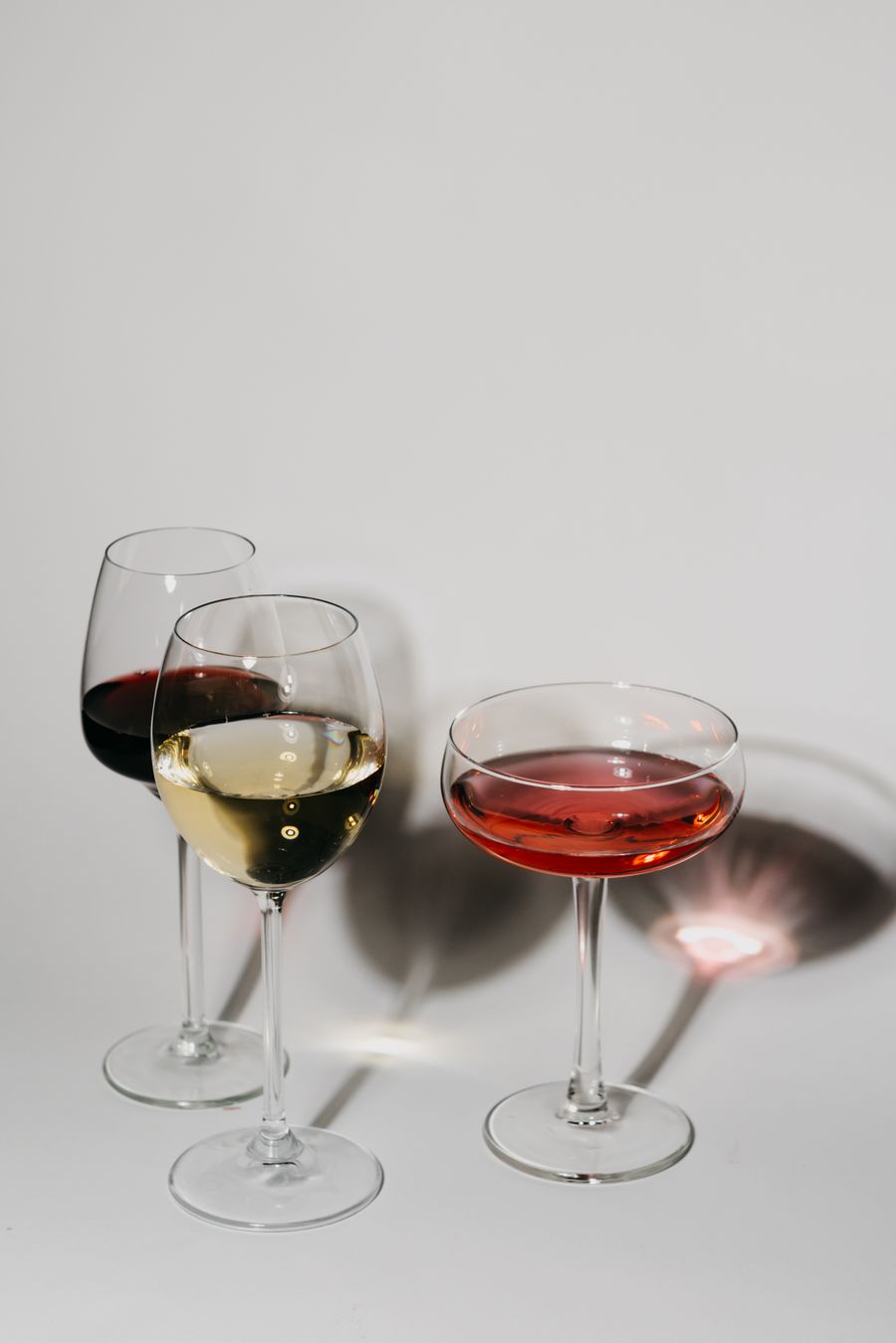
Change the colour and the words used to describe the aroma change. What Bordeaux documented was that shift in vocabulary (photo: Polina Kovaleva / Pexels)
The study gets a little exaggerated every time it's cited. Participants chose from a supplied list of descriptors, and later work argued over how large the effect really is. But no study has reversed its direction. What remains is that sight overwrites how we interpret smell, and that the overwriting happens to trained people too.
Whisky has no experiment this famous. But whisky's position is worse than wine's. Red wine gets its colour from the grape; whisky's amber can be adjusted after the fact with a colouring the law permits.
Olive oil wrote it into the standard
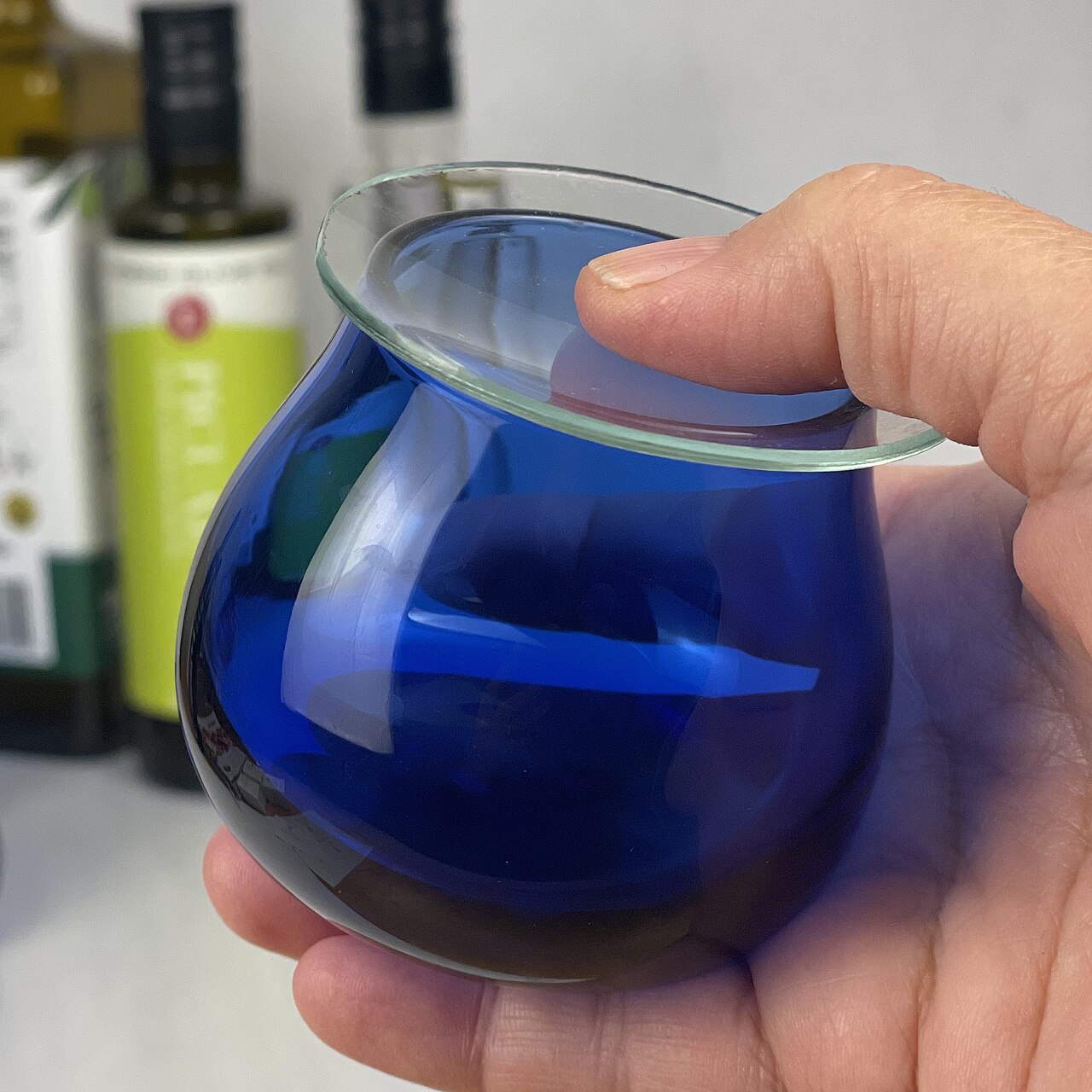
The International Olive Council's standard tasting glass: cobalt-blue glass, a watch-glass lid, shaped to be warmed in the palm (photo: MerchantAdventurer / Wikimedia Commons, CC BY-SA 4.0)
While the whisky trade leaves the black glass optional, one industry made the problem part of its standard outright: olive oil.
In 1987 the International Olive Council (IOC) set out a specification for the official tasting glass (COI/T.20/Doc. No. 5). Its core requirement is that the glass be dark enough that the colour of the oil can't be seen. In practice that settled on cobalt blue. The rounded belly is for cupping in the palm to bring the oil to around 28°C; the narrowing mouth and watch-glass lid hold the aroma in.
The key point is that this isn't a matter of taste. The extra virgin grade is decided by a sensory panel's verdict, and in the EU that verdict has legal force. Not being allowed to see the colour is a precondition of grading.
Olive oil's reason for going this far is plain. Consumers take deep green oil to be fresher and better, but colour comes from variety, harvest timing and filtration and isn't tied directly to quality. Colour made it easy to mislead, so they made colour impossible to see.
Professional sensory labs go a step further. ISO 8589, the guideline for designing test rooms, allows low-level lighting with red or green filters when colour differences between samples need to be masked. Under red light the differences in colour simply don't register. The black glass is, in a sense, a handheld version of that red-lit booth.
But whisky competitions' "blind" doesn't hide colour
Here's something worth pointing out. Major competitions such as the IWSC and the World Whiskies Awards all judge blind. Labels, brands and prices are hidden. The spirits arrive in numbered glasses.
Those glasses are clear.
So what the trade customarily hides is identity, not appearance. There are really two layers inside the single word "blind".
The first is blind to identity: name, origin, price and reputation are removed. Nobody disputes this. Everyone agrees that a score given while looking at the label is a score for the label, not the spirit.
The second is blind to appearance: colour and clarity are removed too. This is where opinions split. Is colour information, or bias? Competitions have mostly chosen the former; the black glass is a tool for the latter.
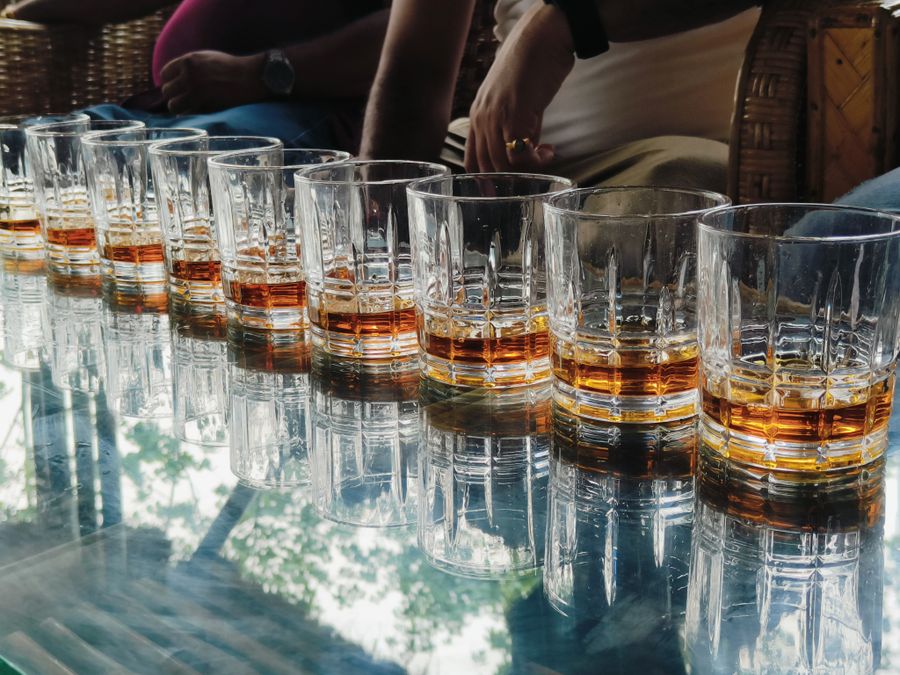
Competition blind tastings usually look like this. No labels, but the colour is plain to see (photo: Dhritishman Bharadwaj Barman / Pexels)
Competitions stick with clear glasses for good reason. Judges have to spot faults too. Floating particles, sediment and unexplained haze are grounds for deductions in themselves, and in a black glass you see none of it. If seeing colour is bias, not seeing faults is dereliction of duty.
What the black glass takes along with the colour
Articles recommending this glass usually stop here: the bias is gone, so you're more accurate. In use, what you lose is just as clear.
You can't see haze. Add water to a non-chill-filtered whisky and fatty acid esters cloud it. That louche isn't a fault but evidence of lighter filtration, and it's also a visual cue for how much water you've added. In a black glass it disappears entirely.
You can't match pours. This matters more than you'd think. With a clear glass you can even out measures by eye; a black glass shows you nothing. If one glass gets 25ml and another 40ml, the intensity of the aroma differs before anything else. A glass picked up to remove one bias ends up introducing a bigger confounding variable. Measure every pour.
You can't check that it's clean. Detergent marks or dust inside a glass happen now and then however carefully you look after it. A clear glass you just hold up to the light; a black one you can't.
The other biases stay put. Colour is only one of several channels that build expectation. The weight of the glass, the pouring order, the host's face, whose bottle it was — the cues covered in the brain tastes the glass aren't blocked by a black glass. If anything, the growing conviction that "I'm tasting objectively now" is the more dangerous part.
And don't forget: for a blender, colour is a legitimate tool. Nothing is quicker for checking consistency between batches or guessing at the state of a cask. Erasing colour removes a bias, and at the same time throws away a piece of information.
Doing it properly at home
If you're going to try it, do it properly or you won't take anything away. This order works.
- Use matching glasses. Four to six of the same model, differing only in colour. Mix shapes and it stops being an experiment and becomes just drinks.
- Measure every pour. 25–30ml with a jigger or a syringe. Remember that judging by eye is impossible.
- The person pouring doesn't drink. A third party shuffles the order and keeps to themselves which colour holds what until the end.
- The host arranges the order by strength. Participants can't see colour, so they can't predict strength. Put a cask strength whisky early and every nose after it is dulled.
- Note nose, palate, finish in that order. One line per glass is enough.
- Write down your guess at the colour before the reveal. This is the whole point of the glass.
Skip that last step and half the reason to use a black glass is gone. The glass you were sure held a dark sherried whisky turns out, poured into a clear one, to be straw-coloured — or the other way round. That moment is the one real lesson this glass gives. Finish by pouring everything into clear glasses and looking together after the reveal.
Not a more accurate glass, but one that makes you decide what counts as information
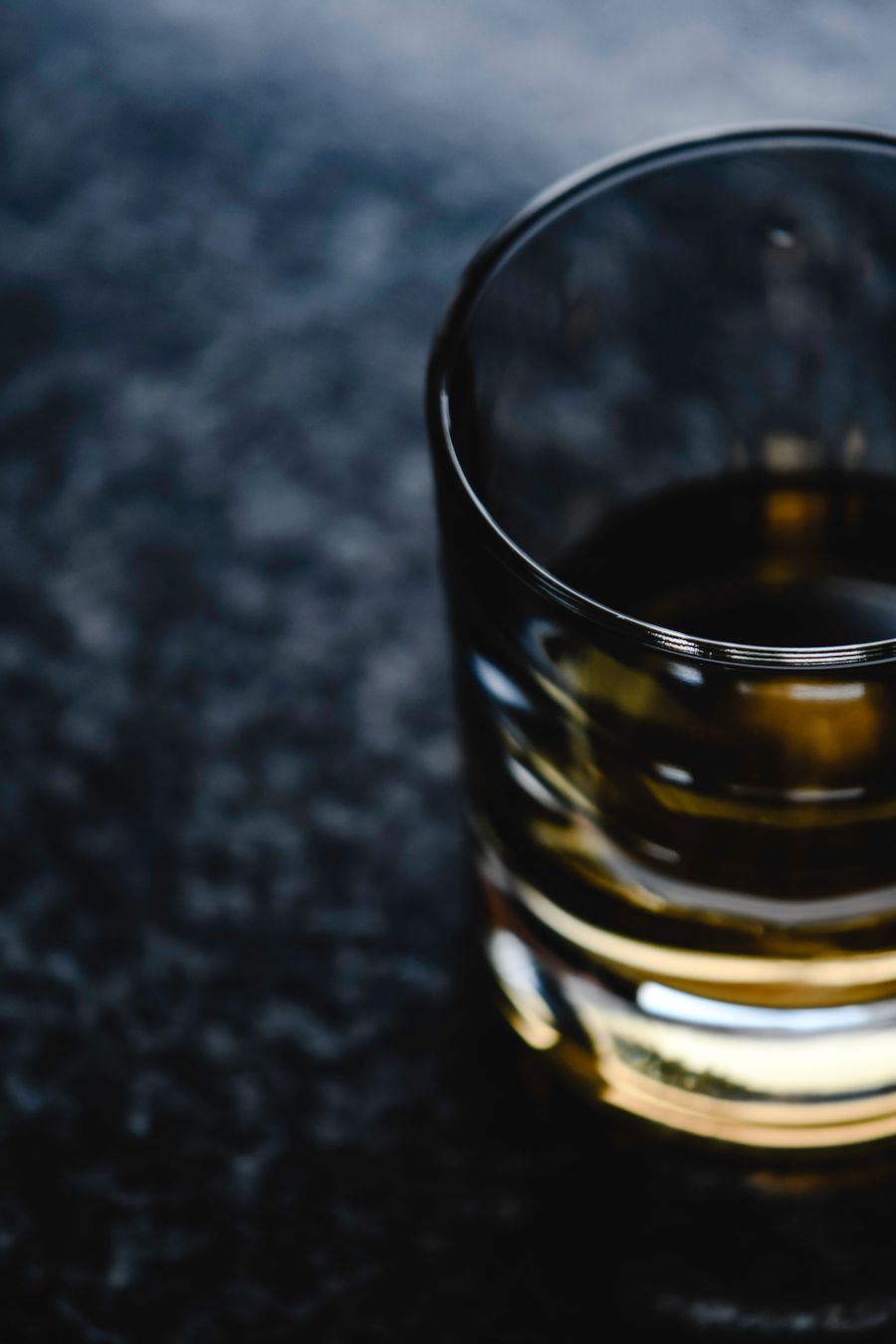
With the colour gone, what's left is aroma, texture, and the fact that you guessed wrong (photo: Eva Bronzini / Pexels)
A black glass won't make you a more objective person. It closes one channel, sight, and in exchange takes away haze, measuring and the cleanliness check.
Its value lies somewhere else. It shows you, once, how much of your judgement was resting on colour. For most people that share is bigger than they expected, and once seen, the sense of it lasts quite a while.
And after going through that once, you can go back to clear glasses. The pleasure of looking at colour is part of the pleasure of drinking whisky. It's just that from then on, a dark colour makes you wonder what wood it passed through instead of how old it is. Not a bad change for one glass to make.
Black INAO tasting glasses (Vacqueyras) — Véronique Pagnier / Wikimedia Commons (Public Domain) · Whisky in a dark glass — Eva Bronzini / Pexels · Two Laphroaig drams and a water jug — Lord van Tasm / Wikimedia Commons (CC BY-SA 3.0) · Red, white and rosé wine — Polina Kovaleva / Pexels · Cobalt-blue olive oil tasting glass — MerchantAdventurer / Wikimedia Commons (CC BY-SA 4.0) · Whisky glasses in a row — Dhritishman Bharadwaj Barman / Pexels