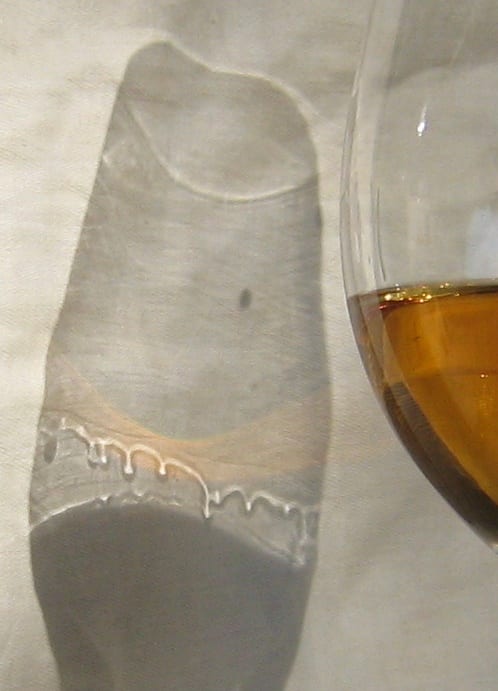
Swirl the glass once and set it down. The thin film left on the wall hangs there for a moment, gathers into a few thick streaks, and runs back into the dram. The commentary that follows in a whisky bar is fairly predictable. Look at those legs — thick and slow, must be well aged. Good viscosity. Plenty of body. Oily.
It has always bothered me slightly. If those streaks really report something about the whisky, how do we explain the same dram producing different legs in a different glass?
Those streaks didn't run down. They climbed up first
This is where most explanations get the first step wrong. Legs are not whisky sliding down the wall. They are liquid that climbed the wall and then got heavy enough to fall.
Here is how it goes. Swirling leaves a very thin film on the glass. That film has a large surface area for its volume, so it evaporates far faster than the dram below. And of the two main components, ethanol goes first. At twenty degrees its vapour pressure is 5.95 kilopascals against water's 2.34 — two and a half times the hurry.
As ethanol leaves, what remains in the film is closer to water. Water's surface tension is 72 millinewtons per metre; ethanol's is 22. A 40% whisky sits around 30, somewhere in between. So the film ends up with higher surface tension than the body of liquid beneath it.
Higher surface tension pulls on lower. Whisky is therefore drawn up out of the dram into the film. The liquid piles into a ridge near the top, and at some point gravity wins and it pinches off into droplets that fall. Keep that round trip going and you have legs.
The first person to explain this properly was James Thomson, a Glasgow physicist. In an 1855 paper he pinned the motion on differences in surface tension, and he was right. Carlo Marangoni covered the same ground a decade or so later, and the name stuck to him. Thomson had reason to feel hard done by.
In 2015 another layer was added. Venerus and Nieto Simavilla showed that the film cools itself as it evaporates, so a temperature gradient contributes to the same stress. A 2020 paper worked out why that ridge sheds droplets at such regular spacing, using shock-wave theory. A hundred and seventy years in, papers are still coming.
Where the word "viscosity" got in
Notice that viscosity has not appeared yet. Evaporation and surface tension build the legs. Viscosity only affects how slowly the finished legs run. It is a speed control on the result, not the cause.
So why has the viscosity story stuck so hard? It came over from wine. Wine does contain glycerol, four to ten grams per litre, and it genuinely contributes to sweetness and texture. From there a syllogism assembled itself: thick legs mean more glycerol, more glycerol means a better wine. Even in wine that is a stretch — the differences in glycerol between wines are nowhere near large enough to move surface tension meaningfully.
Move to whisky and the logic collapses entirely.
Glycerol does not come across in distillation. It boils at 290 degrees. The fermented wash contains plenty of it, but nothing about heating a still and collecting vapour that rises around 78 degrees will bring it along. The glycerol made in the washback stays at the bottom of the wash still and leaves as pot ale. We have been explaining legs with a compound that is essentially absent from the glass.
What about everything the cask gives up? Lignin breakdown products, oak lactones, tannins — real, but a few hundred milligrams per litre in total. Not a quantity any viscometer will notice. The sensation people call "oily" has more to do with the mouthfeel of fatty acid esters than with measurable thickness.
Legs do say something about strength
Clear the myth away and something useful survives. Legs really do track alcoholic strength — just not by the route people assume.
The higher the ethanol content, the bigger the surface tension gradient evaporation can create, and the harder the liquid is pulled up the wall. Pour a 40% and a 60% cask strength side by side in matching glasses and you can see it. Pure water makes no legs. Neither does pure ethanol. The mixture is the whole point.
Viscosity does move with strength too, and here is the fun part: mix water and ethanol and you get something thicker than either one alone. At twenty degrees water is about 1.0 millipascal-seconds and ethanol about 1.2, but around 40 percent the blend climbs to roughly 2.5, because the molecules tangle up in hydrogen bonding. Which means slow-running legs point to a strength band far more often than to deep maturation.
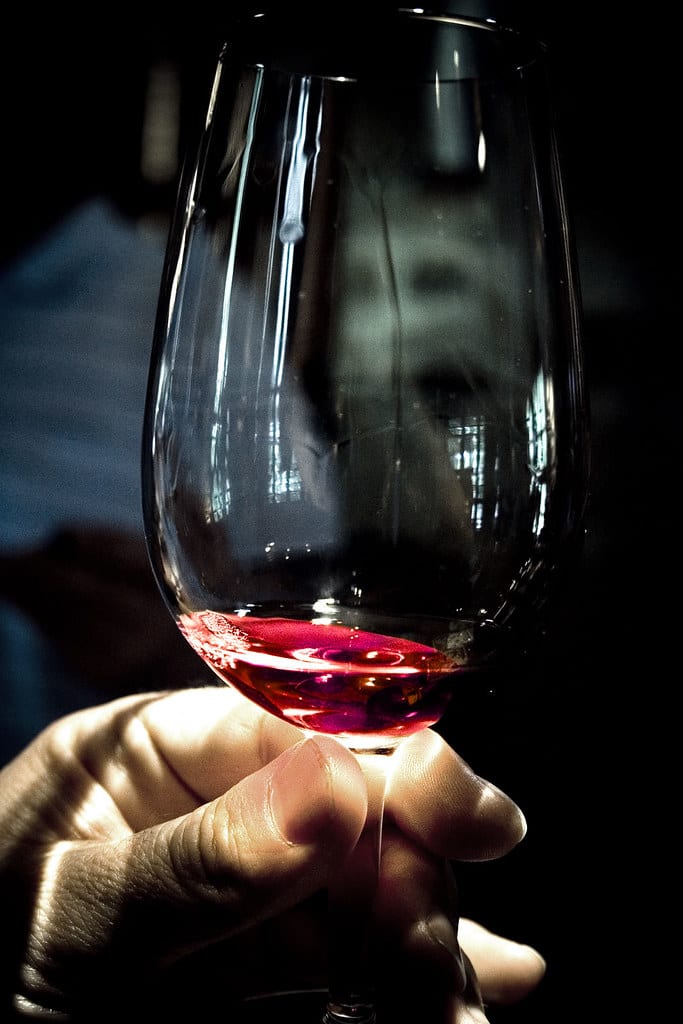
Before legs, the old visual test for strength was beading: shake the bottle and watch how long the bubbles at the neck survive. Broadly, you need something over 46 to 50 percent before the beads hold noticeably. It lasted not because it was accurate but because it was the only gauge available without a hydrometer.
The glass changes the legs more than the whisky does
This is the real reason legs make a poor diagnostic. Split one dram between two glasses and you can get two different answers.
Detergent left in the glass. Rinse badly and a trace of surfactant stays behind, lowering the surface tension of everything. The gap between film and body narrows, and the legs go faint or never appear. How you washed and dried the glass matters more to the result than the age statement does. Dishwashers with rinse aid are the worst offenders.
Humidity. Evaporation is the engine. The same whisky behaves differently in a damp room in July and a dry one in January.
Temperature. Surface tension rises as things get colder. A glass out of the fridge and a glass off the shelf are not the same experiment.
Glass shape and wall angle. A gentle curve holds a long film; a narrow steep bowl cuts it short. A Glencairn and a heavy rocks glass were never comparable.
A lid. Put a watch glass over a nosing copita and the headspace saturates with ethanol vapour. Evaporation stops, and so do the legs.
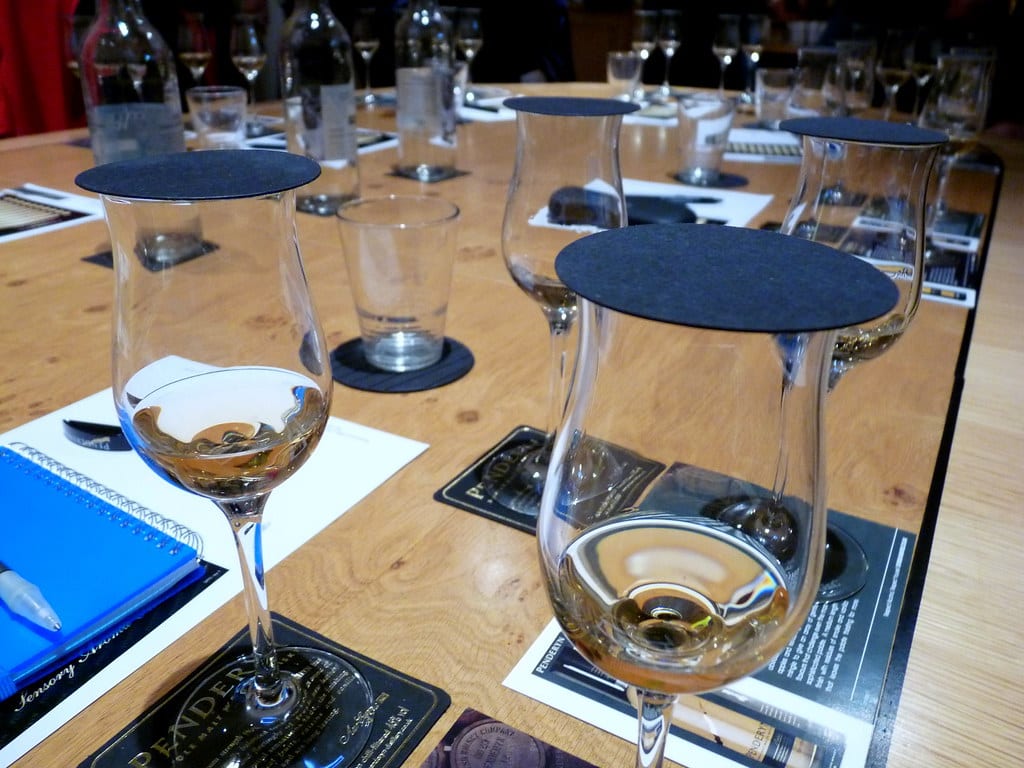
There is an awkward corner here. When people explain why ISO 3591 demands clear, colourless glass, legs usually turn up in the list of appearance criteria. That is not the standard endorsing legs as a quality marker; it only requires that whatever you look at is shown without distortion. But appearing on the list conferred authority anyway.
What legs can actually tell you
They are not useless. The range is just narrow.
Same glass, same room, same evening, and you can read a strength difference well enough. Put 43% and 58% next to each other and it is visible. Change any of those conditions and you can read nothing. Comparing the legs of a dram you had in another bar last month, from memory, is meaningless.
One more use. If you pour something good and the legs are strangely absent, suspect the glass before the whisky. Detergent residue or a smear of grease is the likely answer. Legs work far better as a cleanliness indicator than as a quality one.
Incidentally, seeing legs requires a swirl, and what that swirl does to the aroma is its own argument. At cask strength you often lose more than you gain.
Age, cask type, body, quality — legs report on none of it. And yet I think there is a reason we keep watching them. They buy you a beat of waiting after you set the glass down. In those few seconds the alcohol sting settles and the whisky becomes easier to nose. The pause is worth considerably more than the reading.
J. Thomson, On certain curious motions observable at the surfaces of wine and other alcoholic liquors, Philosophical Magazine, 1855 · D. C. Venerus & D. Nieto Simavilla, Tears of wine: new insights on an old phenomenon, Scientific Reports 5, 16162 (2015)