
Whisky stones make an easy gift. Nine grey cubes in a wooden box, a little pair of tongs. The packaging almost always carries the same line — chill without dilution.
The sentence isn't a lie. Stone doesn't melt, so nothing gets watered down. The trouble is the first half, the chill part. Work out how much cooling the stones actually deliver and it becomes clear that what's being sold is less a cooling method than the idea of one.
Ice isn't powerful because it's cold
This is where most people's intuition goes wrong. A stone and an ice cube pulled from the same freezer are the same temperature — about minus eighteen. What they do once they hit the glass is not remotely the same.
Ice's real weapon is not temperature but the phase change. The moment ice turns to water, it swallows a large amount of surrounding heat while its own temperature doesn't budge from zero. That portion is called the latent heat of fusion, and it runs to roughly 334 joules per gram — about the same energy it takes to heat that same gram of water from zero all the way to eighty degrees.
Stone has no such stage. All a stone can do is start out cold and absorb heat gradually until it goes lukewarm. Soapstone's specific heat is somewhere near 0.98 joules per gram per degree. A stone taken out at minus eighteen and warming to ten absorbs about 27 joules per gram.
Now the same gram of ice: 38 joules warming from minus eighteen to zero, 334 melting, and 42 more as the meltwater climbs to ten. Total, 414.
Fifteen times the difference, gram for gram.
In practice the gap widens further. Commercial whisky stones are usually two-centimetre cubes. At soapstone's density that's about 24 grams each, and the three stones typically recommended come to roughly 70 grams. All told they can absorb about 1.9 kilojoules.
A single three-centimetre ice cube weighs 25 grams and takes up to 10 kilojoules before it has fully melted. Three stones together don't reach a fifth of one cube.
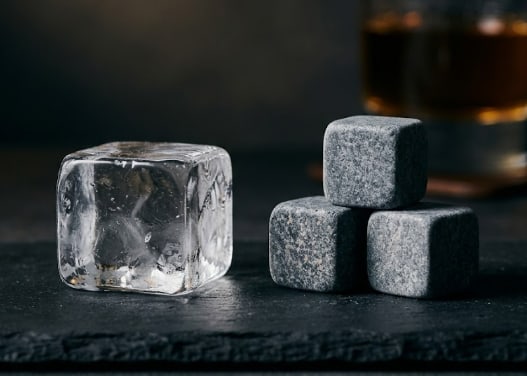
Two things out of the same freezer. The temperature is identical; the scale of what they do inside a glass is not. Ice devours heat as it melts, while stone simply goes lukewarm.
The glass turns out to be the biggest player
Push the arithmetic a little further and something more interesting appears.
Forty-five millilitres of whisky is about 43 grams, and the specific heat of a 40% spirit is roughly 3.6 joules per gram per degree. So the heat capacity of one pour is around 155 joules per degree. Drop three stones at minus eighteen into it, ignore everything else, and the whisky falls from twenty degrees to about ten. On its own that doesn't sound bad at all.
Then there's the glass. A solid rocks tumbler weighs around 300 grams, and glass has a specific heat near 0.84. That single glass carries about 250 joules per degree — more than one and a half times the whisky sitting inside it. If the glass was at room temperature, it hands straight back the temperature the stones worked to remove. Include the glass in the sum and the real drop shrinks to something like five degrees.
And that is the end of it. The stones are already warm, with no latent-heat reserve left in the magazine. Ice, by contrast, pins the glass near zero until the last of it has melted. If ice is a coolant, a stone is a single-use cold pack.
One practical conclusion follows. Rather than buying nine stones, chilling the glass beforehand is a far more efficient way to buy degrees. It makes sense to deal with the object that carries the most heat first.
Soapstone, granite, steel
There are more materials sold under the name "whisky stone" than most people realise, and the differences matter.
Soapstone. Talc-based, with a Mohs hardness of 1 to 2 — you can scratch it with a fingernail. That sounds like a flaw, but it is precisely why the material became the standard. Glass sits around 5.5, so no amount of rolling around will let soapstone mark your glass. The trade-off is that soft stone wears; edges round off and the surface loses its finish over time.
Granite and marble. Hardness climbs to 6 or 7. They barely wear and they look substantial, but they are a hazard to glassware. Dropped carelessly into a thin crystal tumbler, they leave a mark on the base or, at worst, start a crack. Best kept out of crystal glasses altogether.
Stainless steel cubes. The lowest specific heat of the three at 0.5, but with a density of 7.9 it actually beats stone per unit of volume. Some are hollow and filled with a freezing gel, which is the right instinct — the gel freezes and thaws, borrowing part of ice's phase-change trick. Accept the feel of metal against your teeth and the risk of a scratched base, and on performance alone it's the most sensible of the three.
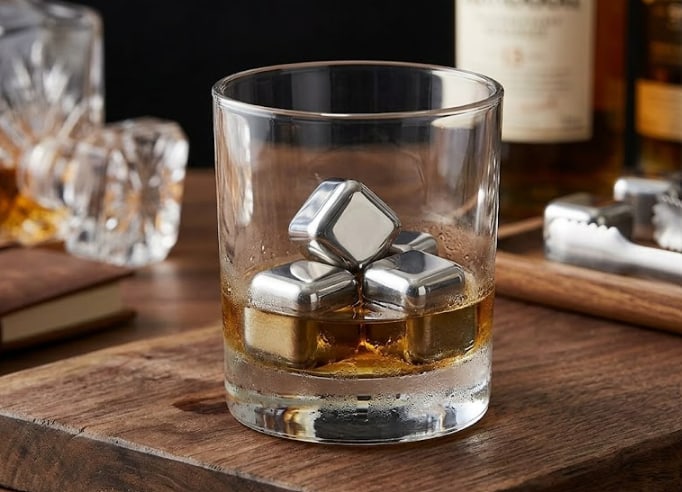
Steel cubes trade a low specific heat for high density. The versions filled with freezing gel go one step beyond stone by borrowing the phase change.
Choosing a material really comes down to two questions: will it hurt my glass, and will it carry a smell into the whisky. Cooling power isn't worth agonising over, because whichever you pick it falls a long way short of ice.
Washing and drying
What people who actually use stones complain about is rarely the cooling. It's the smell.
Soapstone is not fully non-porous. Detergent fragrance settles into the fine surface texture and doesn't leave easily, and a stone in that state will ruin a glass you poured in order to smell it. Hence the standard advice: rinse in hot water only, and dry completely. Left loose in a freezer the stones pick up whatever is in there with them, which is why an airtight container is part of the routine too.
Drying matters more than it sounds. Freeze a stone with water still on it and a film of ice forms on the surface — and that film melts in your glass. You bought the thing to avoid dilution and got dilution you can't control. The amount is trivial, but given the whole point of the object, it's an odd result.
Like caring for the glass itself, this is a piece of kit that asks for attention. Ice comes out of a tray and goes down the sink; stones have to be washed, dried, sealed and refrozen.
Is dilution really the enemy?
It's worth stepping back here. Whisky stones rest on the premise that water in the glass is a bad thing, and with whisky that premise doesn't hold up well.
A few drops of water opening up the aroma is a documented effect explained at the molecular level, and people drinking cask strength treat water as a tool outright. What the distillery adds before bottling to set the strength is, in the end, water too. In whisky, dilution is less an accident than a control.
So "zero dilution" doesn't solve the problem so much as sidestep it. If you genuinely don't want water anywhere near the glass, the method is simple: add nothing and drink it at room temperature. That's better for the aroma anyway.
When they're worth using
None of this means throwing the box away. Adjust the expectation and there are places the stones fit.
Taking a few degrees off a lukewarm pour in summer. Know that you're getting about five degrees and there is nothing to be disappointed about. It's enough to blunt the alcohol on the first sip.
A whisky already bottled at drinking strength. A standard 40% bottle doesn't have much room left for water. Here stones are the more reasonable choice.
Spirits where aroma isn't the point. With vodka or gin, where cold is the objective in itself, a brief chill is pure gain.
For the opposite case — an evening spent slowly over a glass on the rocks — one large cube is the answer. Its small surface area melts slowly, and while it melts it holds the temperature. One piece of ice does what nine stones cannot.
Whisky stones aren't a bad object. They just don't do as much as the box says. Whether you know that before you drop them in is what decides how you'll feel about them afterwards.