
Swirling a wine glass has become almost reflexive. Sommeliers do it. The next table at the restaurant does it. It signals engagement. When a whisky glass is placed in front of you, the same instinct arises. Should you swirl?
The answer is not simple. Swirling does something. But it does not do what you might expect — and in certain situations, it actively works against you.
Where the Habit Comes From
The act of swirling a glass originates in wine culture, where it developed in nineteenth-century European dining as a method of evaluating wine before drinking. By the twentieth century it had become codified in the sommelier's vocabulary: the table swirl, the air swirl, the contemplative pause before nosing.
Because the gesture looked expert and deliberate, it migrated to other spirits. Whisky, cognac, armagnac and even beer have all found swirling enthusiasts. But each beverage responds to swirling differently, and understanding why requires looking at what swirling actually does to the liquid.
What Swirling Does for Wine — Three Functions
For wine, swirling has a clear scientific basis across three distinct effects.
Oxygen contact. Rotating the glass temporarily increases the surface area of the liquid and promotes air contact. This brief oxidation opens up aromatic complexity. The effect is most noticeable in tannic red wines, where short aeration softens astringency and releases secondary aromas.
Carbon dioxide release. Wine retains dissolved CO₂ from fermentation and the production process. Swirling drives off dissolved gas that would otherwise mask aromatic compounds.
Ester activation. The surface disturbance accelerates the transition of aromatic esters from liquid to vapour phase, amplifying the olfactory impression on the first nose.
None of these three mechanisms applies to whisky in the same way.
The Fundamental Difference: Ethanol Concentration
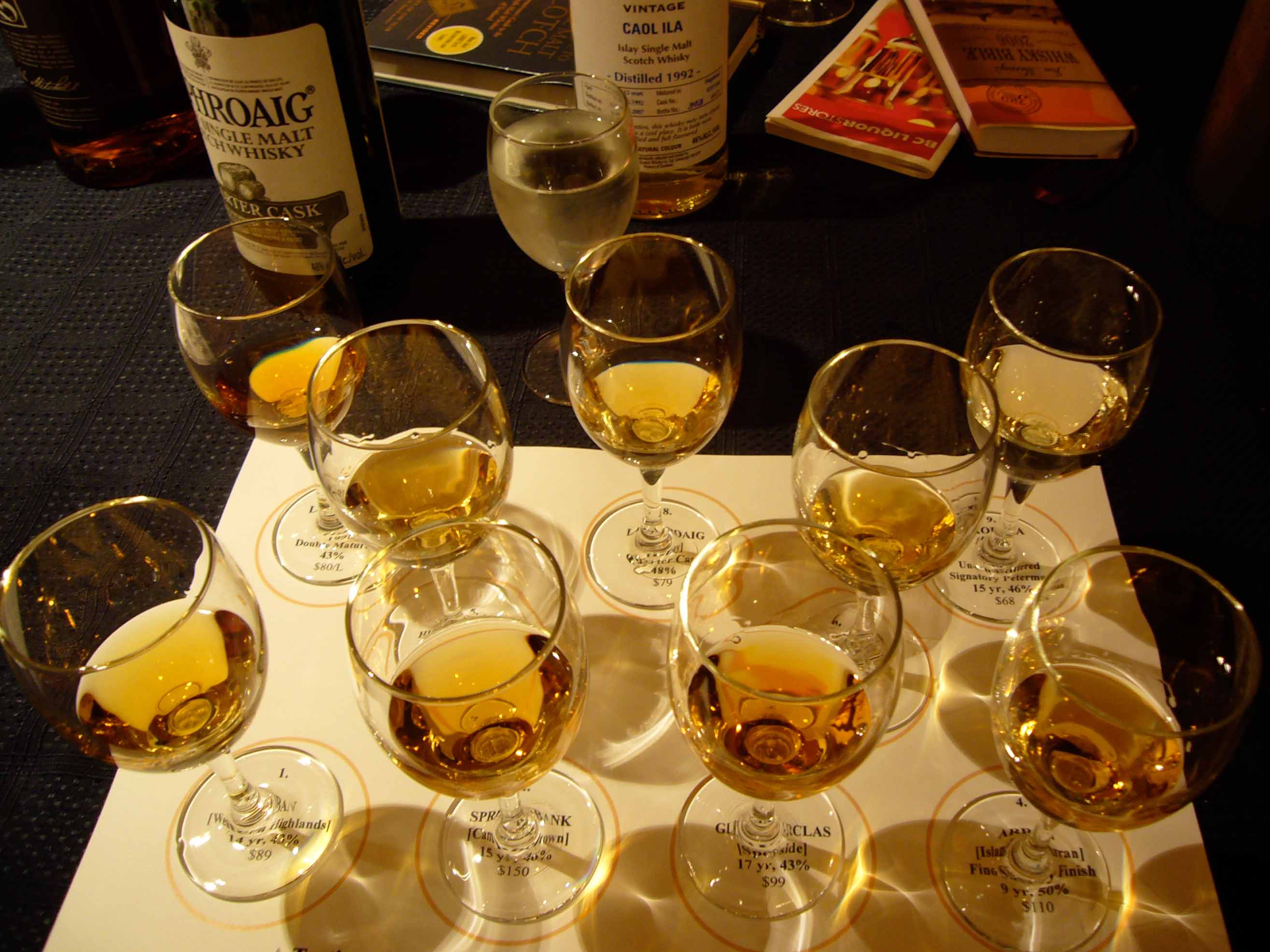
Whisky is not wine. The differences are not merely cultural — they are chemical.
Whisky arrives fully oxidised. Years or decades of contact with oak in the cask have already driven the slow oxidation that swirling briefly provides for wine. The marginal additional oxidation from swirling a whisky in a glass adds essentially nothing.
There is no dissolved CO₂. Distillation removes carbon dioxide. There is nothing to be driven off by agitation.
Ethanol concentration is three times higher. Standard whisky at 40–46% ABV contains roughly three times the ethanol of wine at 12–15%. This is the critical difference. Ethanol is a highly volatile compound — its boiling point of 78.4°C means it evaporates readily at room temperature. When swirling accelerates evaporation across the surface, ethanol vapour surges alongside the aromatic compounds.
The Ethanol Problem
Ethanol vapour is already present above a glass of whisky before any swirling occurs. When swirling is applied, evaporation accelerates — but not selectively. The physics of evaporation does not distinguish between ethanol and the aromatic esters or aldehydes that carry the whisky's character. Both are volatilised more quickly.
Because ethanol is more volatile than most aromatic compounds under these conditions, the ratio of ethanol vapour to aromatic vapour tends to increase immediately after swirling. When the nose is brought to the glass in the moments after a vigorous swirl, ethanol is disproportionately represented in what is inhaled.
This produces the burning, irritating sensation that people sometimes experience when nosing whisky — particularly high-ABV expressions. The nasal mucosa responds to concentrated ethanol vapour with an irritation response that blunts olfactory perception. Aromatic compounds are present, but they arrive behind a wall of ethanol sting.
Gary Spedding, Ethanol Volatility and Sensory Perception in Spirits, Brewing and Distilling Analytical Services (BDAS) Technical Bulletin
High-ABV Expressions — Where Swirling Is Most Counterproductive
For cask-strength whisky at 55–65% ABV, swirling frequently makes the first nose worse, not better. The baseline ethanol concentration is already high enough that the volatile headspace above the glass contains a significant proportion of ethanol vapour without any agitation. Swirling pushes this further, often producing a first impression that is almost entirely alcohol sting.
Many experienced tasters who regularly evaluate high-ABV expressions avoid swirling entirely before the first nose. The protocol is to allow the glass to sit undisturbed for one to two minutes after pouring, then approach the glass from slightly below the rim and inhale slowly. This allows the naturally rising vapours — which represent a more balanced ratio of ethanol and aromatic compounds — to reach the nose without the spike caused by agitation.
What Professionals Actually Do
Within the whisky professional community, opinion on swirling is genuinely divided, and the disagreement is not simply experienced versus inexperienced.
Those who use gentle swirling describe a technique quite different from wine swirling: not a vigorous rotation but a slow tilt of the glass that allows the whisky to coat the inside surface and then run back down. This gentle disturbance, they argue, activates aromatic layers without dramatically spiking ethanol. The motion is closer to tilting than spinning.
Those who avoid swirling hold that ethanol vapour is already present in the nosing glass in sufficient concentration without any assistance, and that any agitation disproportionately amplifies it. This view is most strongly expressed by tasters who work with high-ABV expressions or who do extended multi-sample sessions where cumulative olfactory fatigue is a concern.
Professional tasting panels documented in Whisky Magazine, Malt Whisky Review and similar publications typically describe a protocol of nosing the undisturbed glass first at a distance, then progressively closer, before any deliberate agitation. The swirl, if it appears, comes later — after the initial aromatic impression has been captured.
What Actually Opens Whisky's Aromas: Adding Water
The most consistently effective method for opening a whisky's aromatic complexity is not swirling but the addition of a small amount of water.
When a few drops of water enter a whisky, the hydrogen-bonding structure between ethanol and water molecules is altered. Ethanol molecules, which form loose cluster structures in solution, begin to interact more strongly with water molecules. This disrupts the ethanol-ethanol clusters and releases aromatic compounds — particularly hydrophobic ones — that were partially retained within the ethanol network.
A 2017 study from Linnaeus University in Sweden used molecular dynamics simulation to confirm this mechanism. The study showed that diluting whisky with water increases the surface concentration of guaiacol, a compound responsible for smoky and peaty aromatic character, at the liquid-vapour interface.
Björn C.G. Karlsson & Ran Friedman, Dilution of whisky – the molecular perspective, Scientific Reports, 2017
The practical implication: a drop or two of water added to whisky in the glass changes the ethanol-water-aromatic compound equilibrium in a way that brings aromatic compounds to the surface more accessibly, without the spike in ethanol vapour that swirling produces.
The amount is small — typically 0.5–1 ml in a 30 ml pour as a starting point. The effect is observable: aromas that were tight and muted often open within a minute or two.
How Glass Shape Modifies Swirling's Effects
The same swirling motion produces different results depending on the glass.
Narrow rim (Glencairn-type): Increased ethanol vapour produced by swirling is concentrated through the narrow aperture. The nose receives a more intense hit of ethanol relative to aromatic compounds. The negative effect of swirling is amplified.
Wide rim (ISO 3591-type, wine glass): Ethanol vapour disperses across a larger opening before reaching the nose. The negative effect is moderated. Wide-rim tasters may find swirling less problematic.
Large bowl: A larger headspace volume dilutes the vapour surge before it escapes the glass. The same swirling motion in a larger bowl produces a less concentrated effect at the rim.
This partly explains why Copita or ISO glass users often report less sensitivity to swirling than Glencairn users.
Practical Summary
Swirling is not wrong. Whisky and wine simply respond to it differently, and understanding the difference allows more deliberate choices.
- Standard ABV whisky (40–46%), wide-rimmed glass: Gentle swirling causes minimal harm. A slow tilt before nosing may slightly activate aromatic layers.
- High-ABV whisky (50%+), any glass: Avoid or minimise swirling before the first nose. Let the glass sit, then nose from a slight distance first.
- To open aromas more effectively: Add a few drops of water. This changes the aromatic equilibrium without the ethanol spike.
- For extended tasting sessions: Minimise swirling to slow olfactory fatigue accumulation.
The most useful thing is not a rule about swirling but an understanding of why the choice matters. With that, the decision belongs to the drinker.
Reader Notes
Be the first to leave a note.