
Do you remember the first time you had whisky?
Probably not a good memory. Your throat burned. The smell hit you before the taste did. Somewhere in there, a thought crossed your mind: I don't understand why anyone likes this. And then, quietly, you made a decision — whisky just isn't for me.
Is that conclusion still standing?
I'd push back on it. More precisely, what you judged that day wasn't the whisky. It was the situation. The glass. The way you drank it. Whisky never got a fair shot.
The Nose Gets Hit First
Whisky contains hundreds of aroma compounds. Oak, vanilla, dried fruit, honey, spice. Some bottles smell like flowers. Others like the sea, or smoke. These scents rise slowly from the glass.
The problem is that ethanol rises with them.
Ethanol boils at 78°C — well below water. It evaporates readily at room temperature, and it vaporises faster and more abundantly than most aroma compounds. The moment you bring your nose close to the glass — especially a wide-mouthed rocks glass or tumbler — ethanol vapour reaches your nasal membranes before anything else does. It irritates them. And before that irritation has a chance to pass, the rest of the aromas follow. But your nose is already closed.
That burning smell you got from whisky the first time? That wasn't the whisky's aroma. That was ethanol vapour.
The Glass Makes the Experience
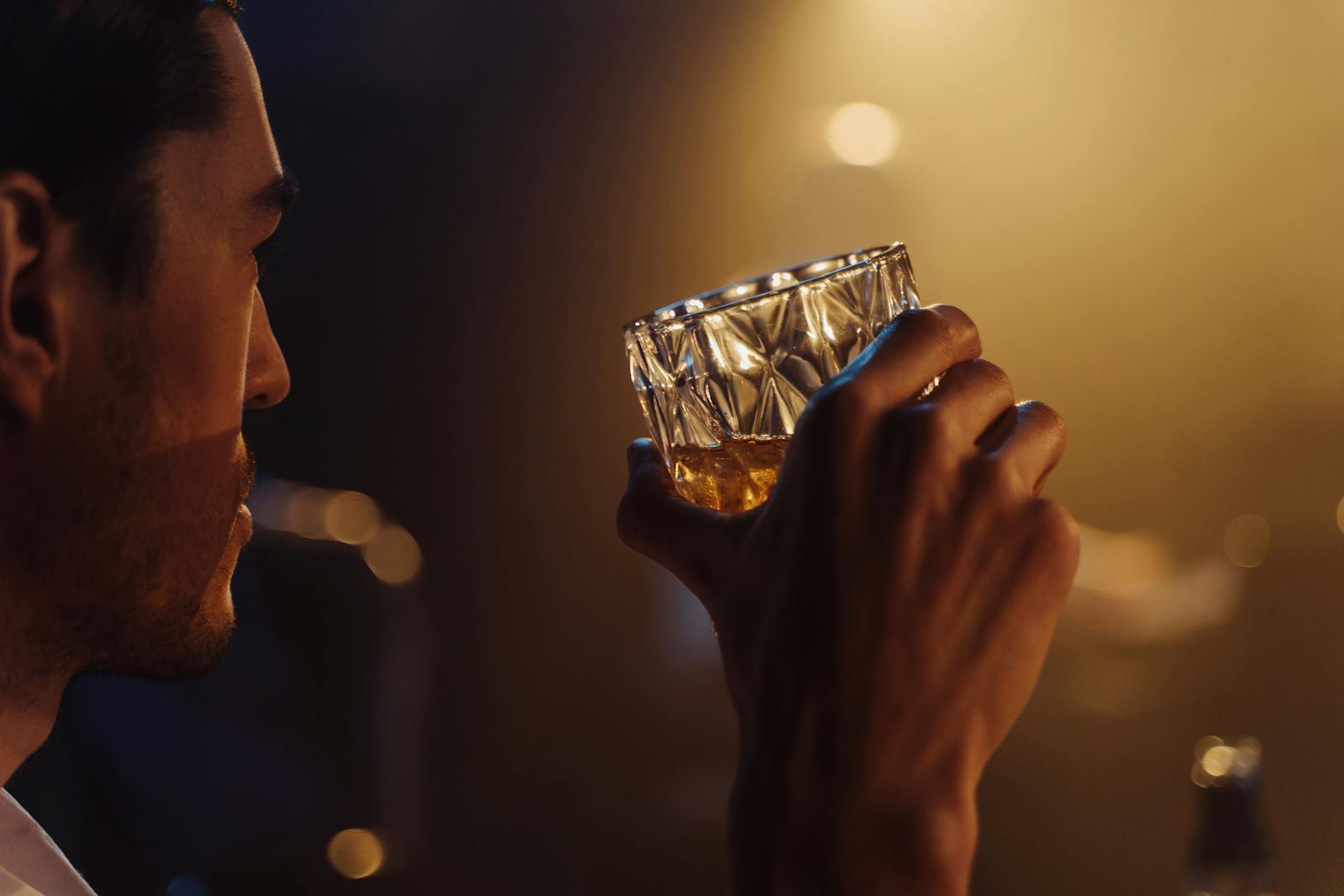
Say you're trying whisky for the first time at a bar. The bartender pours it into a rocks glass. Wide, low, with a cube of ice.
That glass was not designed to hold aroma. The wide opening lets the scent disperse in every direction. The ethanol disperses too — but so does everything subtle and interesting about the whisky.
A glass designed for whisky, like the Glencairn, works differently. The wide bowl gathers the aroma. The narrowing rim channels it upward toward your nose. The same whisky in a different glass is a genuinely different experience. That's not an exaggeration. Pour the same dram into both glasses side by side and you'll feel it immediately.
Most people's first experience of whisky involves a glass that was never meant to deliver what whisky actually has to offer. Of course all you got was alcohol.
Smell It Before You Drink It
If you drink whisky the way you'd drink a shot — bottoms up — what you get is heat and alcohol. That's it. Whisky wasn't designed to be drunk that way.
After you pour, smell it first. Start with the glass about ten centimetres from your nose. Ethanol vapour is dense and sits lower in the glass. The distance lets it disperse, so the aroma compounds drifting upward reach you first. Fruit, sweetness, wood — something starts to form at the tip of your nose.
Then bring the glass slowly closer. The aromas sharpen. Take a small sip. Hold it in your mouth for a moment. Swallow, then wait a few seconds — the aroma comes back up. That's the finish.
The first time you do this it feels strange. Surely drinking isn't meant to be this involved. But wine is the same, isn't it — you look at the colour, smell it, taste it, wait for the finish. Whisky is no different. Nobody just never showed you.
The Water Drop Thing
This sounds strange, but — adding water to whisky changes the aroma.
Not just diluting it. When water enters whisky, the molecular bonding structure between ethanol and water changes. Ethanol molecules bind with the water, and aroma compounds that were trapped inside get pushed to the surface. Compounds responsible for smoky and woody character are particularly affected. A research team at Linnaeus University in Sweden confirmed this in 2017 using molecular dynamics simulations.
Two or three drops is enough. No more than that. Add them and wait a moment, and the aroma shifts. Things that were closed open up. It feels a little surprising the first time.
There's a reason professional blenders always nose their whisky twice — once neat, once with water.
On Temperature
Ice locks the aroma in. The colder the whisky, the less its aroma compounds vaporise.
That doesn't make drinking on the rocks wrong. When you want something light and cool, or when you want to take the edge off a high-ABV pour, ice makes sense. It's a different purpose.
But if you're trying to actually understand a whisky — to meet it properly for the first time — no ice, slightly below room temperature is the better starting point. The aroma needs to be open for a fair first impression.
What I'm Actually Saying
All of that sounds complicated. What you actually have to do is very simple.
One nosing glass — a Glencairn will do. A small pour. Hold the glass away from your nose and bring it in slowly, breathing as you go. One small sip, held in the mouth for a moment. Swallow. Wait. Then add two or three drops of water and go again.
That's it.
Before you decided whisky wasn't for you, did you ever do that? Probably not. Most first encounters with whisky don't offer the chance.
So I'll say it again — what you judged that day wasn't the whisky.
Reader Notes
Be the first to leave a note.