At sea, drink was not a luxury but a supply item. On a wooden ship where the drinking water spoiled within days, anything with a little alcohol in it was simply the beverage that lasted longest.
So the standard ration in the seventeenth-century Royal Navy was a gallon of beer a day — about four and a half litres of weak small beer, sipped through the working hours. The problem was that this beer did not survive more than a few weeks on a tropical route. Once the casks swelled and soured, all that remained was water, and water went off faster still.
What Jamaica changed
When England took Jamaica in 1655, the Caribbean fleet gained access to a spirit it could buy locally in any quantity. Rum. It was cheaper than shipping brandy or arrack out from Europe and, more to the point, it did not spoil. It also took up far less room: half a pint of rum, 280 millilitres, could stand in for four and a half litres of beer.
In 1731 the Navy's regulations wrote that exchange rate down. One gallon of beer equals half a pint of rum. On paper it was a tidy piece of arithmetic.
In practice it was not. It isn't hard to guess what sailors did when handed 280 millilitres of over-strength spirit in one go. Men saved it up to drink all at once, and accidents on deck multiplied. In a space full of rope, canvas and cannon, this was not a discipline problem but a safety one.
August 1740 — add water
The order issued by Admiral Edward Vernon, commanding in the West Indies, still reads as a practical piece of management. Fleet Order 349, dated 21 August 1740, came down to this.
Half a pint of rum was to be mixed with a quart of water. It was to be issued not once but twice a day, once between ten and noon and again between four and six. And anyone who wanted sugar and limes in it for the taste was welcome to buy them himself.
The order was aimed at two things: dropping the strength to a quarter, and making the ration impossible to hoard, since watered spirit begins to spoil the moment it is mixed. The second mattered more. Take away the ability to save a ration and the binge disappears with it.
Sailors named this watered rum after the admiral. Vernon habitually wore a coat of grogram, a coarse mixed cloth, and was known throughout the fleet as Old Grog. So watered rum became grog.
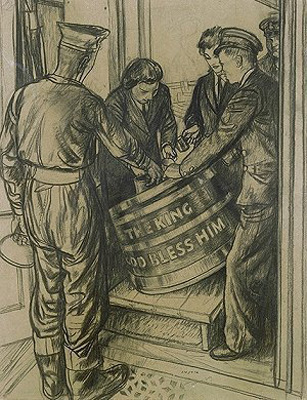
Grog coming out of the tub. The lettering reads "THE KING GOD BLESS HIM" — the inscription changed with whoever was on the throne (artwork: Robert Sargent Austin, Public Domain)
The English word groggy comes from here. That a word for unsteadiness survived from a drink deliberately watered down says something about how well the dilution worked.
The lime deserves to be set straight. Vernon mentioned limes for flavour, not for scurvy. The man who demonstrated experimentally that citrus prevents scurvy was James Lind, in 1747, and the Navy did not begin issuing lemon juice as policy until 1795. There is more than half a century between them. Having lime in the grog may well have helped as a side effect, but it was never the prescription.
The test poured over gunpowder
Suspicion followed the ration everywhere: somewhere up the supply chain, someone might have added water of their own. The method said to have been used before hydrometers existed was the gunpowder test.
Pour rum onto gunpowder and put a flame to it. If the powder still catches, the spirit is strong enough; if it is too wet to ignite, there is too much water in it. The threshold for passing sits somewhere around 57 per cent alcohol, and 100 degrees on the old British proof scale is 57.15 per cent. This is the root of the term navy strength on gin and rum bottles today.
Whether this actually happened on deck as routine is less clear. The more convincing account has it as a check made by the supply officer in the store, and what survives now has a good deal of sailors' legend mixed in. The strength of the issued rum itself fell over time; in the later period it is generally given as around 54.5 per cent, or 95.5 proof.
"Up spirits" at noon
The issue was one of the fixed points of the day. Around noon the call of "Up spirits" went out, and the rum tub appeared — a cask with brass letters set into it, one of the most conspicuous objects on the ship.
Each mess — the group of five or six men who ate and slept together — sent one man to collect its share in a metal container known as a fanny. From there it was divided again.
The form of the issue depended on rank. Petty officers and above received their rum neat; ratings below them received it as grog. A man given it neat could save it if he chose; a man given grog could not. The method of issue was itself a rank.

The grog tub of the royal yacht Britannia, in use until the ration ended in 1970. Brass-lettered tubs like this were among the best-kept pieces of equipment aboard (photo: Hammersfan, CC BY-SA 4.0)
One man's share was called a tot. In the later period it was an eighth of an imperial pint — about 71 millilitres. As with the Korean soju glass settling at 50ml or the shot glass fixing on a different number in every country, what set the size here was not taste but regulation.
Sippers, gulpers, sandy bottom
What makes the tot interesting is that it was both a drink and a currency.
Cash is useless at sea. In its place stood 71 millilitres arriving at exactly the same time every day. Stand someone's watch, take over their laundry, cover for them in an awkward moment, and the debt was settled in rum. The units of repayment had names of their own.
Sippers — a wetting of the lips. The unit for a small favour.
Gulpers — a full swallow. The price of something considerably larger.
Sandy bottom — down to the bottom. Handing over the whole day's tot, and admitting to a correspondingly large debt.

Here the vessel was a measuring instrument and a contract at once. Arguments over the size of a swallow were, by all accounts, common. If the Scottish quaich was a cup for confirming friendship, the naval tot was a cup for settling accounts.
A century of shrinking
The ration kept getting smaller. The half pint of 1740 was cut to a quarter pint in 1824, and after a Grog Committee reviewed the matter in 1850 it fell to an eighth of a pint, issued once a day. The evening issue disappeared at that point.
An alternative appeared alongside it. Men who declined the spirit were paid grog money in cash instead — partly a result of the temperance movement, partly of tea and cocoa arriving in the ship's stores.
Officers lost their ration in 1881. The ratings' ration outlived it by ninety years.
31 July 1970
By the middle of the twentieth century the ships had changed. On a warship handling missiles, radar and reactors, the practice of drinking 71 millilitres of strong rum at noon and going on watch in the afternoon had become impossible to defend.
In January 1970 the House of Commons debated the question — the session remembered afterwards as the Great Rum Debate. The conclusion was abolition, and the final issue was set for 31 July that year.
What happened aboard that day is on record. Sailors wore black armbands. Some ships held mock funerals and poured a tot into the sea; on others a coffin was built and carried around the deck. The day is remembered as Black Tot Day.

In exchange for the abolition, a canned beer ration was permitted and the remaining money went into a sailors' welfare fund. The Canadian navy followed in 1972, the New Zealand navy in 1990. The US Navy had gone much earlier, banning alcohol aboard ship in 1914 under Secretary Josephus Daniels' General Order 99. The story that coffee came to be called a "cup of joe" because of Daniels is popular, but the etymological evidence for it is thin.
What's left
Drink has not vanished from the Royal Navy entirely. The order to splice the mainbrace survives. Originally an extra issue to all hands after a major repair, it is now given only on special occasions such as a royal celebration, and only with the sovereign's approval — a handful of times a year at most.
On the civilian side, what remains is a brand. Pusser's, which claims descent from the issued blend, takes its name from the sailors' pronunciation of purser, the ship's supply officer. Bottlings are released to mark Black Tot Day. That is one way for a three-hundred-year practice to survive: as a product name.
Among collectors, the measures and tot cups of the period change hands. They are unremarkable objects — a small vessel of brass or tin, a single graduation. They sit at the opposite end of the scale from a finely made crystal glass, shaped with no concern beyond not breaking on a moving deck.
But that is also why they lasted. Some vessels are made so a drink tastes better; others are made so a fixed amount can be divided exactly. The naval tot was the second kind. Once a day, the same for everyone, and not a drop more — one small cup said all three things at once.
Image credits: rum measures — Tim Sheerman-Chase / Wikimedia Commons (CC BY 4.0) · grog issue artwork — Robert Sargent Austin / Wikimedia Commons (Public Domain) · HMY Britannia grog tub — Hammersfan / Wikimedia Commons (CC BY-SA 4.0) · rum ration aboard HMS King George V — S J Beadell / Wikimedia Commons (Public Domain)